Some awards feel ceremonial. This one feels declarative.
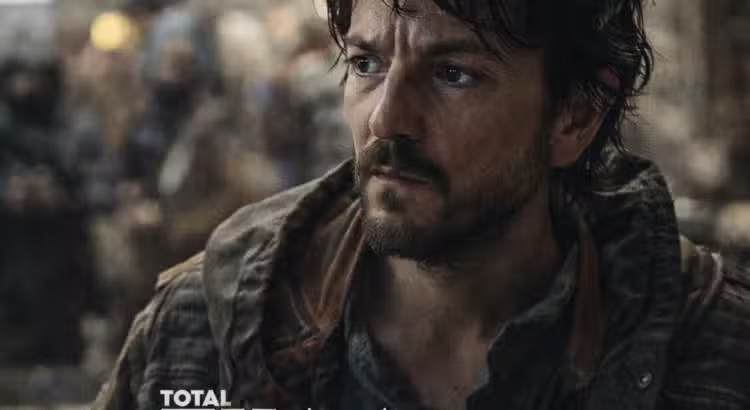
Total Film has named Andor Season 2 the Best Television Series of 2025, putting a firm stamp on what many viewers sensed long before year-end lists began to roll out: this was prestige television operating at full confidence.
And it matters because Andor didn’t win by leaning on legacy. It won by out-thinking the medium.
Why this matters now
Season 2 closed the loop on a bold experiment—one that asked whether Star Wars could thrive as a grounded political thriller without lightsaber spectacle as its engine.
Total Film’s recognition arrives as a clear answer. Not only could it work—it could lead the year.
What Total Film recognized
The publication’s top honor acknowledges Season 2’s sustained focus on consequence, ideology, and character rather than escalation for its own sake.
Across its final run, Andor doubled down on the ideas that defined its first season: rebellion as process, power as bureaucracy, and sacrifice as something that scars rather than glorifies. The show trusted silence as much as speeches, and patience as much as plot twists.
That consistency is rare. It’s also why the season held together as a complete statement rather than a collection of moments.
Context: why Andor stood apart in 2025
Television in 2025 was crowded with spectacle. Big budgets, louder stakes, faster pacing.
Andor moved in the opposite direction.
It treated the Empire not as a villainous caricature, but as a system—procedural, exhausting, and frightening precisely because of how ordinary it felt. The rebellion, meanwhile, wasn’t framed as destiny, but as a series of morally compromised decisions that demanded real cost.
That tonal discipline is what made Season 2 feel coherent from start to finish—and what separated it from prestige competitors chasing constant escalation.
Why this resonates with Star Wars fans
For longtime Star Wars audiences, Andor didn’t replace myth—it contextualized it.
By showing what oppression looks like on the ground, the series gave emotional weight to the larger saga without retconning it. Familiar symbols felt heavier because the human toll behind them was finally visible.
Season 2 didn’t ask fans to cheer. It asked them to understand.
That shift has already changed how many viewers talk about Star Wars storytelling—and what they expect from it going forward.
The bigger takeaway
Being named the best TV series of the year by Total Film isn’t just an accolade. It’s validation that Andor’s approach wasn’t niche or experimental—it was effective.
The show proved that restraint can be more gripping than spectacle, that political storytelling can coexist with blockbuster IP, and that audiences will follow if the writing earns their trust.
What this means going forward
Not every Star Wars project should try to be Andor. But none of them can ignore it now.
Season 2 set a benchmark for tone, intent, and narrative discipline that will linger long after awards season fades. It showed what’s possible when a franchise stops trying to remind viewers what it is—and starts asking what it wants to say.
Total Film’s choice doesn’t just close the book on Andor.
It cements it as one of the defining television achievements of the decade.
Stay connected with the galaxy’s latest updates!
Follow us on X, Facebook, Instagram, or Pinterest for exclusive content, mod guides, Star Wars gaming news, and more. Your support helps keep the Holonet alive—one click at a time
Author

Related Posts

Using Musick.ai to Shape Music Ideas-
SWTOR Releases “Tumble in Yusinduu Factory,” a New Track That Leans Into Momentum and Mood 
This Year’s Lucasfilm Christmas Card Continues a Festive Star Wars Tradition
What the KOTOR II Switch Lawsuit Really Revealed About Fan Mods and Value




SWTOR Developers Talk Darth Nul With Samantha Béart — and Why Galactic Threads Hits Differently-
Why Finding a Reliable PC Game Torrent Site Has Become So Difficult 
A Sweet Slice of the Galaxy: New Star Wars Minis Holiday Short Arrives-
Vince Zampella, Architect of Modern Star Wars Games and Shooters, Has Died