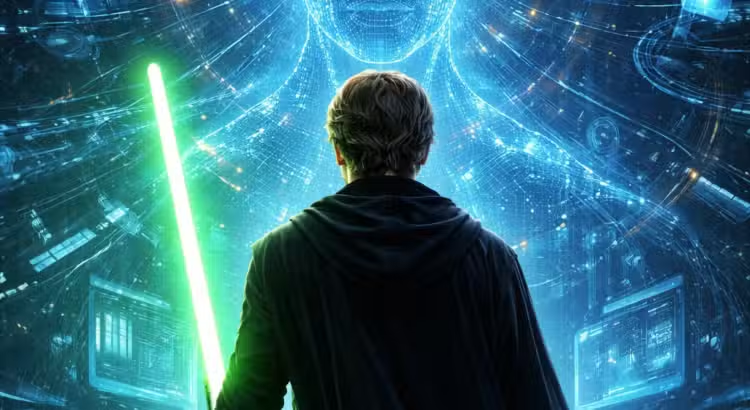
When the topic of AI-generated characters comes up in Hollywood, few voices resonate like that of Mark Hamill — the maIn an interview with Variety, Mark Hamill was asked a question that sits right at the intersection of fandom, technology, and legacy: would he want AI to be used to depict Luke Skywalker in future Star Wars projects?
His answer wasn’t a yes. It wasn’t a no. It was something more thoughtful—and far more revealing.
“It’s hard to predict the future, but I may have to ask my family if they want me in a Star Wars movie 30 years from now after I’m gone.”
That single sentence captures the uncertainty Hollywood is now wrestling with as AI-generated performances move from novelty to inevitability.
Why Mark Hamill’s Opinion Matters
Hamill isn’t just another actor — he is Luke Skywalker. That role has spanned nearly five decades, from the original 1977 Star Wars trilogy to recent appearances in The Mandalorian and The Book of Boba Fett where younger versions of Luke were digitally recreated.
Because he’s been through both traditional acting and modern deepfake-assisted VFX, his perspective bridges old-school performance and cutting-edge technology.
AI in Film: A Tool or a Trap?
AI tools like deepfakes and voice synthesis have already been used in Star Wars production — for instance, the de-aging of Hamill’s likeness required extensive visual effects work. Outside of Star Wars, tools like Respeecher show how AI can replicate voices convincingly, raising questions about control and consent.
In the broader film world, AI has been used for de-aging stars (e.g., Tom Hanks) and enhancing performances, demonstrating both creative potential and ethical tension.
Practical Insight: Studios must balance artistic innovation with the rights and dignity of the actors whose faces and voices are being synthesized.
So, Will Luke Skywalker Return via AI?
“Maybe — but not without consent.”
Hamill essentially says that if future Star Wars projects use AI to depict him posthumously, it should be a family decision, not a corporate one.
This acknowledges a key industry concern: what happens to an actor’s likeness after they pass away?
In other franchises, digitally resurrecting deceased actors has stirred controversy and even legal debate.
Hamill’s stance reinforces the idea that legacy characters shouldn’t be treated as perpetual brand assets without input from the people connected to them.
Common Questions (FAQ)
Q: Has Luke Skywalker already been recreated with AI?
A: Yes — The Mandalorian and Book of Boba Fett used digital de-aging and voice synthesis to portray a younger Luke Skywalker, with real VFX teams leading the work.
Q: Is Mark Hamill opposed to AI entirely?
A: Not exactly. He isn’t ruling out AI, but he emphasizes thoughtful usage and consent.
Q: What are the risks of AI character recreation?
A: Ethical questions about likeness rights, fan reception, and the potential devaluation of human performance are ongoing issues in Hollywood today.
Bottom Line
Mark Hamill’s comments reflect a wise balance: embracing technological evolution without sacrificing human agency or respect for artistic legacy. As AI becomes more capable of bringing characters to life long after actors retire — or even after they’re gone — the industry will need clear standards on consent, compensation, and creative integrity.
Whether you’re a Star Wars fan, a filmmaker, or just curious about the future of digital performance, Hamill’s words offer a valuable perspective on what’s at stake.
Stay connected with the galaxy’s latest updates!
Follow us on X, Facebook, Instagram, or Pinterest for exclusive content, mod guides, Star Wars gaming news, and more. Your support helps keep the Holonet alive—one click at a time