

Star Wars under Disney has been called a lot of things over the last decade: a comeback story, a franchise machine, a fandom battleground.
But in box office terms? It’s something much simpler — and much more measurable.
Because between The Force Awakens, Rogue One, The Last Jedi, Solo, and The Rise of Skywalker, Lucasfilm didn’t just reboot a franchise.
It ran a full theatrical experiment in real time.
And the global box office results show a pattern that’s more interesting than the usual “hit vs flop” debate.
Why this matters now
Star Wars is moving back into theatrical mode again.
A new movie slate is taking shape, and Lucasfilm is still trying to solve the same modern blockbuster puzzle: how to make Star Wars feel like an event without burning out the audience.
That’s why looking at the Disney-era numbers matters.
Not as a scorecard for fan arguments — but as a reality check for how the brand performs in different markets and under different release strategies.
The baseline: the Disney-era global totals
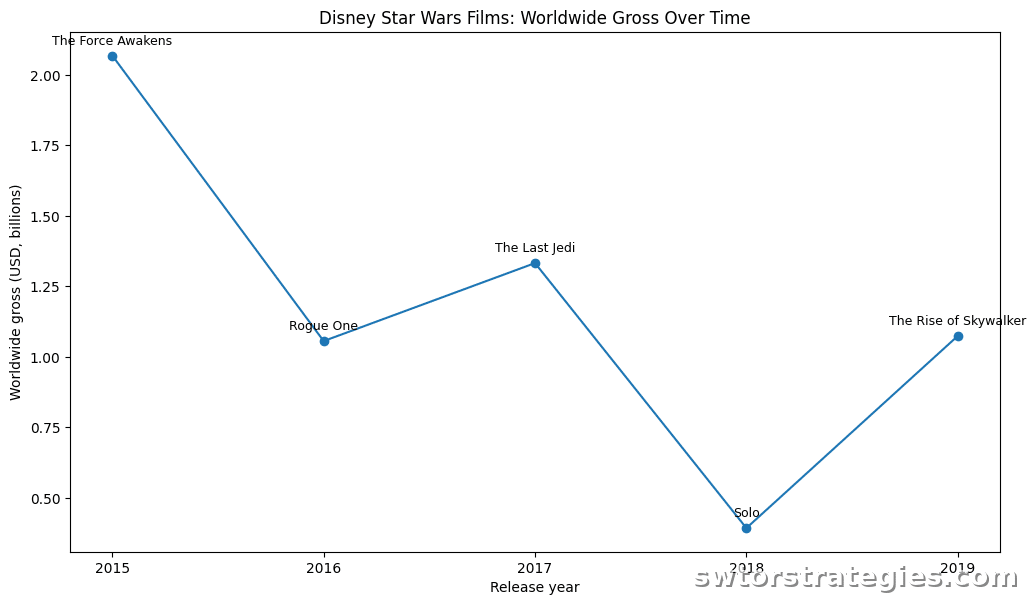
Here’s the core box office picture (worldwide grosses):
- The Force Awakens (2015): $2.05B
- Rogue One (2016): $1.06B
- The Last Jedi (2017): $1.33B
- Solo (2018): $0.39B
- The Rise of Skywalker (2019): $1.06B
(These align with the widely cited global box office totals and aggregate reporting.)
On the surface, it looks like a simple arc: massive peak, a dip, a recovery, a stumble, and then a stable finish.
But the more revealing story is the split underneath those totals.
Domestic vs International: where Star Wars actually wins
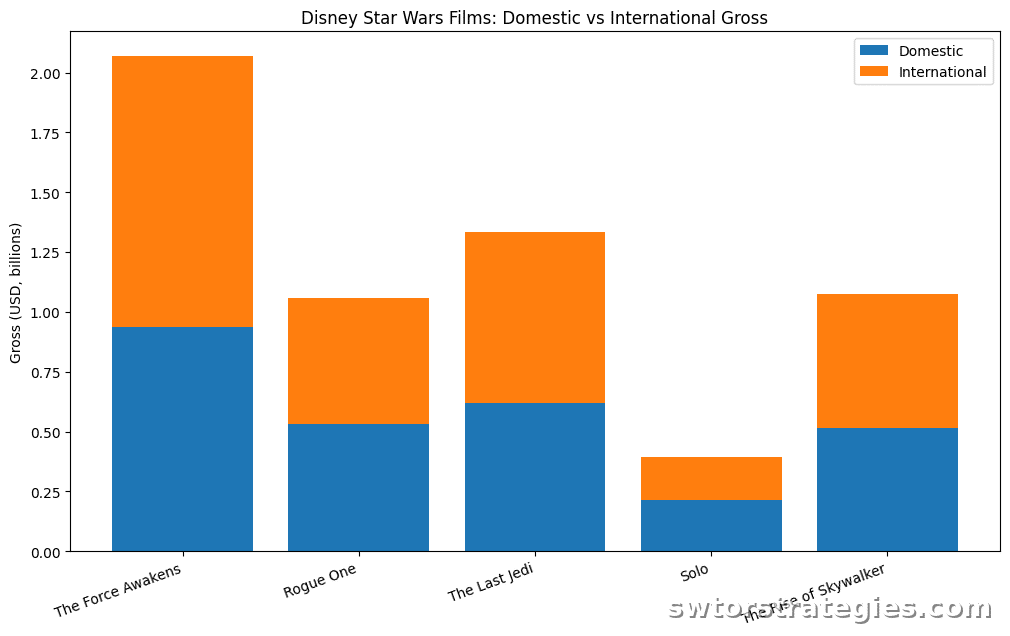
Using Box Office Mojo’s reported split, the films break down like this:
- The Force Awakens: Domestic $936.7M (huge), International remainder
- Rogue One: Domestic $533.5M / International $525.1M (near even split)
- The Last Jedi: Domestic $620.2M / International $714.2M (more global weight)
- Solo: Domestic $213.8M / International $179.2M (domestic-heavy)
Even without getting into country-by-country data, two things jump out:
1) Star Wars is still a domestic monster
When Star Wars hits, it hits hardest in North America. The Force Awakens is a perfect example, still standing as one of the biggest domestic earners ever.
2) The spin-off vs saga dynamics are real
Rogue One looks particularly strong because it behaves like a balanced global blockbuster — not just a US-driven mega hit.
That’s an important signal for Lucasfilm’s future slate. “Anthology movies” didn’t die because the idea can’t work.
They stumbled because execution and timing matter.
The outlier: why Solo didn’t just underperform — it broke the pattern
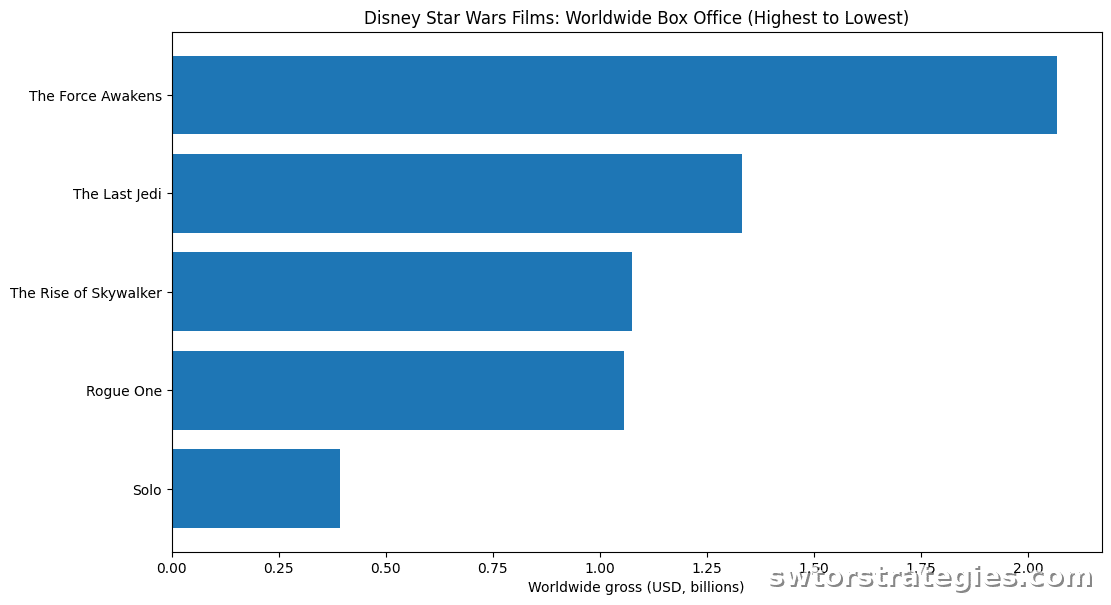
Solo is the movie that wrecked the rhythm.
Its worldwide total sits far below the other Disney-era releases, and what makes that significant is that this wasn’t a “Star Wars fatigue” problem in isolation.
It was a perfect storm:
- release window issues
- weaker urgency (“must-see event” factor)
- confusing marketing (prequel recasting = high risk)
- and a franchise moment where momentum wasn’t guaranteed
Even the domestic/international split shows it: Solo isn’t the profile of a global blockbuster.
It’s the profile of a film that never found lift outside its core audience.
What the numbers don’t show (but still matters)
Box office doesn’t track everything Star Wars becomes after theaters:
- home release performance
- licensing and merch
- park synergy
- and now the biggest of all: Disney+ value
That’s why a pure financial “rank the movies” framing is honestly too simplistic.
Star Wars at Disney isn’t just a film series — it’s an ecosystem.
But theatrical results still matter because they determine something Disney values above all:
confidence.
If Lucasfilm wants theaters back at full strength, it needs the next era to feel like a clear plan again — and not just a series of isolated projects.
The Takeaway: Disney-era Star Wars didn’t collapse — it normalized
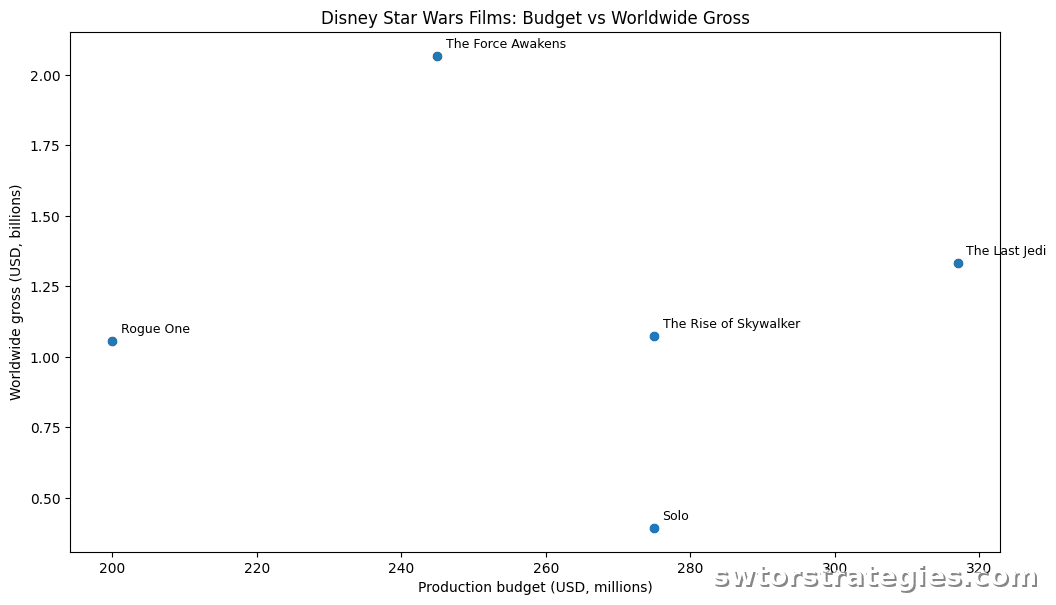
The Disney Star Wars movies didn’t follow a steady decline.
They followed a more familiar franchise arc:
a historic peak, followed by normalization.
That’s not failure. That’s the reality of launching a sequel trilogy after 30 years of absence — and then trying to replicate that lightning strike multiple times in a tight schedule.
The bigger question isn’t “did Disney Star Wars make money?”
It did.
The real question Lucasfilm must answer now is:
Can Star Wars still generate a new peak — or will the next era be built around consistency instead of record-breaking events?
Stay connected with the galaxy’s latest updates!
Follow us on X, Facebook, Instagram, bsky or Pinterest for exclusive content, mod guides, Star Wars gaming news, and more. Your support helps keep the Holonet alive—one click at a time.
Author

Related Posts

From Hoth to Greenland: Why Star Wars Always Returns to Ice Worlds
Star Wars: Galaxy’s Edge – Echoes of the Empire Comic Announced, Bringing Luke, Leia & Chewie to Batuu-
Hollywood Reporter Says a “Sequel-Sequel Trilogy” Feels Inevitable — and Honestly, They Might Be Right 
Dave Filoni’s MandoVerse Movie Is Reportedly on the Backburner — But Thrawn Remains the Big Threat



-
Kathleen Kennedy Says Casting Han Solo Was “An Impossible Situation” for Alden Ehrenreich 
Kathleen Kennedy Looks Back on The Last Jedi Nine Years Later: “One of the Best Star Wars Movies”
Kathleen Kennedy Gives Major Updates on Star Wars Movies — Including Mangold “On Hold” and Kinberg’s “New Trilogy”-
Kathleen Kennedy Addresses Sexism in Star Wars Fandom: “They Unfairly Get Targeted”