

For a Star Wars show built around one of the franchise’s angriest survivors, Maul: Shadow Lord picked a very smart place to land.
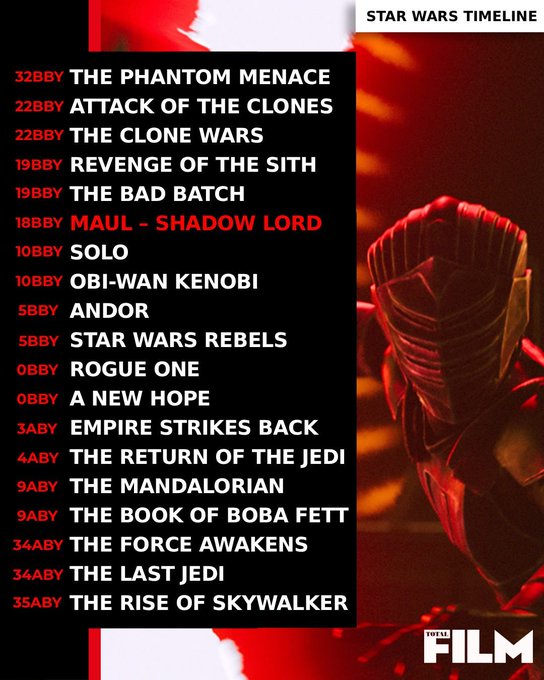
The series is set in 18 BBY, about a year after Revenge of the Sith and the fall of the Republic. That alone makes it more than just another “Maul is back” project. It drops him into one of the ugliest, most unstable corners of the timeline: the moment when the Jedi are broken, the Empire is tightening its grip, and the galaxy is still trying to figure out what just happened. GamesRadar and Fantha Tracks both place the series in 18 BBY, while official Star Wars material describes the show as following Maul after The Clone Wars as he tries to rebuild his criminal power.
That matters because Maul’s story has always had a weirdly large hole in the middle.
We know who he was in The Phantom Menace. We know how The Clone Wars turned him into something far more interesting than “guy with red face and double-bladed lightsaber.” We know he later reappears with influence, scars, and unfinished business in Solo and eventually becomes the bitter wreck we meet again in Star Wars Rebels. What Shadow Lord offers is the missing bridge between those versions of the character.
That bridge is where the real story is.
A perfect era for a fallen warlord
Setting the series in 18 BBY means Lucasfilm is not picking Maul at his peak. It is picking Maul after disaster.
By this point, the Clone Wars are over, Sidious has won, and Maul is no longer playing the game from a position of strength. Official material and reporting around the show frame the series around Maul rebuilding his criminal syndicate and chasing revenge after losing control of his power base. That makes Shadow Lord less about rise and more about recovery, obsession, and reinvention.
And honestly, that is where Maul tends to be most compelling.
Peak-power villains can be fun, but broken villains with something to prove usually hit harder. A Maul story set in 18 BBY gives Lucasfilm room to explore a version of him that is still dangerous, still ambitious, but no longer untouchable. He is surviving in the early Imperial era, trying to rebuild influence in a galaxy that has already moved on from the Sith power struggles he thought defined everything.
That is a much nastier, more interesting emotional space.
The timeline makes the galaxy feel smaller in a good way
The 18 BBY setting also places Shadow Lord in a crowded but useful stretch of Star Wars history.
This is the same general era where the Empire is consolidating power, clone-era loyalties are collapsing, and the underworld is being reshaped by Imperial rule. It sits after The Bad Batch’s opening post-Order 66 chaos and before later stories like Solo, Obi-Wan Kenobi, Andor, and Rebels. That gives the show a chance to do something Star Wars often does well when it is disciplined: connect major shifts in the galaxy without feeling like a checklist of cameos.
In other words, Shadow Lord is parked right in the era where Maul can still plausibly matter a lot.
He is not yet the isolated, haunted figure from later years. He is still close enough to the collapse of the old order to feel dangerous as a political and criminal force. That makes 18 BBY a sweet spot. It lets the show explore how Maul went from chaos agent to underworld operator, and how much of that transformation was strategy versus pure desperation.
This is where Maul stops being a Sith story
Another reason the setting works: it pushes Maul even farther away from the traditional Sith narrative.
By 18 BBY, the Sith story is basically over for him. Sidious has won. Vader exists. The Empire is in power. Maul is not climbing back into that hierarchy. He is stuck outside it, which makes him more unpredictable. Reporting on the series points to Maul rebuilding his syndicate and even seeking an apprentice, which suggests Shadow Lord is less interested in restoring the old status quo and more interested in showing Maul trying to create something new out of rage, abandonment, and control.
That is a key distinction.
A pre-Phantom Menace Maul story would have been all obedience and Sith grooming. A later Maul story becomes tragedy. But 18 BBY gives Lucasfilm a version of Maul who is free enough to be creative and wounded enough to be unstable. That is where the character can do real damage.
Why this matters for the bigger Maul picture
The biggest promise of Shadow Lord is not just that it features Maul. It is that it might finally explain the version of Maul Star Wars has been hinting at for years.
How does he rebuild?
How does he keep people loyal after everything that happened?
How does he go from war-era chaos to criminal influence?
And how much of his later image is power versus performance?
That is the real “Maul gap.” Not just a missing section on the timeline, but a missing piece of character evolution.
A lot of Star Wars characters get their mythology expanded by adding earlier adventures. Maul gets stronger when the franchise fills in the damage after the fall. That is why 18 BBY is such a good call. It gives the show access to the most unstable version of him: not the apprentice, not the icon, not the relic, but the survivor trying to force himself back into relevance.
And that is a dangerous place to start a story.
For more on where this fits in the wider saga, it also makes sense to connect this one to our complete Star Wars games archive and especially the growing Maul coverage hub as the series keeps expanding its role in the canon conversation.
The real appeal of 18 BBY
The smartest thing about this setting is that it gives Shadow Lord tension before the first scene even starts.
We already know Maul survives this era. We know he remains a factor. But we do not fully know what it cost him to get there, who he used, who betrayed him, and what kind of monster he had to become after the Sith dream was taken away from him.
That is where 18 BBY stops being a date on a timeline graphic and starts becoming the whole point.
Because for Maul, the most interesting story was never the fall.
It was what came after.