
After Star Wars Episode I: Racer (1999) proved that one scene from The Phantom Menace could somehow carry an entire game, it did not take long for someone to look at that success and think the obvious next thought: what if we made it bigger, louder, flashier, and more likely to eat your spare change in a public building?
That is basically the story of Star Wars Racer Arcade.
Released in 2000, the game was Sega’s arcade spin on the podracing craze, built with LucasArts and shown off as a dedicated cabinet experience rather than a straight port of the 1999 home game. Contemporary coverage from GameSpot described it as a separate arcade project from the team behind Star Wars Trilogy Arcade, while arcade sales material listed Sega as the manufacturer in 2000.
And that distinction matters, because Racer Arcade is not just “the N64 game in a cabinet.” It is the same fantasy viewed through a very different lens. Episode I: Racer was the version you lived with. This one was the version that wanted to impress you in about ten seconds flat. It wanted noise. It wanted spectacle. It wanted you to sit down, grab the controls, and immediately feel like your podracer had a worrying relationship with the concept of structural integrity.
That makes it a perfect fit for both the Complete List of All Star Wars Games Ever Made (1979–Present) and the Star Wars Games (2000–2005) hub. This was the beginning of a ridiculously rich era for Star Wars games, and Racer Arcade is one of those side roads that makes the bigger picture more fun. It is not the heavyweight champion of the period. It is the loud cousin who showed up late, looked fantastic, and immediately made the room more chaotic.
Not a port, not a clone, and definitely not subtle
One of the easiest mistakes to make with Racer Arcade is assuming it was just Sega taking LucasArts’ 1999 game and stuffing it into a deluxe cabinet. That was never really the pitch.
GameSpot’s early 2000 coverage made it clear that this was its own arcade project, built by the same team responsible for Star Wars Trilogy Arcade, and running on Sega’s Hikaru hardware. The game was shown at London’s ATEI 2000 show, where Sega was already selling it as an ultra-fast visual showcase with a deluxe cabinet, a large screen, and the kind of booming sound system arcade operators loved because it basically announced itself from the other side of the room.
That arcade-first mindset shaped everything about it. Home racing games can afford to be patient. They can let you fiddle with upgrades, learn longer systems, and settle in over hours. Arcade racers do not have that luxury. They need to hook you instantly. So Racer Arcade took the podracing idea and pushed it in a more direct, more theatrical direction. Less “carefully building your season.” More “sit down, grip the controls, and try not to embarrass yourself in front of strangers.”
Which, to be fair, is a very arcade way to live.
How it played: faster answers, fewer complications
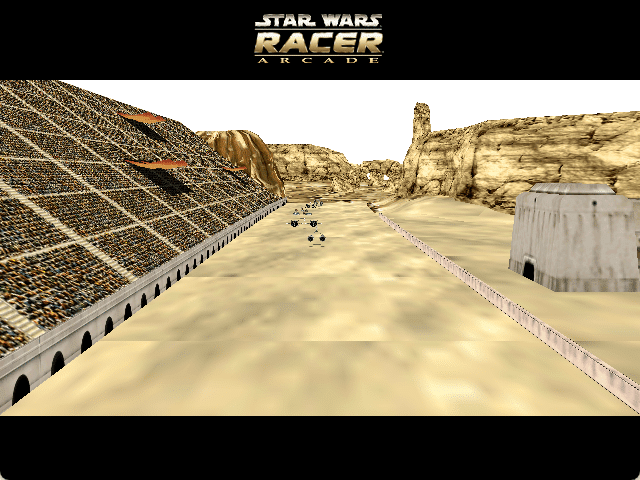
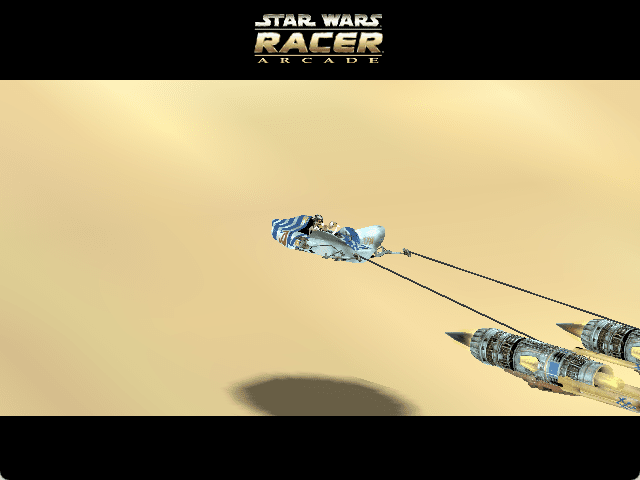
The game centered on four tracks with escalating difficulty, including the familiar Boonta Eve race on Tatooine and other courses such as Smuggler’s Cove and Pixelito Challenge. Available character choices were trimmed to four marquee racers: Anakin Skywalker, Sebulba, Gasgano, and Ben Quadinaros. Contemporary preview coverage also emphasized checkpoint-based racing against the clock, plus linked multiplayer support for head-to-head competition.
That already tells you a lot about what Racer Arcade wanted to be. The home game had more of a progression mindset. The arcade game wanted strong silhouettes, recognizable faces, short explanations, and instant drama. If you know those four pilots, you can already feel the pitch. Anakin for the hero fantasy. Sebulba for people who enjoy winning rudely. Gasgano for the real heads. Ben Quadinaros for anyone who appreciates a racer with the energy of a disaster waiting politely to happen.
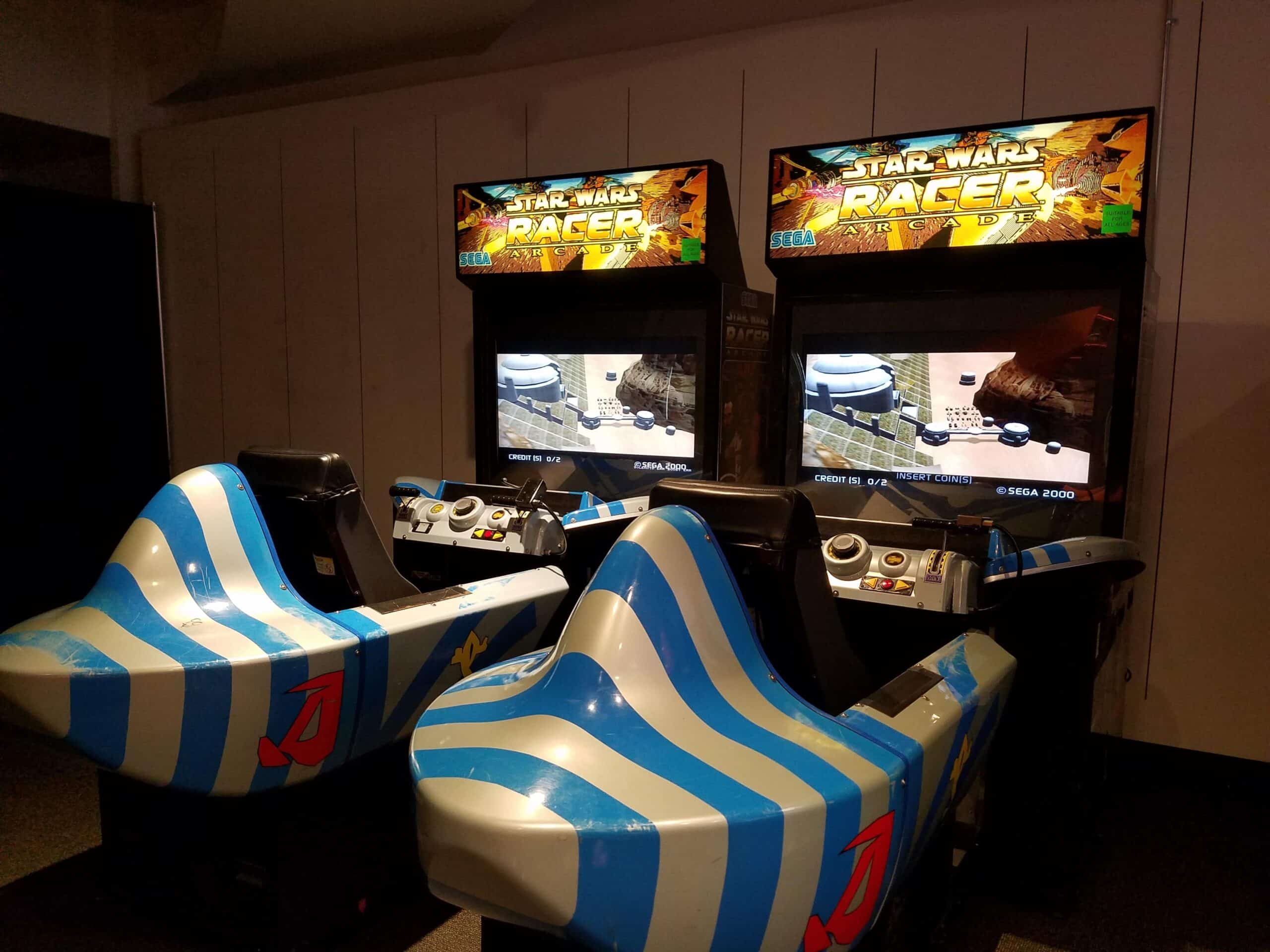
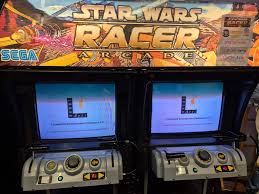
The controls helped sell the fantasy. Player reports from 2000 described the machine as using two handles like the pods in the movie, with a central boost button and a separate brake control. That was one of the cabinet’s smartest decisions. It did not just let you steer a podracer. It made you feel like you were handling one of those barely sensible twin-engine missiles from the film. Even players who found the machine tough to control still described it as fun, which is honestly the most arcade compliment possible.
And yes, that matters. Podracing should not feel tidy. It should feel like there is a very real chance your vehicle was assembled by someone who does not believe in maintenance.
The cabinet was half the point
If you only describe Racer Arcade as a racing game, you are missing a huge part of the appeal. This thing was also a piece of theater.
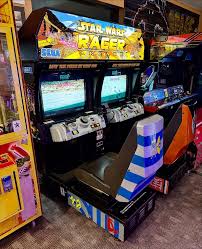
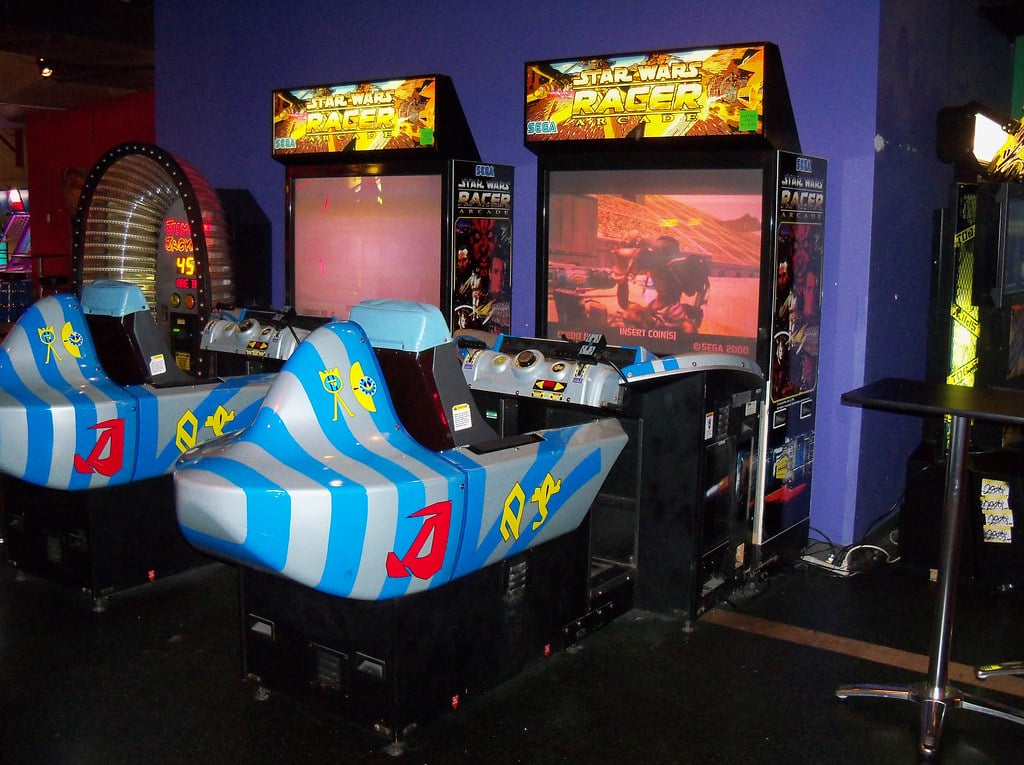
According to contemporary preview coverage and later game references, the deluxe version featured a large display, powerful sound, and a cabinet shaped to resemble Anakin Skywalker’s podracer cockpit. Some versions could also be linked together for multiplayer, with up to four cabinets connected. That is not just a technical detail. That is the whole sales pitch. Sega was not asking operators to buy a game. It was asking them to buy an attraction.
That is why Racer Arcade makes so much sense in Sega’s hands. Sega understood spectacle-based arcade design better than almost anyone. It knew how to build machines that looked expensive, sounded expensive, and made people stop walking. In that sense, Racer Arcade was a very Sega answer to Star Wars. It took a movie sequence that was already oversized and treated it like something that deserved an equally oversized public machine.
Honestly, it is hard not to love that level of confidence.
There is also something wonderfully specific about the timing. In 2000, arcades were still alive enough to support these kinds of showpiece cabinets, but the era was already changing. Home hardware was getting stronger. Consoles were getting greedier with your free time. Arcade games increasingly had to justify why you should leave the house and pay for something you could not get at home. A giant podracer cockpit with booming speakers and linked multiplayer? That was a decent argument.
Development history: a little patchy, but still revealing
One challenge with Racer Arcade is that its development story is not documented nearly as deeply as major PC or console releases from the same period. That is the curse of a lot of arcade history. Cabinets vanish, operators move on, websites disappear, and suddenly the paper trail is thinner than you would like.
Still, the surviving picture is pretty clear. GameSpot’s coverage from early 2000 framed the game as a Sega-developed arcade production tied to LucasArts’ podracing success, and specifically linked it to the team behind Star Wars Trilogy Arcade. Sega showed the game publicly at ATEI 2000 in London and leaned hard on performance, speed, and cabinet spectacle in the early pitch.
That alone tells you a lot about the design priorities. This was not some afterthought cash-in where a publisher lazily recycled assets and hoped the logo did the rest. The whole thing was built around arcade logic: eye-catching cabinet, fast visual feedback, familiar Star Wars iconography, and just enough mechanical bite to keep players feeding it another coin after the first rough run.
There are also signs that Sega was aiming for multiple cabinet configurations. The game appears in sales flyer and machine references as a 2000 Sega release, and later summaries describe deluxe, mini-deluxe, and twin-style variants depending on the setup. That suggests Sega was trying to make the machine flexible enough for different arcade spaces, from bigger destination locations to more standard amusement floors.
In other words, Sega did not treat this like a novelty. It treated it like a real product line.
How it was received in the wild
This is where Racer Arcade gets especially charming, because a lot of the period reaction we still have is not polished critic prose. It is people writing in from malls, movie theaters, and arcade locations to say, basically, “I found one, it looks cool, and it kicked my ass.”
TheForce.net’s 2000 reporting captured that early word-of-mouth beautifully. Players and readers reported seeing the machine in places like Buffalo, Grapevine, California, Rhode Island, Chicago, Indianapolis, and Pittsburgh. One report mentioned four linked cabinets at a new Dave & Buster’s, with lines two or three people deep at each pod on weekends. Another described the machine as hard to control but fun. Another noted the one-dollar-per-play rhythm and how the differences from the home version made it feel designed to keep players pumping in more money.
That is almost the ideal reception story for an arcade game. Not “this is a profound artistic statement.” More “this thing is loud, difficult, and people keep queuing for it anyway.”
The early reports also suggest that the machine made a strong first impression visually. One reader report highlighted “stunning graphics,” while GameSpot’s preview said Sega had intentionally prioritized smoothness and speed, even if that meant making some sacrifices elsewhere. When boost kicked in, GameSpot wrote that the pod could rocket above 1200 kilometers per hour. Whether you read that as an exact metric or classic arcade hype, the message was the same: this game wanted to sell the feeling of velocity first.
And that was a smart instinct. Podracing lives or dies on sensation. If it does not feel reckless, there is no point.
Critical reputation: small footprint, solid memory
Because Racer Arcade was an arcade title, it did not rack up the same big review trail that console and PC games usually did. That is just the reality of the format. But the signs we do have are pretty positive.
Wikipedia’s sourced summary notes that Game Machine listed it as the fifth most successful dedicated arcade game in Japan for August 2000, which is a meaningful little signal that the machine was not disappearing without a trace. Later retrospectives also tended to treat it fondly, with Kotaku summarizing it as a beefier, fancier-looking version of Episode I: Racer. That is not a bad elevator pitch, honestly. It is also a pretty accurate one.
And that is probably the fairest way to remember it. Racer Arcade was never the deeper game. It was never the more important game. It was not trying to replace the home release. It was taking the same core fantasy and presenting it with more cabinet drama, more public spectacle, and less interest in subtle balance.
Sometimes that is enough. Sometimes “the louder version” is exactly what an arcade machine should be.
Why it matters in the archive
The reason Star Wars Racer Arcade deserves a real place in the archive is not because it changed the franchise forever. It did not. It is not a KOTOR-sized landmark or a Jedi Knight-style turning point.
It matters because it shows how flexible Star Wars games could be when publishers were still willing to follow weird instincts.
That late-90s and early-2000s stretch gave us sims, shooters, strategy games, action adventures, RPGs, and then, right here on the side, a full-on Sega arcade cabinet built around podracing. That is part of what makes the broader Complete List of All Star Wars Games Ever Made (1979–Present) so fun to explore. The franchise was not just chasing one idea. It was trying everything. Some of it was huge. Some of it was strange. Some of it was both.
And Racer Arcade also works nicely as a follow-up to Star Wars Episode I: Racer (1999). That earlier game is still the richer, more complete podracing experience. But this one gives the sub-series a second branch. It shows what happened when the same basic concept got handed over to arcade specialists and told to make a spectacle out of it.
The result is not deeper. It is not cleaner. It is definitely not calmer.
It is just more arcade.
Legacy: a great little side road
One reason people still remember Racer Arcade at all is that it hit a very specific nerve. It captured that old Sega-arcade magic where a licensed property was not just merch. It became an event. You sat inside the thing. You grabbed the handles. You heard the speakers go off. You tried not to slam into a canyon wall in front of whoever was waiting behind you.
That kind of experience ages differently from a home release. You do not always remember exact lap counts or balance quirks. You remember the machine. You remember the sound. You remember the feeling that it looked too expensive to be standing there in a cinema lobby next to a claw machine and a sticky carpet.
And that is why Star Wars Racer Arcade still earns its spot. It is a reminder that Star Wars game history is not just about the biggest titles. It is also about the weird, shiny, loud side attractions that made the galaxy feel bigger.
Some games want to be masterpieces.
This one mostly wanted your quarters.
That is not a criticism.
FAQ
What is Star Wars Racer Arcade?
It is a 2000 Sega arcade racing game based on the podracing scenes from The Phantom Menace, built as a separate arcade experience rather than a normal home release.
Is Star Wars Racer Arcade the same game as Episode I: Racer?
No. It is related, but contemporary coverage treated it as a distinct arcade project with its own cabinet design, hardware, and gameplay structure.
How many tracks and racers did it have?
The arcade game featured four tracks and focused player selection around four racers: Anakin Skywalker, Sebulba, Gasgano, and Ben Quadinaros.
What made the cabinet special?
The deluxe cabinet was designed to resemble Anakin’s podracer cockpit, used a large screen and powerful sound, and could be linked with other cabinets for multiplayer.
Was Star Wars Racer Arcade popular?
It appears to have performed well enough to get broad location reports in 2000, and sourced summaries say Game Machine ranked it among Japan’s top dedicated arcade games for August 2000.
Why is it worth covering today?
Because it is a great example of how wild and varied Star Wars gaming used to be. Not every release had to be a giant prestige title. Sometimes Star Wars just needed to be fast, loud, and a little irresponsible.
Stay connected with the galaxy’s latest updates!
Follow us on X, Facebook, Instagram, bsky or Pinterest for exclusive content, mod guides, Star Wars gaming news, and more. Your support helps keep the Holonet alive—one click at a time