There are many ways to protest.
Signs. Chants. Speeches. Marches. Very angry cardboard.
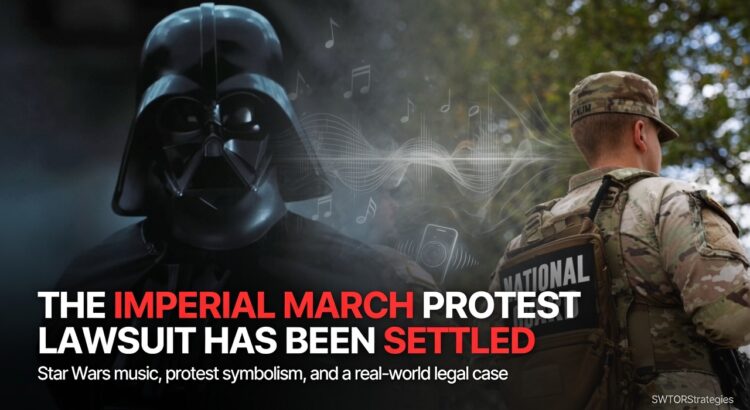
Sam O’Hara went with something simpler: walking behind National Guard troops in Washington, D.C. while playing “The Imperial March” from Star Wars on his phone.
Subtle? Absolutely not.
Recognizable? Instantly.
According to the Associated Press, the District of Columbia has now reached a settlement with O’Hara, who claimed police illegally detained him after he followed an Ohio National Guard patrol while playing Darth Vader’s theme as an act of protest. The exact settlement amount has not been made public.
The case is one of those real-world stories where Star Wars suddenly stops being background entertainment and becomes cultural shorthand. No lightsabers needed. No costumes. No elaborate speech. Just John Williams doing what John Williams does best: making everyone immediately understand the vibe.
The Imperial March Is Not Just Movie Music Anymore
“The Imperial March” was written as Darth Vader’s theme, but it has long since escaped the screen. People use it at sports games, political events, school assemblies, weddings, and probably at least one very awkward office meeting.
That is the power of Star Wars music. It does not need explanation.
Play a few seconds of “The Imperial March,” and people immediately think of power, menace, order, black armor, stormtroopers, and someone breathing through machinery like a nightmare with a management position.
That is why the D.C. story works as a protest image. O’Hara reportedly followed troops while playing the song and recording the interaction, turning a piece of film music into a public message. Whether someone agreed with him or not, the reference was clear.
That is not random fandom behavior. That is Star Wars functioning as a shared political and cultural language.
The Lawsuit and Settlement
The ACLU of D.C., which represented O’Hara, said D.C. agreed to settle the lawsuit related to the conduct of Metropolitan Police Department officers. The organization also said the case continues against Ohio National Guard Sgt. Devon Beck, who was named separately in connection with the incident.
The lawsuit centered on O’Hara’s claim that he was handcuffed and detained for a constitutionally protected act of protest. AP reports that he was held for roughly 15 to 20 minutes and released without charges.
That legal side matters, but the Star Wars angle is what made the story travel.
A protester silently trailing troops would be one thing. A protester trailing troops while blasting Darth Vader’s entrance music becomes a headline that writes itself.
Star Wars Keeps Escaping the Screen
This is not the first time Star Wars has become a real-world reference point, and it will not be the last.
The franchise has always been built around big, readable symbols: empires, rebels, masks, uniforms, marches, corrupted power, doomed idealism, and scrappy resistance. That is why its imagery keeps getting reused outside theaters and streaming apps.
Sometimes that reuse is serious. Sometimes it is funny. Sometimes it is both at once.
“The Imperial March” may have started as a villain theme in a space opera, but decades later it can still turn a city street into a scene people instantly understand. That is an absurd kind of staying power.
We have spent plenty of time covering Star Wars as games, books, shows, comics, and odd little behind-the-scenes stories. But this is another reminder that Star Wars also lives in public culture. It is not just something people watch. It is something people quote, remix, argue with, and sometimes weaponize with a smartphone speaker.
A settlement does not turn a protest into a movie scene.
But when the protest soundtrack is Darth Vader’s theme, the galaxy gets dragged into the story whether anyone planned it or not.
Author

Related Posts

The Ultimate Star Wars Quiz: 30 Questions to Test Your Galactic Knowledge
The Cancelled Darth Maul Game Still Hurts 15 Years Later
The Mandalorian Used a Fan-Made Bo-Katan Helmet for One Very Practical Reason
SWGOH Update 6-24-2026 Just Made Dedra Meero Farmable

Galactic Racer’s Smartest Trick Is Making Crashing Matter
Leia (Jedi Training) Is Coming to Galaxy of Heroes, and Jedi Master Luke Just Got Interesting Again
Star Wars: Galactic Racer Is Turning Racing Into a Buildcraft Problem
The Mandalorian and Grogu Is Quietly Holding Better Than the Box Office Doom Suggested