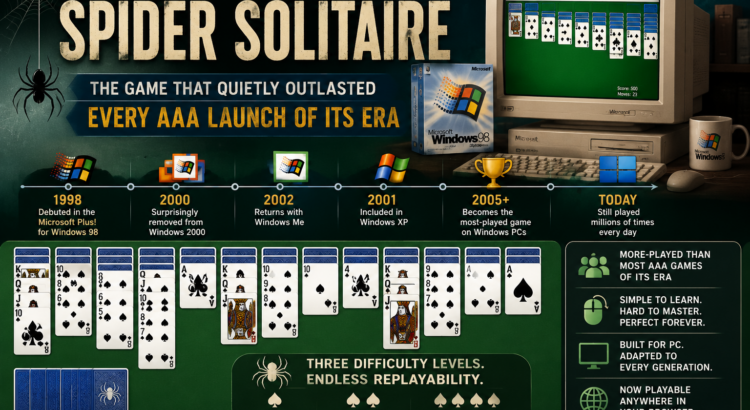
Every generation of gaming has its headline launches – the ones with the marketing budgets, the midnight release parties, the magazine covers. And then there’s the game that showed up on millions of Windows desktops with zero fanfare, no voice acting, no cutscenes, and somehow ended up more-played than almost anything that launched around it. Spider Solitaire never got a launch trailer. It didn’t need one. Its story is one of the quieter, weirder success stories in PC gaming, and it deserves the same kind of retrospective treatment we’d give any cult classic that outlived its hype cycle.
A Rocky Start Nobody Remembers
Spider Solitaire’s first appearance on Windows wasn’t even a clean debut. It showed up as part of Microsoft’s Plus! add-on pack for Windows 98 back in 1998 – an optional extra, not a built-in feature, which is a pretty unglamorous way for a future cultural fixture to enter the world. Then, in one of those decisions nobody at Microsoft has ever fully explained, it got cut entirely from Windows 2000. Imagine shipping a launch title and then quietly not including it in the next console generation. That’s roughly the energy.
It came back for real with Windows Me and then Windows XP, and that’s the version burned into most people’s memory. No sequel announcement, no anniversary edition, no remaster hype. It just quietly reappeared, pre-installed, and got on with things.
The Comeback Nobody Was Tracking
Here’s the part that would make for a great gaming-journalism headline if it happened today: by 2005, Spider Solitaire had overtaken the older Klondike-style Solitaire as the most-played game on Windows PCs. No marketing push, no esports scene, no streamer moment. It simply out-competed a more established game through sheer, quiet staying power, at a time when the industry was busy obsessing over the graphical arms race of the early Xbox 360 era.
That’s a genuinely strange flex for a game with a total budget that probably wouldn’t cover catering on a modern AAA production. It didn’t win by being flashier. It won by being the thing people kept coming back to.
The Design That Made the Comeback Possible
Unlike a lot of “legacy” games that survive purely on nostalgia, Spider Solitaire’s staying power actually holds up under inspection. It deals from two full decks across ten columns and offers three difficulty tiers based on how many suits are in play:
- One suit: Every card is compatible with every other, making this the equivalent of a tutorial difficulty that never stops being available.
- Two suits: Real friction starts here, once color clashes actually matter to your sequencing.
- Four suits: A completely different puzzle, demanding genuine forward planning rather than pattern recognition.
That’s effectively three games disguised as one install, which is a smarter difficulty curve than plenty of games that shipped with a dedicated design team and a marketing deck.
The Part That Actually Ported Well
A lot of “classic” games age badly the moment you take them off the exact hardware they were built for. Old control schemes stop making sense, UI conventions feel foreign, and something that felt intuitive in 1998 turns clunky the second it’s asked to run somewhere new. Spider Solitaire mostly dodged that fate. The core interaction – click, drag, drop, repeat – translated cleanly from a mouse-driven desktop to a touchscreen decades later without needing a redesign. That’s not an accident so much as a side effect of the original design being simple enough that there was very little to break in translation.
It’s worth comparing that to how much retooling goes into porting a modern game between platforms. Spider Solitaire never needed a “next-gen remaster” conversation, because the thing that made it work in the first place never depended on the hardware it launched on.
Why This Still Matters for a Site Like This One
We spend a lot of time here tracking games with decades of baggage – CD-ROM-era spectacle, arcade cabinets from the 80s, launch titles that either found their footing or didn’t. Spider Solitaire is a weirder case study than most of them, because it never had a launch moment worth covering in the first place. It just accumulated relevance quietly, year after year, until it was one of the most-played pieces of software on the planet almost by accident.
That’s a genuinely unusual story in an industry that mostly runs on hype cycles, pre-order bonuses, and day-one patches. A game with no marketing spend, no voice cast, and no anniversary re-release outlasted entire console generations of competition, purely because the core design was sound enough to not need updating.
The Legacy Nobody Announced
There’s no reboot on the horizon, no “Spider Solitaire Remastered” coming to next-gen consoles, and there doesn’t need to be. The original design already solved the problem it set out to solve, decades ago, and it’s still doing the job today in a browser tab instead of a bundled Windows install. Every big franchise eventually gets the “how did this hold up for so long” retrospective treatment. Spider Solitaire earned one just as much as anything with a bigger marketing budget ever did – it’s just been waiting quietly for someone to actually write it.
Author

Related Posts

Star Wars: Starfighter Leak Points to Jedi Refuge, Lightsaber Duel, and a Very Different Post-Skywalker Story
Star Wars: Rebel Assault II – The Hidden Empire (1995): The Sequel That Let Star Wars Get Even More Cinematic
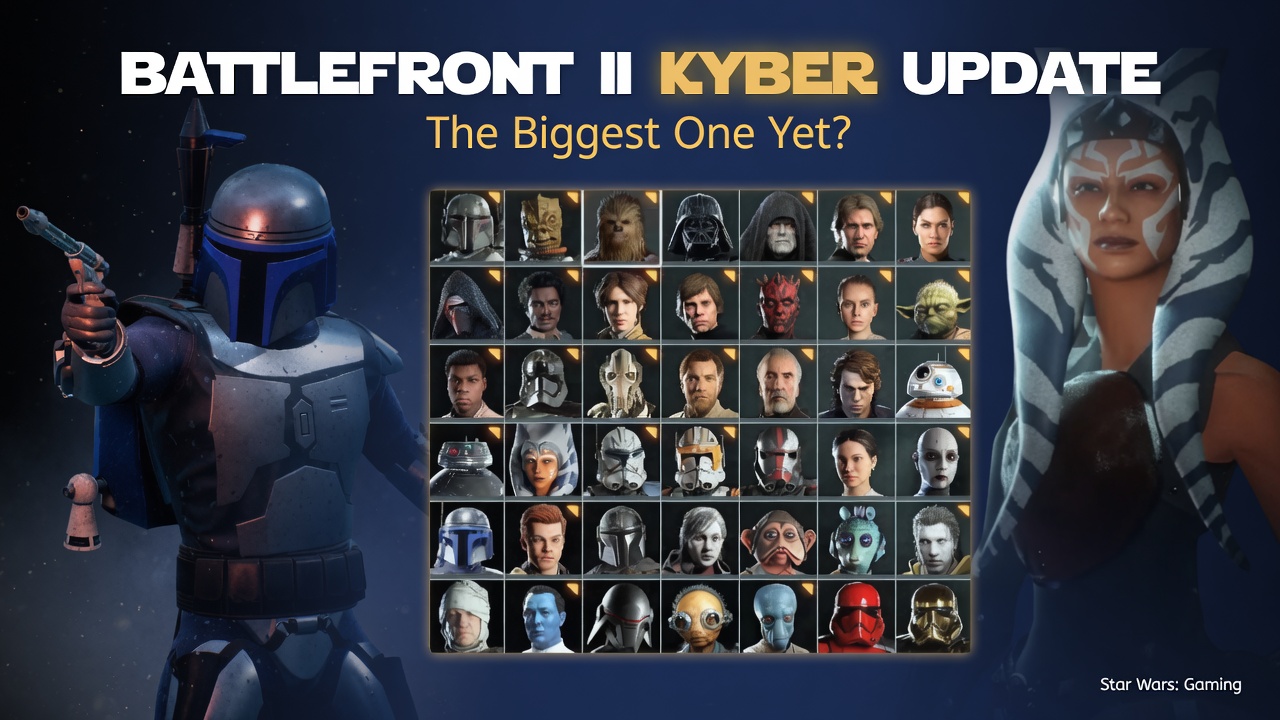
Star Wars Battlefront II’s New Kyber Update Sounds Like the Biggest One Yet
Star Wars Battlefront II Is Back in the PS4 Charts, Because This Game Refuses to Die


Star Wars Battlefront II’s Hero Starfighters Update Still Deserves a Small Victory Lap
SWTOR’s 8.0 Era Is Starting to Take Shape After Legacy Reborn
Star Wars: Galactic Racer Is Getting Post-Launch Content, But Still No Season Pass
SWTOR July 2026 Events Bring Back Gree Weirdness and Dantooine Pirates