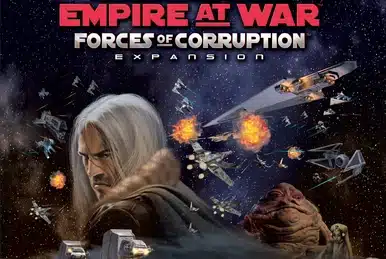
If Star Wars: Empire at War (2006) gave players the fantasy of commanding the Galactic Civil War, Forces of Corruption asked a much messier question: what happens when the war is no longer just Rebels versus Empire?
Released later in 2006 as the official expansion to Empire at War, Forces of Corruption did more than add extra maps and units. It introduced the Zann Consortium, a criminal faction that turned the strategy sandbox into something more unpredictable, more opportunistic, and in some ways more distinctly “Star Wars underworld” than the base game ever was.
That shift is exactly why the expansion still matters. It did not simply make Empire at War bigger. It made it stranger.
A clean way to frame its legacy is this:
Forces of Corruption expanded Empire at War by proving that Star Wars strategy did not have to be about armies alone — it could also be about crime, sabotage, and galactic manipulation.
Game Information
Title: Star Wars: Empire at War – Forces of Corruption Release year: 2006 Developer: Petroglyph Games Publisher: LucasArts Platforms: PC (Windows), later Mac Genre: Real-time strategy (RTS) / expansion Era of Star Wars game development: 2006–2012 Era / Post-Golden Age LucasArts Period
Gameplay Overview
At a mechanical level, Forces of Corruption builds on the same structure that made Empire at War work:
galactic conquest
land battles
space battles
faction-based strategy across a campaign map
But the expansion’s biggest contribution is not just “more content.” It is the different style of play introduced by the Zann Consortium.
The Zann Consortium changes the tone
The Empire and Rebels are military factions. The Consortium is something else entirely. It operates like a criminal syndicate, built around corruption, intimidation, black-market power, and disruption.
That changes the feel of the game immediately. Instead of simply overpowering planets with fleets and armies, the Consortium often feels like it is sneaking, undermining, bribing, or destabilizing its way across the galaxy.
This gives the expansion a very different flavor from the base game:
more underworld energy
more asymmetrical strategy
more emphasis on dirty tricks and control through influence rather than pure battlefield force
New units and new priorities
Like any good RTS expansion, Forces of Corruption adds more toys to the sandbox. But again, the important part is not just quantity. The important part is that the added units and mechanics support a distinct faction identity.
The Zann Consortium does not feel like “Empire with different colors.” It feels like a faction designed around exploiting chaos.
Space and land battles
The expansion keeps the strong split between surface combat and fleet warfare. Space battles remain one of the game’s biggest strengths, and the new strategic layer adds more reasons to care about controlling trade, movement, and planetary pressure.
Land battles still tend to be the less iconic side of the game compared to space, but the expanded faction design and campaign context help keep them more interesting than simple repetition.
How it compares to Empire at War
Compared to the base game:
Empire at War is cleaner, more iconic, and more directly tied to the Empire vs Rebel war fantasy.
Forces of Corruption is more experimental, more faction-driven, and more interested in the galaxy’s criminal power structures.
That makes it a great follow-up article in your archive, because it shows how a Star Wars expansion can deepen the setting rather than just pad the unit list.
Be sure to link directly to your base-game article:
Forces of Corruption arrived in the same year as Empire at War, which says a lot about how much LucasArts and Petroglyph believed in the strategy branch of Star Wars gaming at the time.
By 2006, Star Wars games had already proven themselves in shooters, action games, and RPGs. Empire at War had opened the door for large-scale galactic strategy. Forces of Corruption then expanded that formula in a direction that felt especially Star Wars: the underworld, the crime syndicates, the power behind the front lines.
That matters historically because Star Wars has always been bigger than just Jedi and armies. Smugglers, gangsters, bounty hunters, and crime lords are a huge part of the franchise’s identity. Forces of Corruption is one of the clearest examples of a strategy game actually embracing that.
For archive purposes, it belongs squarely in your next-era hub:
Like the base game, Forces of Corruption was developed by Petroglyph Games, and the studio’s RTS background helped the expansion avoid one of the biggest traps of licensed add-ons: feeling disposable.
Instead, the expansion was designed around a meaningful new angle. The smartest decision was making the Zann Consortium the centerpiece rather than treating them as a minor side faction. That gave the expansion a fresh identity and justified its existence as something more than “Empire at War plus extra missions.”
Design-wise, the expansion works because it understands that a new faction should change how players think, not just what they build. The Consortium’s criminal flavor gives the campaign a different strategic rhythm, and that makes the expansion memorable even for players who already knew the base game well.
Reception
Forces of Corruption was generally received as a worthwhile expansion, especially by players who wanted more reasons to stay inside the Empire at War sandbox.
The biggest praise usually focused on:
the Zann Consortium as a fresh faction
expanded campaign possibilities
more Star Wars flavor beyond the standard Empire/Rebel war
extra replay value for an already well-liked strategy game
The most common criticism was that it was still fundamentally tied to the strengths and weaknesses of the base game. So if someone already disliked Empire at War’s RTS simplifications or preferred space over land combat, the expansion was unlikely to change their mind completely.
But for fans of the original, that was rarely the point. What they wanted was more Empire at War with a new angle, and Forces of Corruption delivered exactly that.
Legacy
The legacy of Forces of Corruption is tied to one important achievement: it made the Empire at War branch of Star Wars gaming feel more complete.
It proved that the strategy side of Star Wars could handle:
factions beyond Empire and Rebels
morally gray or openly criminal power structures
a broader galactic ecosystem than simple military conquest
That matters because it expanded what people expected from Star Wars strategy games. Instead of just recreating the films’ war, Forces of Corruption reminded players that Star Wars also includes shadow economies, crime syndicates, and power brokers working between the cracks of galactic conflict.
A strong way to describe its long-term significance is this:
Star Wars: Empire at War – Forces of Corruption remains important because it showed that Star Wars strategy could be about influence, crime, and opportunism — not just fleets and front lines.
That is why it still stands out as more than “just an expansion.”
Trivia and Interesting Facts
Forces of Corruption is best remembered for introducing the Zann Consortium, one of the most distinctive factions in any Star Wars strategy game.
It released in the same year as the base game, which helped keep Empire at War’s momentum alive.
For many players, the expansion’s underworld focus gave it a very different vibe from the cleaner military framing of the original.
It remains one of the clearest examples of a Star Wars expansion that meaningfully changed a game’s identity instead of simply enlarging it.
FAQ
When was Star Wars: Empire at War – Forces of Corruption released? It was released in 2006.
What platforms was Forces of Corruption available on? It originally launched on PC, with later availability on Mac as well.
Do you need Empire at War to play Forces of Corruption? As an expansion, it is directly tied to Empire at War, and it is best understood and appreciated after playing the base game first.
Why is Forces of Corruption important? Because it introduced the Zann Consortium and expanded Star Wars strategy into the criminal underworld side of the galaxy, not just the military conflict between Empire and Rebels.
Follow us on X, Facebook, Instagram, bsky or Pinterest for exclusive content, mod guides, Star Wars gaming news, and more. Your support helps keep the Holonet alive—one click at a time.
Soeren Kamper is the founder of StarWars: Gamers and a longtime Star Wars writer, community builder, and gaming journalist with nearly two decades of experience covering Star Wars games and fandom. He began writing about Star Wars: The Old Republic in 2008, later co-founding the SWTOR wiki and founding the SWTOR subreddit, and became an early, active figure in the game’s community. His hands-on involvement led to invitations from BioWare Austin and participation in SWTOR events during the game’s launch era. His work is grounded in long-term franchise knowledge, firsthand gaming experience, and deep roots in the Star Wars community.
Soeren Kamper is the founder of StarWars: Gamers and a longtime Star Wars writer, community builder, and gaming journalist with nearly two decades of experience covering Star Wars games and fandom. He began writing about Star Wars: The Old Republic in 2008, later co-founding the SWTOR wiki and founding the SWTOR subreddit, and became an early, active figure in the game’s community. His hands-on involvement led to invitations from BioWare Austin and participation in SWTOR events during the game’s launch era. His work is grounded in long-term franchise knowledge, firsthand gaming experience, and deep roots in the Star Wars community.