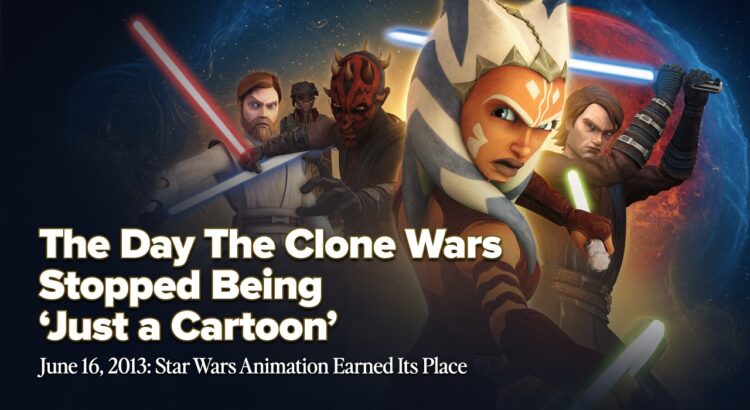
On June 16, 2013, Star Wars animation quietly crossed a line.
That was the night Star Wars: The Clone Wars won the Daytime Emmy for Outstanding Special Class Animation, after years of being treated by some people as the “extra” Star Wars thing. The side project. The cartoon. The show for kids while the “real” saga lived in the movies.
Then it won.
And suddenly that argument looked a lot weaker.
The Clone Wars Had Already Earned Respect
By 2013, anyone actually watching The Clone Wars knew what the show had become.
It was no longer just filling gaps between Attack of the Clones and Revenge of the Sith. It was expanding Anakin’s fall, turning Ahsoka Tano into one of the most important characters in modern Star Wars, making the clones feel like actual people, and giving the prequel era more emotional weight than the films ever had time to carry alone.
It also gave us Mandalore politics, Nightsisters, Mortis, Maul’s return, Savage Opress, Hondo Ohnaka, Rex, Fives, and enough trauma to make “kids show” feel like a deeply suspicious label.
The Emmy did not magically make The Clone Wars great.
It simply made the wider industry notice what many fans already knew.
Huyang Winning Makes This Even Better
The same Emmy weekend also gave David Tennant a win for voicing Huyang, the ancient droid who helps young Jedi construct their lightsabers.
At the time, that might have seemed like a charming side note. Doctor Who star voices weird Jedi lightsaber professor. Lovely. Put it on the shelf.
Years later, Huyang returned in Ahsoka, still voiced by Tennant, and suddenly that old Clone Wars arc felt even more important.
That is one of the funniest things about Star Wars now. A character can look like a strange little animated detour in 2012, then return years later as part of the live-action spine of the franchise.
Huyang is basically proof that The Clone Wars was not disposable.
It was planting seeds.
Animation Became Essential Star Wars
That is the real legacy of the 2013 Emmy moment.
The Clone Wars helped change how Star Wars animation was treated. Without it, it is hard to imagine Rebels landing the way it did. It is hard to imagine The Bad Batch carrying clone identity and Republic aftermath so deeply. It is hard to imagine Ahsoka becoming the character she is now.
The show proved that animation could do more than explain lore.
It could create mythology.
It could fix weak spots.
It could make side characters matter.
It could take a galaxy people thought they understood and reveal that half the best stories were hiding between the movie scenes.
The Cartoon Won
That is why June 16 still matters.
Because The Clone Wars did not win by pretending to be something else. It won while being proudly animated, proudly serial, proudly weird, and proudly Star Wars.
It did not stop being a cartoon.
It proved that being a cartoon was never the problem.
The real mistake was thinking “cartoon” meant “less important.”
Author

Related Posts

Star Wars: Galaxy of Heroes Was Announced 11 Years Ago, and Somehow It Became the Mobile Game That Wouldn’t Die
The Mandalorian and Grogu Just Crossed $315 Million, and Star Wars Finally Escaped Solo’s Shadow
Ahsoka Season 2 Might Finally Give Ezra Bridger the Spotlight He Deserves
Manny Jacinto’s Favorite Star Wars Movies Say a Lot About Why Fans Love the Weird Stuff