For years, theatrical Star Wars has been haunted by one name.
Not Palpatine.
Not Snoke.
Not “somehow.”
Solo.
Ever since Solo: A Star Wars Story underperformed in 2018, every conversation about Star Wars returning to theaters has carried the same nervous question: can this franchise still work on the big screen without being a billion-dollar Skywalker Saga event?
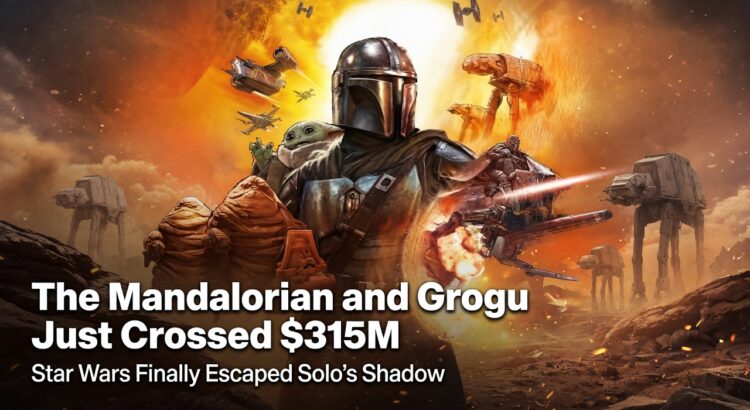
The Mandalorian and Grogu may have finally given Lucasfilm the answer.
No, it is not the biggest Star Wars movie ever. No, it is not pulling The Force Awakens numbers. But according to Box Office Mojo, the film has crossed $315 million worldwide and currently sits as the 7th highest-grossing movie of 2026.
That matters.
This Is Not a Flop Story Anymore
The online box office debate around The Mandalorian and Grogu has been weird from the start.
Some wanted it to be a disaster. Some wanted it to be a triumphant rebirth. The actual numbers are less dramatic and more interesting.
The film has passed $315 million worldwide, with The Numbers listing its production budget at around $165 million. That means this is not the same situation as Solo, which grossed $392.9 million worldwide but carried a reported $275 million budget.
That distinction is important.
The Mandalorian and Grogu does not need to beat every old Star Wars movie to prove something. It only needs to show that theatrical Star Wars can return in a more focused, controlled, sustainable form.
And right now, that is exactly what it is doing.
Escaping Solo’s Shadow Was Never Just About Money
To be clear, The Mandalorian and Grogu has not passed Solo in raw worldwide total.
But it may have escaped Solo’s shadow in a more meaningful way.
Solo became the symbol of Star Wars overreach: expensive production trouble, release-date fatigue, audience uncertainty, and a franchise suddenly looking less invincible.
Mando and Grogu feels different.
It is built around characters audiences already know. It has a clearer identity. It arrived with a smaller reported budget. And instead of needing to prove Star Wars can dominate everything, it proves something more useful: Star Wars can still show up, compete, and matter.
Being a top-10 global movie in 2026 is not failure.
That is a real theatrical footprint.
Star Wars Does Not Need to Be All or Nothing
This is where the conversation needs to grow up a bit.
Not every Star Wars movie has to be a billion-dollar cultural earthquake. That cannot be the only measure of success. If Lucasfilm is going to rebuild theatrical Star Wars, it needs room for different kinds of wins.
A Mandalorian movie performing solidly at a more reasonable scale is a good sign.
It suggests Star Wars can stop living in the shadow of impossible expectations. It can be more than “Skywalker Saga or bust.” It can be movies, shows, games, animation, comics, and everything in between.
That wider galaxy has always been part of the franchise’s strength, which is why we keep tracking the playable side of it in our Complete List of All Star Wars Games Ever Made.
And it also makes this a useful follow-up to the earlier box office debate around The Mandalorian and Grogu.
A Solid Win Is Still a Win
The best way to read The Mandalorian and Grogu right now is simple:
Not a miracle.
Not a meltdown.
A solid theatrical win for a franchise that badly needed one.
After years of “remember what happened to Solo?” hanging over every Star Wars movie conversation, this feels like a step forward.
Star Wars is back in theaters.
It is in the global top 10.
It has crossed $315 million.
And for once, maybe that should be allowed to count as good news.