

Star Wars Outlaws surprised players not only with the scale of its world, but also with the unexpected reincarnation of the legendary card game Sabacc. Why did the developers need to rethink this iconic element of the universe, how difficult was it to integrate it into modern gameplay, and what did it bring to fans of cunning cosmic gambling games?
The history and significance of Sabacc in the Star Wars universe
Sabacc is not just a card game, but an important element of Star Wars mythology, one of the symbols of the underworld life of the Galaxy. It first appeared in early books and comics, and gained wide recognition thanks to the film “Solo: A Star Wars Story,” where the famous “Millennium Falcon” was at stake. Later, Sabacc began to appear in animated series, board games, and numerous fan projects. For fans of the franchise, the authenticity of this game has always been a matter of principle. They see it as a detail that gives the universe credibility and depth, immersing the viewer or player in the atmosphere of a real world with its own rituals and entertainments.
Card games similar to Sabacc exist on Earth as well. Poker, blackjack, and various dice games have become a kind of inspiration for the creators of game versions. As in a real casino, here the stakes are not only money, but also the fates of the heroes, which makes each game rich in drama.
Why the developers needed to create a new version
Previously, Sabacc appeared in video games, but more often in simplified or alternative forms. For example, in Knights of the Old Republic, fans could try their hand at “Pazaak“—a game with mechanics reminiscent of blackjack, but lacking the atmospheric component of the original Sabacc. Such versions always sparked debate: some praised them for their simplicity, others criticized them for departing from canon.
Jean-Baptiste Siroden, game designer at Ubisoft Paris, noted at GDC 2025: “Sabacc already had a history. We didn’t start from scratch, but previous versions didn’t meet the goals of Outlaws. We wanted to create a mini-game that would become an organic part of the world, not just an insert between missions.” The team faced the task not only of restoring the atmosphere of the cosmic underworld, but also of making the process interesting for modern players.
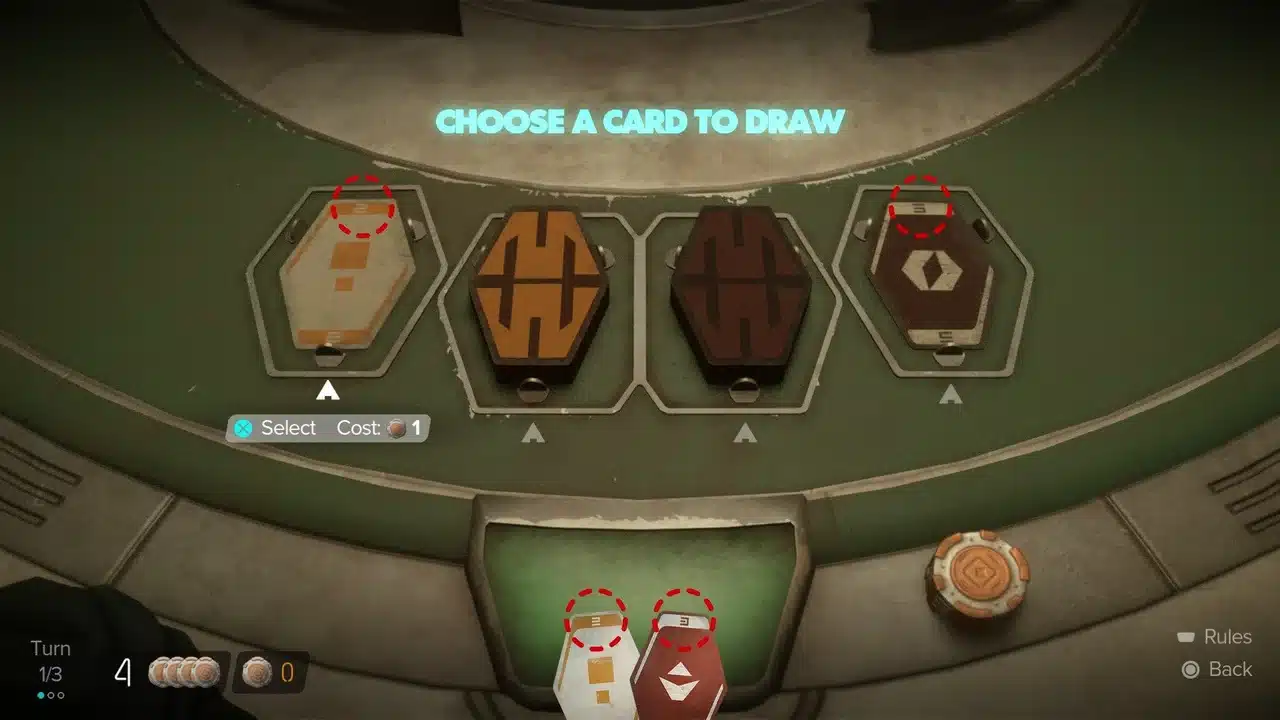
How “Kessel Sabacc” was developed
Work on the new version began with surprisingly simple tools. Prototypes were tested on an ordinary table with cards and chips, checking the dynamics and balance at early stages. The team was inspired by several classic gambling games at once:
- The principle of counting points and striving for a certain sum came from blackjack
- Randomness and elements of risk were borrowed from dice games such as 421 and Yahtzee
- For tactics, special cards and decisions were introduced, complicating players’ choices
A special innovation is the “shift tokens.” These are special cards or tokens that allow you to change the course of the game: discard extra cards, influence the result of a roll, or even change the rules on the fly. Such elements added real unpredictability and gave players room for creativity.
Integration of the mini-game into the world of Outlaws
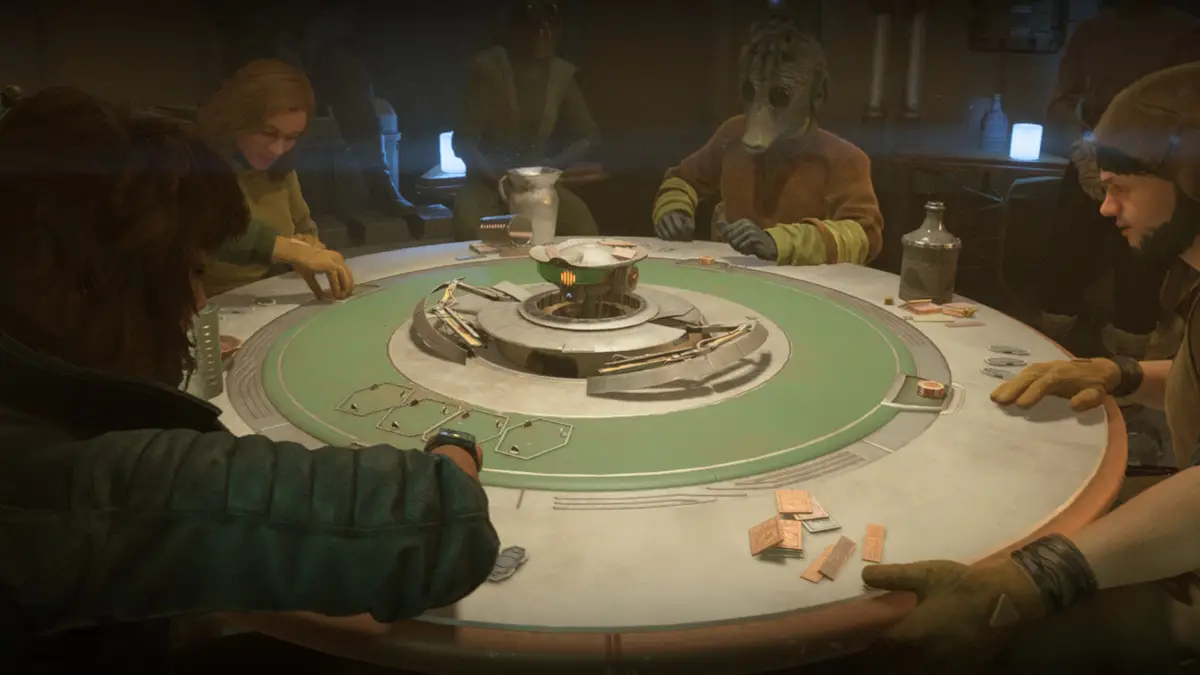
The main goal of the developers was not just to add Sabacc for the sake of it, but to make it part of the narrative and the everyday life of the heroes. Sabacc is integrated into the gameplay through diegetic storytelling—the players see the game through the eyes of the heroine Kay and her companion Nix, sitting at the table with non-player characters. There is no separate menu or abstract interface; everything happens directly in the world of Outlaws.
Diegetic storytelling is an approach in which an in-game event is perceived by both the characters and the player in the same way. Here, the player is not just an observer, but becomes part of the scene, where you can bluff, cheat, or rig events. Kay, for example, can use Nix to spy on opponents’ cards. Importantly, despite the highly detailed 3D visualization, the logic of the mini-game itself is implemented in a 2D layer. This allows for maximum clarity and speed of play.
How the new version of Sabacc differs from previous ones
Kessel Sabacc” has become a true hybrid of classic games and Ubisoft Paris’s own solutions. Unlike older versions, the new version combines ease of learning with tactical depth. The mini-game has become recognizable thanks to:
- adaptive rules that are easy to remember
- unique action cards and tokens
- a visual style that conveys the spirit of the criminal world of Star Wars
Fans note that the atmosphere of an underground game, constant tension, and the ability to influence the outcome of the game make the experience especially exciting. According to players, it is precisely such features that bring back the feeling of life in a galaxy far, far away.
Fan reaction and the role of the mini-game in player experience
After the release of Outlaws, there were enthusiastic reviews both on fan forums and on social networks. On Reddit and Discord, people discuss strategies and share their impressions of the games. According to Game Informer, some fans even tried to recreate “Kessel Sabacc” with paper cards to play outside the game—the mechanics made such a vivid impression.
Some players also shared how they studied classic gambling mechanics, comparing them to the game in Outlaws. Many of them compared the mechanics of this game to gambling entertainment they already knew from online casinos. Judging by the statistics of thematic industry sites, the release of the game coincided with a rise in interest in IGaming.
Having studied this issue in more detail, we found several such sites. On one of them—twinspinca.com with online casino reviews—we were able to contact experts. By reaching out to its authors, we learned that with the release of the “Kessel Sabacc” expansion for Outlaws, their traffic increased by about 12–15% in the first weeks.
According to them, the growth was mainly due to the fact that players began to look for materials on card and risk mechanics to better understand the principles of Sabacc and compare it with real gambling systems.
According to players, the integration of the mini-game makes the world of Outlaws more alive, and the characters themselves more human. This allows not only to take a break from the main plot, but also to feel like a real participant in a space adventure.
The influence of mini-games on engagement and franchise development
Why do mini-games become an integral part of modern large projects? Such elements make the game world deeper, allow the characters’ personalities to be revealed, and create unique stories within the main campaign. In other popular games—for example, Gwent from The Witcher or poker from Red Dead Redemption—such mechanics have achieved cult status, and sometimes even become independent products.
Star Wars Outlaws offers an original approach thanks to the tight integration of the mini-game into the narrative and visual environment. Isn’t it interesting what innovations await us in future game adaptations of our favorite franchises and how mini-games will develop further?
Author

Related Posts

Disney’s 2026 Slate Confirms Two New Star Wars Shows — And They Couldn’t Be More Different
Mark Hamill Says Luke Skywalker’s Ending in The Last Jedi Was “A Nice Exit” — And He Means It-
The Mandalorian Joins Disney’s Billion Hours Club — And It’s a Star Wars First -
Remembering Jeremy Bulloch: The Man Behind Boba Fett, Five Years On


-
Star Wars: Galaxy of Heroes – Update 12-17 Breakdown (Datacrons, Make Goods, and a Small Oops) -
Sigourney Weaver Cheekily Breaks Down What It’s Like to Hang with A Group of Grogus on The Mandalorian & Grogu -
Rian Johnson Says The Last Jedi and Wake Up Dead Man Are Spiritually Connected — And Suddenly Everything Clicks -
The Classiest Clapback in Star Wars History: Ron Howard Defends 9-Year-Old Jake Lloyd