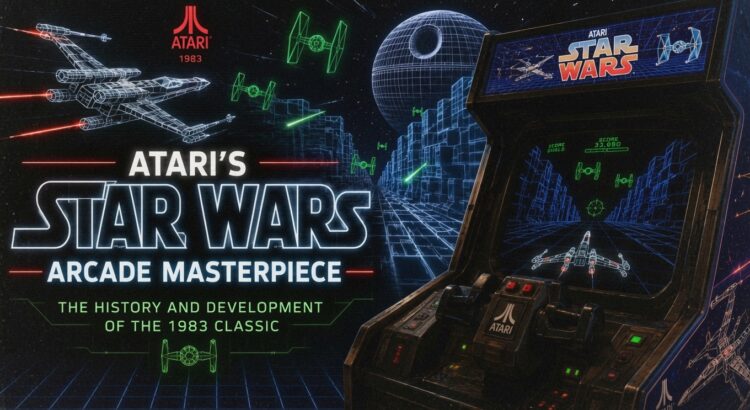
Star Wars hit arcades in May 1983, wrapped in the glow of green and white vector lines, with Obi-Wan Kenobi’s voice crackling out of the cabinet to tell players that the Force would be with them, always.
It became Atari’s best-selling arcade release of the year and one of the most beloved licensed games ever made. But it was built on the bones of a failed project, assembled by a team racing against a clock nobody could see yet, and released into an industry that was about to collapse around it.
This is the story of how Star Wars, the arcade game, came together, and how a game that perfectly captured the cutting edge of arcade technology arrived just as that whole world started coming apart.
A Space Game Nobody Could Finish
Before there was a Death Star to blow up, there was a problem nobody at Atari could quite solve: how do you put a player inside a 3D space battle?
In 1979, hardware engineer Jed Margolin took a job at Atari specifically because he wanted to build that game. As he put it bluntly years later:
“I wanted to do a 3D space war game. I mean, I really wanted to do a 3D space war game. It is why I went to work for Atari.”
The project that grew out of that ambition was called Warp Speed, and its early history is tangled. According to longtime Atari designer Owen Rubin, the original Warp Speed concept and prototype hardware came from Ed Rotberg, who built a two-cabinet, back-to-back 3D version of Spacewar! that let two players fly free-form through space and fight each other.
It looked incredible on paper. In practice, it was nearly unplayable. Full 3D roll, pitch, and yaw turned out to be brutally disorienting for most people, and the screen-wrap tricks that worked fine in 2D fell apart in a 3D cockpit.
The two-player version was scrapped, but the underlying vector hardware did not go to waste. Rotberg repurposed it to build Battlezone, which became one of Atari’s defining hits of 1980.
Margolin, meanwhile, kept chasing his original idea, working on titles like Sebring and Tube Chase while waiting for a shot at the space game he had joined the company to build.
Warp Speed limped along as a project for roughly two years, never quite landing on a design that worked. An internal Atari proposal document for the game described the bones of what it might become: a player moving through free space, attacking formations of enemy ships, with the action building toward something the document explicitly compared to the ending of a certain 1977 movie.
The document stated that “a feeling similar to the end of Star Wars can be achieved by the player and is a desirable goal.”
Atari Licenses the Galaxy
In 1982, Atari struck a deal with Lucasfilm to make arcade games based on the Star Wars trilogy. Sensing an opportunity, Margolin suggested that his stalled Warp Speed hardware would make a sound foundation for an actual Star Wars game.
Management agreed, likely relieved that someone had handed them a solution to a project that had been spinning its wheels for two years.
The job of actually designing and leading that game went to Mike Hally, a mechanical engineer who had joined Atari straight out of Santa Clara University in the late 1970s to work in the company’s pinball division. When that division shut down, Hally moved over to coin-op arcade games, cutting his teeth on titles like Gravitar and the obscure Akka Arrh.
Landing the Star Wars project was, by his own account, the high point of his career to that point.
“I think that was the most excited I’ve ever been in my life. They could have picked people like Ed Logg or Ed Rotberg, who had superiority over me… but for some reason they chose me to run the project and design the game.”
Hally’s pitch for what the game should actually be was almost defiantly simple. Rather than trying to adapt the whole film or invent a new story, he zeroed in on one sequence: the assault on the Death Star.
“To me it was really, really simple. The whole climax of the movie was about Luke Skywalker flying his X-wing, shooting TIE fighters, trying to get down to the Death Star past the gun turrets, and then diving into the trench to get to the exhaust port. It was perfect for a videogame.”
That clarity shaped everything that followed. The finished game is built around exactly three connected sequences: dogfighting TIE fighters in open space, skimming the Death Star’s surface past gun towers, and the trench run itself. The game then loops back to the start with the difficulty ratcheted up each time.
It does not try to be the whole movie. It bottles the one scene that was already structured like a video game and lets the player play it.
Building the Cockpit
Getting Star Wars into arcades took roughly a year and a half of work, and a lot of it went into things players would never consciously notice, like how to steer a spaceship.
The team’s first attempt used a conventional joystick, and Atari built a cabinet prototype around it, complete with a molded plastic surround designed by Ken Hata. It went to a focus group, and the results were not encouraging: players could not intuitively figure out which way to push the stick to steer the X-wing the way they expected.
Rather than ship something confusing, the team went back to Atari’s management and made the case for a bigger investment: a proper flight yoke.
That yoke had an unlikely background. It was adapted by mechanical engineer Jerry Liachek from a controller originally built for the Bradley Trainer, a secretive piece of hardware Atari had developed for the U.S. Army as a simulator for the Bradley Fighting Vehicle, repurposing Battlezone’s tank-combat engine for military training.
That controller’s DNA, built for soldiers learning to operate armored vehicles, ended up in miniaturized form in the hands of arcade-going teenagers pretending to be Luke Skywalker. Atari mounted the fire and trigger buttons directly on the yoke itself, which made the whole rig feel less like “a joystick bolted to a cabinet” and more like an actual flight control.
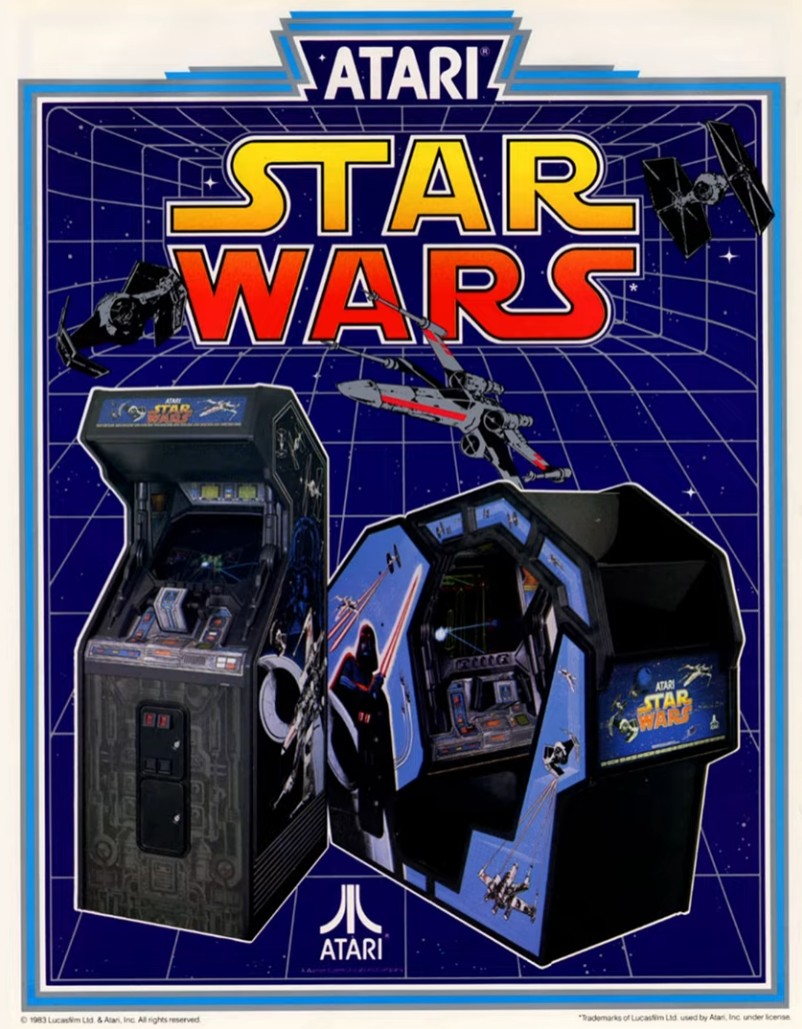
The cabinet itself was the work of industrial designer Mike Jang, who sketched the cockpit’s now-iconic look, including the hydraulic-ram detailing on the plastic moldings around the monitor, echoing the ramp mechanisms seen on the Millennium Falcon in the film, and the angled truss-style roof meant to extend that mechanical theme.
Jang built early prototypes out of cardboard, later refined into a particle-board mockup wrapped in plain blue vinyl decals while the final artwork was still in production. According to Jang, that very prototype cabinet, with its graphics unfinished, was the one Atari shipped off for George Lucas’s personal approval.
Hally recalled why the sit-down cockpit mattered so much to the team:
“We knew it would be perfect for a sitdown cab as well as a standup. That’s why we made such cool mouldings around the monitor and used this see-through dark Perspex, so people could see what was going on. And we spent a long time working on the controller so [the whole cockpit experience] felt just right.”
The cockpit version used a larger 25-inch Amplifone monitor compared to the upright’s 19-inch Wells-Gardner screen, amplifying the sense of actually sitting in an X-wing.
A First for Atari: Putting Real Voices in the Cabinet
One more piece set Star Wars apart from anything Atari had shipped before: it talked.
Using digitized speech samples pulled from the movie itself, the game barked encouragement and threats in the actual voices of the cast: Obi-Wan Kenobi’s “The Force will be with you,” Han Solo’s “Yahoo! You’re all clear, kid,” and Darth Vader’s “I have you now.”
It was the first time Atari had put synthesized speech into one of its games. To make it possible, Margolin created an entirely separate processor for the sound of the game. That sound board could also “fake” stereo surround sound, playing sound through each speaker asynchronously.
It paid off. The combination of recognizable film dialogue, the rumbling Star Wars theme playing through the cabinet’s speakers, and digitized sound effects gave Star Wars a sense of presence that flat 8-bit bleeps simply could not match.
Pushing Vector Graphics to Its Limit
Visually, Star Wars sat at the absolute peak of a technology Atari had spent years cultivating: the color vector display.
Where most arcade games of the era drew raster graphics, grids of glowing pixels, vector games used an electron beam to trace sharp, glowing lines directly onto the screen, the same underlying principle as an oscilloscope.
Atari had been refining this approach since Lunar Lander and Asteroids, and the breakthrough into full color came with 1981’s Tempest, built on Atari’s new “Quadrascan” color vector hardware.
Star Wars pushed that hardware about as far as it could go, layering in a more complex coordinate-generation system, which engineers called an “Analog Voltage Generator,” as opposed to the simpler digital approach used in earlier titles. This helped render the TIE fighters breaking apart on impact, the Death Star’s trench rushing past, and the glowing flash that lit up the whole screen whenever the player’s ship took a hit.
It looked like nothing else in the arcade. It also turned out to be something of a high-water mark. Vector monitors were notoriously failure-prone, a serious problem for arcade operators who wanted machines that could sit on the floor unattended and just keep collecting quarters.
George Lucas Comes to Sunnyvale
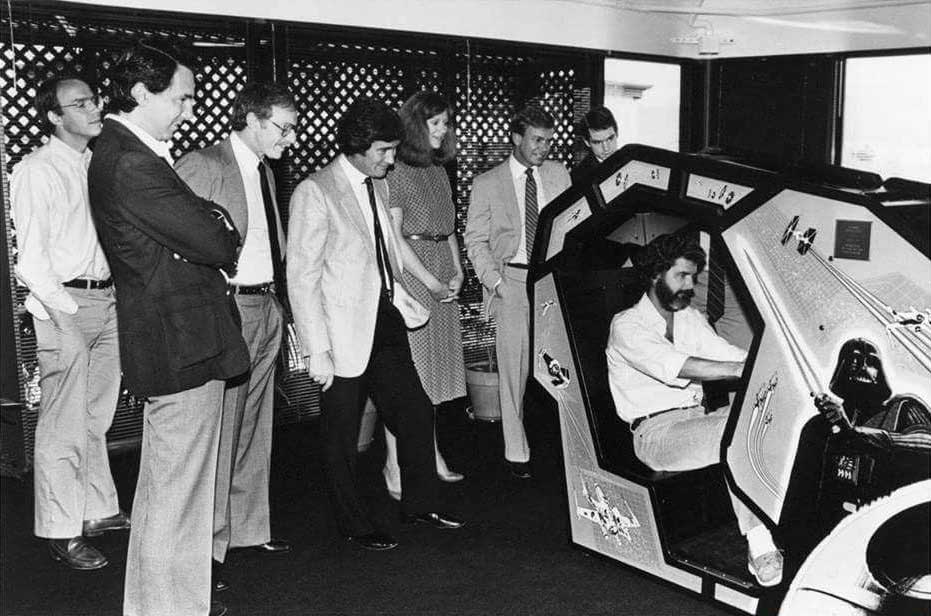
With the cabinet, controller, hardware, and speech all locked in, Atari brought the finished machine to George Lucas himself for approval at Atari’s Sunnyvale, California factory.
Photos from the visit show Lucas seated in the cockpit, with Atari’s Don Osborne walking him through the controls, surrounded by Atari staff who, according to Mike Jang, had uncharacteristically dressed up for the occasion. That was a notable departure from the jeans-and-t-shirts culture of early-’80s Atari, where showing up in slacks and a button-down was liable to get you asked if you were heading out to a job interview.
Lucas approved the cabinet, and Atari gifted him the actual unit he had tested, complete with a plaque reading “A special thanks for creating THE FORCE behind so much fun.”
It is a small detail, but a telling one. This was not a studio rubber-stamping a licensing checkbox from a distance. Lucasfilm was reviewing storyboards, sending written feedback on proposed gameplay elements, and weighing in directly on what the finished cabinet would look like before it ever reached an arcade floor.
Released Into the Storm
Star Wars hit arcades in May 1983, in two cabinet configurations: 10,245 standard uprights and 2,450 deluxe sit-down cockpits, for a combined total of just under 13,000 units.
It became Atari’s top-selling arcade release of the year, topped the U.S. street-location charts that October, and was Japan’s best-selling upright/cockpit cabinet that November. It was also boosted by the release of Return of the Jedi in theaters that same summer.
It also arrived at one of the worst possible moments in the industry’s history.
By 1983, the home console market that Atari had built was in freefall. A flood of rushed, low-quality third-party software, with Pac-Man and E.T. the Extra-Terrestrial on the Atari 2600 becoming the era’s poster children for the problem, had eroded consumer trust just as home computers from Commodore and Apple started pulling buyers away from dedicated game consoles entirely.
Atari’s parent company, Warner Communications, would report a loss in the hundreds of millions of dollars for the year. Industry-wide, North American video game revenue cratered from roughly $3.2 billion in 1983 to around $100 million by 1985, a collapse of almost 97 percent in two years.
The arcade side of the business felt the crash too, just less catastrophically. Coin-op revenue declined, and a wave of arcades closed nationwide as the glut of mediocre console software soured the broader public on video games in general.
Star Wars also launched just two weeks before another revolutionary game took technology and graphics in a different direction: Dragon’s Lair. The animation-focused Dragon’s Lair would end up overshadowing Star Wars and taking its spot as the number-one game in arcades in 1983.
Legacy
Star Wars outlived the crash and the tough competition that surrounded its release by a wide margin.
It stayed profitable on arcade floors for years afterward. Collectors have reported sightings of working cabinets still earning quarters as late as 1991, an almost absurd lifespan for a coin-op machine.
It was ported to nearly every home platform of the era, from the Atari 2600 and 5200 to the Commodore 64, ColecoVision, and later the Amiga, Atari ST, and Macintosh.
Decades on, it is still regularly cited on greatest-games lists, and its blink-and-you-missed-it yellow grid lines on the Death Star have become one of the best-known Easter eggs in arcade history. On odd waves, the lines spell out “MAY THE FORCE BE WITH YOU.” On even waves, they spell out the names of the programmers themselves: Hally, Rivera, Margolin, Avellar, Vickers, and Durfey.
It also marked something of an ending. Star Wars was the last great success of Atari’s color vector era, a technology the company had spent half a decade perfecting only to watch it fade out almost immediately afterward, undone by unreliable hardware that was simply too expensive to maintain and caused too much downtime.
Margolin himself moved on to a new vector project after Star Wars, codenamed Tomcat, but the format’s moment had effectively passed.
What Star Wars proved, in the end, was that a licensed arcade game did not have to be a cheap cash-in stitched together to capitalize on a movie poster.
Built by people who clearly loved the source material, working through two years of false starts on the underlying hardware, fighting for a better controller after a focus group exposed a bad one, and pushing speech synthesis into a cabinet for the first time, it became proof that the right team, given the right piece of source material and enough room to get it right, could make something that still holds up more than forty years later.
Star Wars was also a great precursor to the iconic PC game Star Wars: X-Wing, which game 10 years afterward, and built upon every aspect of the arcade classic.
Hally went on to direct Indiana Jones and the Temple of Doom and the raster classic Road Runner for Atari, and would later design the lightgun shooter Area 51. But Star Wars remains the project he calls the most exciting of his career.
A game built from a failed prototype, a license nobody was sure how to use yet, and a small team that turned out to be exactly the right one for the job.
References
References:
- Star Wars (1983 video game) Wikipedia page
- Video game crash of 1983 Wikipedia page
- Star Wars and Atari: Documentation of a Classic Arcade Game, The Strong National Museum of Play
- Atari Star Wars: Arcade Cockpit Development, The Arcade Blogger
- From the Pages of Star Wars Insider: Celebrating 40 Years of Atari’s Star Wars Arcade Game, StarWars.com (Star Wars Insider #218)
- 5 Fascinating Facts About Atari’s Star Wars, Mental Floss
- Tomcat: Atari’s Lost Vector Game, The Arcade Blogger
- Star Wars (1983) Arcade Video Game by Atari, Inc., Arcade History
- Mike Hally profile, The Dot Eaters

About the Author
Retro Gaming Geek dives into the magic of retro gaming from the 70’s, 80’s and 90’s and focuses on telling the story behind the creation of some of our favorite games. Every game has a story.
Related Posts

Star Wars: Maul – Shadow Lord Just Picked Up a Major Animation Festival Nomination
Super Star Wars: Return of the Jedi (1994): The Finale That Turned the SNES Trilogy Into a Proper Monster
Star Wars Eclipse Developers Are Reportedly Striking to Save the Game
LEGO Star Wars: Castaways Gives Players One Last Shot at Attack of the Clones Gear


SWG Legends’ June 2026 Update Brings Empire Day Back and Gives Bespin a Serious Push
Which Star Wars Game Should You Play Next? Take the Quiz
The Mandalorian and Grogu Helping Disney Pass $3B Makes the Box Office Story Messier
From Blank Screen to Stunning Visual: How Nano Banana Pro Transforms the Way You Create Images