
Exclusive interview: The composer discusses building an interactive score for Monopoly Star Wars: Heroes VS Villains, writing for younglings, escaping John Williams’ shadow and why creative work should never become completely frictionless.
Monopoly is not the first place most people would expect to find one of the more technically unusual Star Wars scores.
Composer Jon Everist initially had similar reservations.
When Ubisoft and Behaviour Interactive approached him about Monopoly Star Wars: Heroes VS Villains, he imagined a familiar board game wrapped in Star Wars artwork and supported by arrangements of themes audiences already knew.
That assumption did not survive the first meeting.
The game had new rules, character-specific powers, battles, cinematics and a large playable roster drawn from both sides of the galaxy. More importantly, the developers did not want to rely on any of the existing themes from the Star Wars universe.
Everist would need to create an original musical identity while still making the score feel naturally at home in the galaxy.
There was another complication: the project did not have the budget to record a live orchestra. Every instrumental performance would need to be programmed using orchestral samples.
The result was nearly an hour of original interactive music designed to move between heroes and villains, expand and contract through removable musical layers and support a family-oriented game without treating every roll of the dice like the fate of the galaxy depended on it.
For readers who want a closer look at how those musical systems fit into the complete experience, our full review of Monopoly Star Wars: Heroes VS Villains explores its team structure, character powers, battles and constantly shifting board events.
The size of the roster also became part of the musical challenge. Each side needed a strong identity without reducing every hero to bright fanfare or every villain to threatening brass. The game extends that playful contrast into the characters’ visual presentation too, which we have catalogued in our complete guide to the unlockable costumes in Monopoly Star Wars: Heroes VS Villains.
Everist is no stranger to large musical worlds. The GRAMMY-nominated and ASCAP award-winning composer’s credits include Star Wars Outlaws, Overwatch, The Lamplighters League, BattleTech, Shadowrun, Destiny: Rising and GRAFT.
For this exclusive interview, Star Wars: Gaming spoke with Everist about the unexpected ambition behind Monopoly Star Wars: Heroes VS Villains, what Wilbert Roget II taught him about writing inside the Star Wars universe and where he believes generative AI does, and does not, belong in a composer’s life.
This interview has been lightly edited for clarity and punctuation.

A Bigger Musical Challenge Than Monopoly Suggests
When you were first approached about composing for Monopoly Star Wars: Heroes VS Villains, what immediately attracted you to the project? Was there a particular creative opportunity that made you think this could become something more musically ambitious than people might expect from a Monopoly game?
At first, I’ll be honest, I was a little hesitant.
I assumed it would be a simple reskinned Monopoly game with a lot of direct arrangements of existing themes and iconic tracks.
My fear was immediately washed away when I met with Ubisoft and Behaviour Interactive. They told me all about the new rules and mechanics, the hero and villain powers, the combat sections, the cinematics, the depth of the playable character roster and the fact that it was a game specifically targeted towards kids.
They also told me they did not want to use any of the existing themes from the universe.
They briefly mentioned their ideas for interactivity, which is always something I love to hear when considering taking on a new game.
We also did not have any budget for live recording, which meant I would have to program the orchestra entirely myself using samples.
All of this combined felt like a fun challenge to me.
The orchestral language of Star Wars is all about having fun with the orchestra. Combining that with interesting dynamic game moments, interactivity and a direction geared towards kids just sounded like a cool challenge.
This is a lighter and more playful Star Wars experience than many of the games you have worked on. How did that affect the tone of the score, and how did you make the music exciting without making every turn of the board sound like the fate of the galaxy was at stake?
I wrote a few pieces at the start of the project that really ramped up the emotional arc.
I remember the feedback from the team was something like, “This is great stuff, but remember this is for kids, and we don’t want to scare them!”
I loved that feedback, and it immediately helped me calibrate my approach.
This is the first game I have scored that is geared towards a younger audience.
Writing for younglings in this context did not mean writing simpler music. Quite the opposite, actually.
The harmonies and the way the backing tracks breathe could move from big, melodic and triumphant moments in one bar, then back into playfulness in the next. That was a very cool challenge.
The music always had to feel like it was moving somewhere. On top of that, it was written with both vertical and horizontal interactivity in mind.
It was a very fun process.
Writing Star Wars Without Imitating John Williams
Any composer entering Star Wars works beneath one of the largest musical shadows in popular culture.
John Williams did not simply write memorable themes for the films. His orchestration helped define what audiences believe the entire galaxy should sound like.
For Everist, the solution was not to reverse-engineer Williams’ techniques or constantly ask what the legendary composer might have done.
It was to focus on the spirit behind the music.
Star Wars has one of the most recognizable musical identities in popular culture. How do you respect the musical language established by John Williams while still ensuring the score sounds like your own work rather than an imitation?
The language of Star Wars music, to me, is fun.
Williams is always having the most fun with the orchestra and allowing the players themselves to have a ton of fun.
It is a very classical approach to scoring, like Shostakovich’s music for early films or Stravinsky’s ballets.
I think because of this, any score that is very classically orchestral can lean Williams-esque and feel relatively coherent within the Star Wars universe.
Sure, there are certain modes, chord structures, calling-card flourishes and orchestration techniques that can make someone think “Star Wars.”
But when you really look at how Williams writes music for the universe, he is just having a lot of fun and fully utilizing the orchestra to support the story.
Rather than thinking about this game through the lens of what I thought Williams would do, which would undoubtedly be a daunting task, I focused on having fun with the orchestra.
Going back to my initial hesitation with the project, I have a lot of trouble not sounding like myself in a score.
I do not say that as a brag. It is simply very difficult for me to write in any other way.
I write very instinctually, and I am constantly unfolding a track by chasing ideas I find interesting.
Had I found myself thinking, “What would Williams do here?” or “What would be the most Star Wars thing I could do here?”, my creative flow would have been compromised.
The game places heroes and villains against each other. How did you distinguish the two sides musically without relying too heavily on familiar ideas such as bright heroic music for one team and dark, threatening music for the other?
This was a particular challenge, especially since the game is geared towards kids.
The dark side could not sound too scary, and the light side could not sound too tame. Both had to occupy a musical space that was triumphant but also fairly lighthearted.
I mostly did this by allowing the music to flow through several ideas quite quickly. We never lingered too much on one particular idea.
Both the light- and dark-side themes have joyful, lighthearted moments that move into fuller presentations of their motifs before lightening up again.
For the dark side, I still liked to rely on woodwinds and pizzicato strings to help the heavier themes lighten up after presenting themselves.
For our heroes, I have layers orchestrated with heavier brass to accentuate their power a little more.
Music That Can Change With Every Turn
Interactive game music must work under conditions traditional linear music never faces.
A player may remain in one situation longer than expected. A battle can begin halfway through a musical phrase. A turn can suddenly transfer control from the heroes to the villains without waiting for the orchestra to reach a convenient stopping point.
The score therefore cannot exist as one fixed recording.
In Monopoly Star Wars: Heroes VS Villains, individual instrumental layers can disappear and return while the underlying composition continues. Hero and villain versions of the gameplay music are also designed as paired compositions capable of switching between one another.
The interactive system can remove and reintroduce individual musical stems as the game develops. When composing music that may be heard with several layers missing, what must remain intact for a cue to retain its identity and emotional purpose?
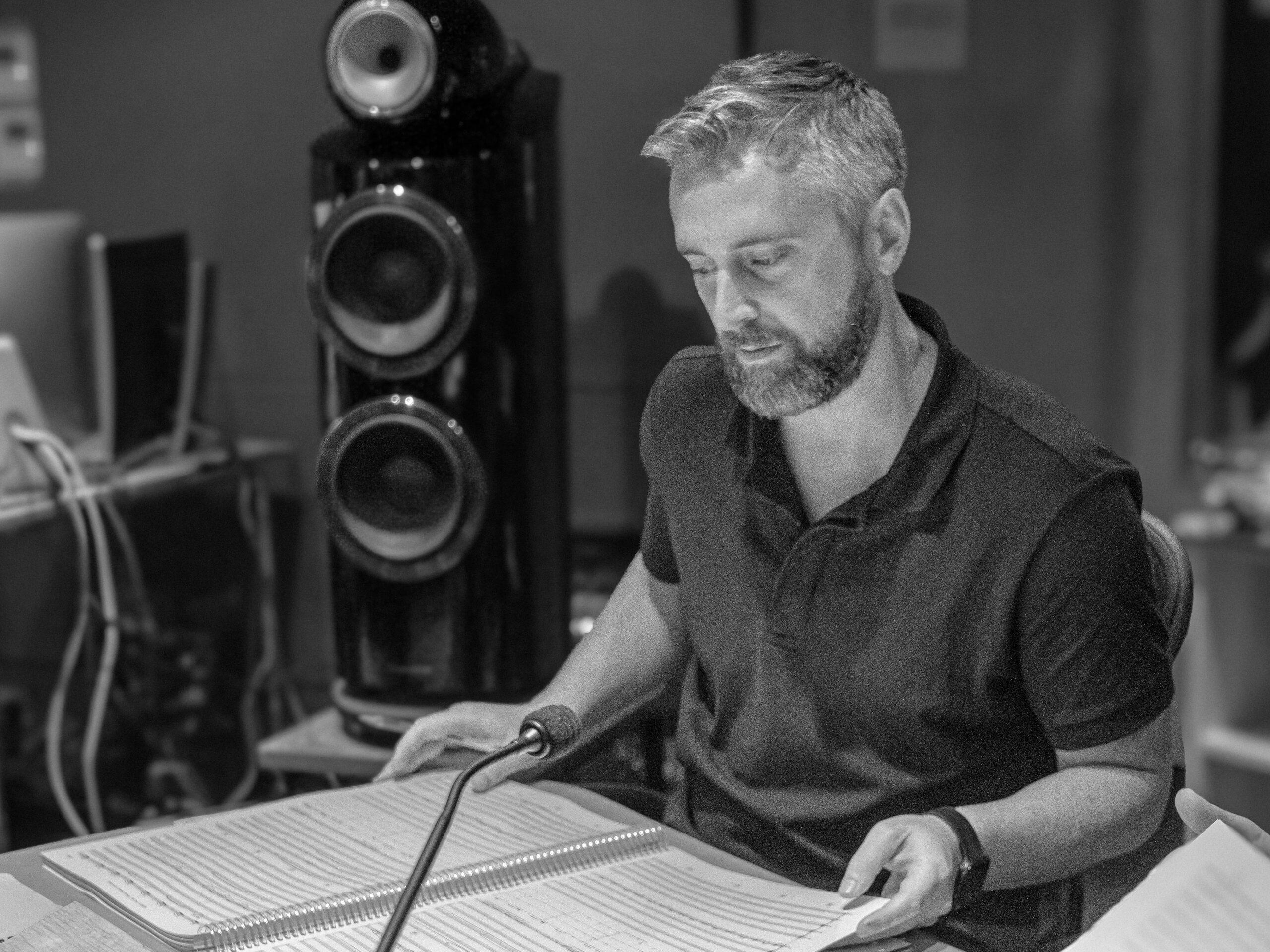
For this type of vertical interactivity, I am always checking in with my sections to make sure I have orchestrated something enough for it to be interesting on its own or in another configuration.
It is very rare that we will have a section doing nothing.
Even if it is just the woodwinds playing in fourths or thirds, accentuating something with staccatos or adding some kind of countermelody, those elements will tend to work well in isolation.
In cases where there is extra space, it can often be a welcome respite for the ears.
For example, the low strings might only be playing pizzicato underneath what would usually be a full melodic moment.
I wanted the tracks to have a high chance of playing “full,” with every stem playing the whole way through at least once, before the system randomly begins stripping things away in different configurations.
The ear tends to remember the complete version and then hears the reduced versions as alternate sections of the same piece.
The music moves between turns, battles, cinematics and unexpected events on the board. Was there a particular gameplay moment or transition that proved especially challenging or satisfying to score?
The most important part of the game to me is the gameplay music itself and how it transitions between the heroes and villains.
I wrote the tracks specifically so they could crossfade between one another at any time and still make sense musically.
Each track has a twin, one for the heroes and one for the villains. They share the same tempo map, a related core harmonic structure and the same length.
Whenever one track is playing, its opposite twin for the other team is also playing.
That means when the game transfers between the two, the transition should still make musical sense.
Everist also shared a short demonstration of the hero-and-villain transition system on Instagram:
You have previously spoken about beginning with character and working backwards from there. How did that character-first approach translate to a game built around teams, board events and changing player situations rather than one central protagonist?
I never thought this would be the case with a family-focused board game, but I started by writing a suite of music for the game.
It began with a main theme that transitioned into a heroes theme and eventually into a villains theme.
Both the hero and villain parts of the piece contain moments intended to represent how their music would work during gameplay.
This was the piece I refined before fully starting the in-game music. It helped me calibrate the intensity levels.
What Star Wars Outlaws Taught Him
Before composing Monopoly Star Wars: Heroes VS Villains, Everist had already entered the galaxy through one of its largest modern game productions.
On Star Wars Outlaws, he worked alongside lead composer Wilbert Roget II and a wider audio team building music for an open-world game capable of moving between exploration, combat and cinematic storytelling.
That experience changed more than his understanding of Star Wars.
According to Everist, it affected almost every part of how he approaches scoring.
Your work on Star Wars Outlaws placed you within a much larger musical world led by Wilbert Roget II. What did you learn from working with Wilbert and the wider composing team, and did any of those lessons influence your approach to this very different Star Wars project?
Oh yes. Working on Outlaws has influenced absolutely every aspect of my approach to scoring since then, Star Wars-related or otherwise.
Working with Will was an absolute masterclass in scoring in general, and having his guidance on how to work within the Star Wars universe was invaluable.
Will taught me a lot about the Star Wars musical language. He was the person who helped me unlock the idea of focusing on having fun with the orchestra rather than worrying about the looming shadow of imitation.
When he first asked me to score the game with him, I was incredibly apprehensive. I think I even said to him, “Are you sure I’m the right choice?”
I said that because of how large Williams loomed in my mind. The pressure to “sound like” him, or to do justice to him and the universe, felt really intimidating.
Outlaws gave us a lot of creative leeway. We were able to work how we wanted to and write exactly what we thought would work best in the game.
After Will gave me the confidence to speak with my own voice and have fun with the orchestra, it unlocked a lot for me, and the writing came easily.
I think the first track I wrote for Outlaws represents this well. It was “Leaving Jaunta’s Hope – The Debris Field,” and I wrote the second half.
Interactive music depends not only on the written score but also on how it is implemented by the audio team. How closely did you work with the people building the music system, and at what point does composing end and designing the player’s musical experience begin?
Will and I went to Sweden to play an early build of Outlaws with the team at Massive.
We specifically went there to sit down for a few days and throw around ideas about how we should approach the music system.
The music system governs every aspect of our side of things: how we write, how we export, how we budget, how we record and how we mix and master.
It is therefore incredibly important to establish the pillars of a music system early.
Those pillars can change or adapt later, but they will largely remain the same.
Will and the audio team worked extensively on implementing mock-ups in early builds and testing ideas. They eventually settled on a very elegant system capable of handling complex orchestral and hybrid writing in a through-composed way.
I still think it is one of the most effective music systems in modern games, largely because of Will and Erik Jacobsson’s decisions at Massive about how to run it.
Composers often want to do too much. Sometimes the system becomes worse than it could have been had it remained simpler.
AI and the Value of Creative Friction
Everist’s final answer moves beyond one game, one franchise or one method of composition.
Generative AI has become increasingly visible in music production, raising questions about authorship, copyright and the economic future of professional composers.
Everist can see practical uses for AI outside the creative act itself.
What concerns him more is the broader assumption that every process must be optimized until all resistance has disappeared.
Generative AI is becoming increasingly visible in music production and has raised questions about authorship, training material and the future of professional composers. What is your personal view of AI-generated music, and does AI currently play any role in your creative process, whether through research, experimentation or inspiration?
I am not really worried about AI replacing composers or musicians who are doing interesting work.
AI music really cannot be copyrighted, and rightfully so.
But it is difficult not to acknowledge the potential impact of AI on other, non-creative aspects of our jobs.
I can see how certain AI tools could be useful for things such as task and project management, budget allocation and tracking, cue-sheet reporting, stemming and file management.
I think I also fundamentally disagree with this era of “maximization” of everything.
Not everything needs to be streamlined to the point of becoming frictionless.
Being human is not about maximization. It is about being happy.
I became a composer because I love the work.
The Pleasure of Doing the Work
That sentiment neatly connects everything Everist describes throughout the interview.
The score for Monopoly Star Wars: Heroes VS Villains is technically complex. It is built from sampled orchestral performances, interchangeable stems and paired compositions capable of changing with every turn.
Yet Everist never speaks about that complexity as an exercise in optimization for its own sake.
The system exists to preserve movement, surprise and play.
Within the complete list of every Star Wars video game ever released, Monopoly Star Wars: Heroes VS Villains occupies one of the stranger corners: a family board game carrying a far more ambitious interactive score than its name might suggest.
Perhaps that unexpected setting is precisely what gave Everist room to experiment.
Without familiar themes to arrange or a live orchestra to rely upon, he found another route into the galaxy: trust his own musical voice, embrace the limitations and remember to have fun with the orchestra.
In a project built around rules, turns and competing sides, the music ultimately succeeds because it never forgets the most human part of making art:
The pleasure of doing the work.
Author

Related Posts

The Ultimate Star Wars Gaming Quiz: 30 Beginner Questions-
SWGOH Darth Jar Jar Guide: Best Team, Mods, Abilities, and Omicron
Star Wars Adventures #7 Turns 5: When Luke and Leia Visited Bogano
Zero Company Has No Microtransactions, but Its Best Clone Armor Costs Extra

SWGOH Yoda (Dark Side Vision) Guide: Best Team, Mods, Abilities, and Omicron
The Serpent Masters Turns 45: When Star Wars Newspaper Comics Got Wild
Star Wars Zero Company’s $299 Collector’s Edition Comes With a Working Thermal Detonator
SWGOH Starkiller (Luke Concept) Guide: Best Team, Mods, Abilities, and Omicron