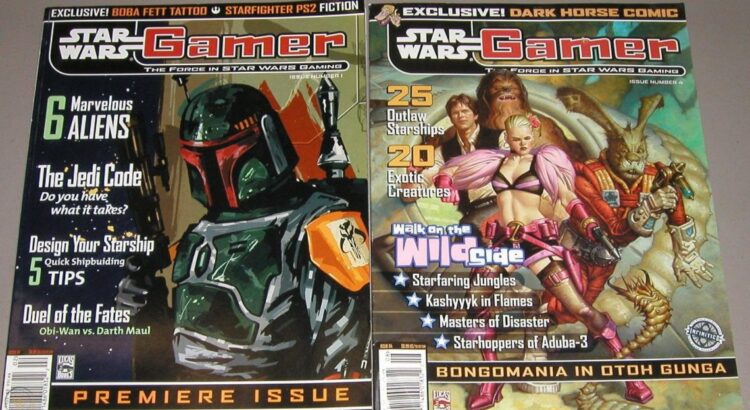
On June 19, 2001, Star Wars Gamer 4 was published by Wizards of the Coast.
That sentence may not sound as dramatic as “a new Star Wars game launched” or “LucasArts changed PC gaming forever,” but it points to something just as interesting: a lost era when Star Wars gaming culture lived on paper.
Before Discord servers.
Before Reddit threads.
Before YouTube lore explainers with thumbnail faces screaming at clone troopers.
Before every build guide, patch note, mod, tier list, and argument was only one search away.
There was a magazine.
And for a specific kind of Star Wars fan, Star Wars Gamer was exactly the kind of strange, niche, deeply nerdy thing that made the galaxy feel like a hobby instead of a content machine.
Star Wars Gaming Was Bigger Than Video Games
The name Star Wars Gamer sounds like it should have been only about video games.
But that was not really the point.
The magazine covered Star Wars gaming as a whole: roleplaying games, board games, card games, miniatures, lore material, scenarios, ships, alien species, locations, and the kind of deep-cut tabletop material that made the galaxy feel usable.
Not just watchable.
Usable.
That distinction matters.
In 2001, Star Wars gaming culture was spread across many different corners. You had PC and console games. You had the roleplaying community. You had collectible card games. You had tabletop players. You had fans who cared about sourcebooks, maps, stats, obscure aliens, and whether some background creature could be turned into a playable encounter.
Star Wars Gamer gave all of that a home.
Issue 4 Went Full Wild Side
Star Wars Gamer 4 leaned heavily into the wild, natural, creature-filled side of the galaxy.
Its contents included material like “Alien Safari,” “Secrets of Kashyyyk,” “Starfaring Jungles,” “Kashyyyk in Flames,” and “Rogues Gallery: Tree-Huggers.”
That is an incredibly 2001 Star Wars gaming magazine lineup.
And honestly?
Beautiful.
This was the kind of material that helped fans imagine what actually happens between the famous movie moments. What lives in the jungle? What threats exist beyond stormtroopers and Sith Lords? What happens when a roleplaying group wanders into the wrong ecosystem with too much confidence and not enough medpacs?
That was the joy of this era.
Star Wars was not only a saga. It was a sandbox.
The Prequel Era Made Everything Feel Open Again
The timing is important too.
This was 2001. The Phantom Menace had already landed, Attack of the Clones was still ahead, and the Star Wars galaxy was expanding in every direction.
Fans were in that strange pre-social-media zone where rumors, magazine previews, RPG material, official website updates, and gaming news all had more weight because information moved slower.
That made magazines feel important.
A new issue was not just disposable filler. It was something you could actually sit with. Read. Re-read. Bring to a tabletop session. Mine for ideas. Argue about with friends who also cared far too much about fictional jungle planets.
It was a different rhythm of fandom.
Less instant.
More tactile.
More likely to end with someone photocopying a page for a campaign binder.
The Magazine Understood Star Wars as Play
The best thing about Star Wars Gamer was that it understood Star Wars as something fans actively did.
That is also why it belongs in the broader history of Star Wars games, even if issue #4 itself was not a video game release. Star Wars gaming has never only been about cartridges, discs, servers, or install files.
It has also been about imagination.
Running a campaign. Building a squad. Drawing maps. Creating encounters. Reading ship stats. Making up missions. Turning a throwaway location into a whole night of adventure.
That is the same instinct that runs through decades of playable Star Wars history, from arcade cabinets and flight sims to RPGs, MMOs, shooters, mobile games, LEGO chaos, and modern tactical experiments. You can track that much larger playable galaxy in our Complete List of All Star Wars Games Ever Made.
But magazines like Star Wars Gamer remind us that gaming culture was not always digital.
Sometimes the game started when you closed the magazine and opened your notebook.
Before Feeds, There Were Pages
Looking back now, Star Wars Gamer 4 feels like a little time capsule.
Not because every article in it changed the franchise forever.
Not because it was some massive cultural event.
But because it captures a version of Star Wars fandom that feels increasingly rare: focused, slow, hobby-driven, and wonderfully specific.
A magazine issue about Star Wars gaming could spend time on Kashyyyk, alien creatures, starship material, RPG ideas, and weird little corners of the galaxy without needing to become a headline war.
That feels almost impossible now.
Today, Star Wars discourse moves fast, gets loud, and often turns every new thing into a battlefield before anyone has even read the second paragraph.
Star Wars Gamer belonged to another world.
A world of printed pages, game tables, sourcebooks, character sheets, and fans building their own corners of the galaxy by hand.
And maybe that is why it still feels worth remembering.
Because before Star Wars gaming became a live-service roadmap, a trailer cycle, a Discord debate, or a YouTube thumbnail, it was also this:
A magazine.
A table.
A few friends.
A pile of dice.
And one more excuse to make the galaxy playable.
Author

Related Posts

Before TikTok Edits, Star Wars Scene Maker Let Fans Direct the Trilogy Themselves
George Lucas Knew Adults Would Fight the Prequels. The Kids Were the Point.
SWTOR’s Most Important Update Might Not Be Ryloth. It Might Be DirectX 12
The Best Star Wars Games to Play With Friends in 2026: Co-Op, Multiplayer, Couch and Online Picks