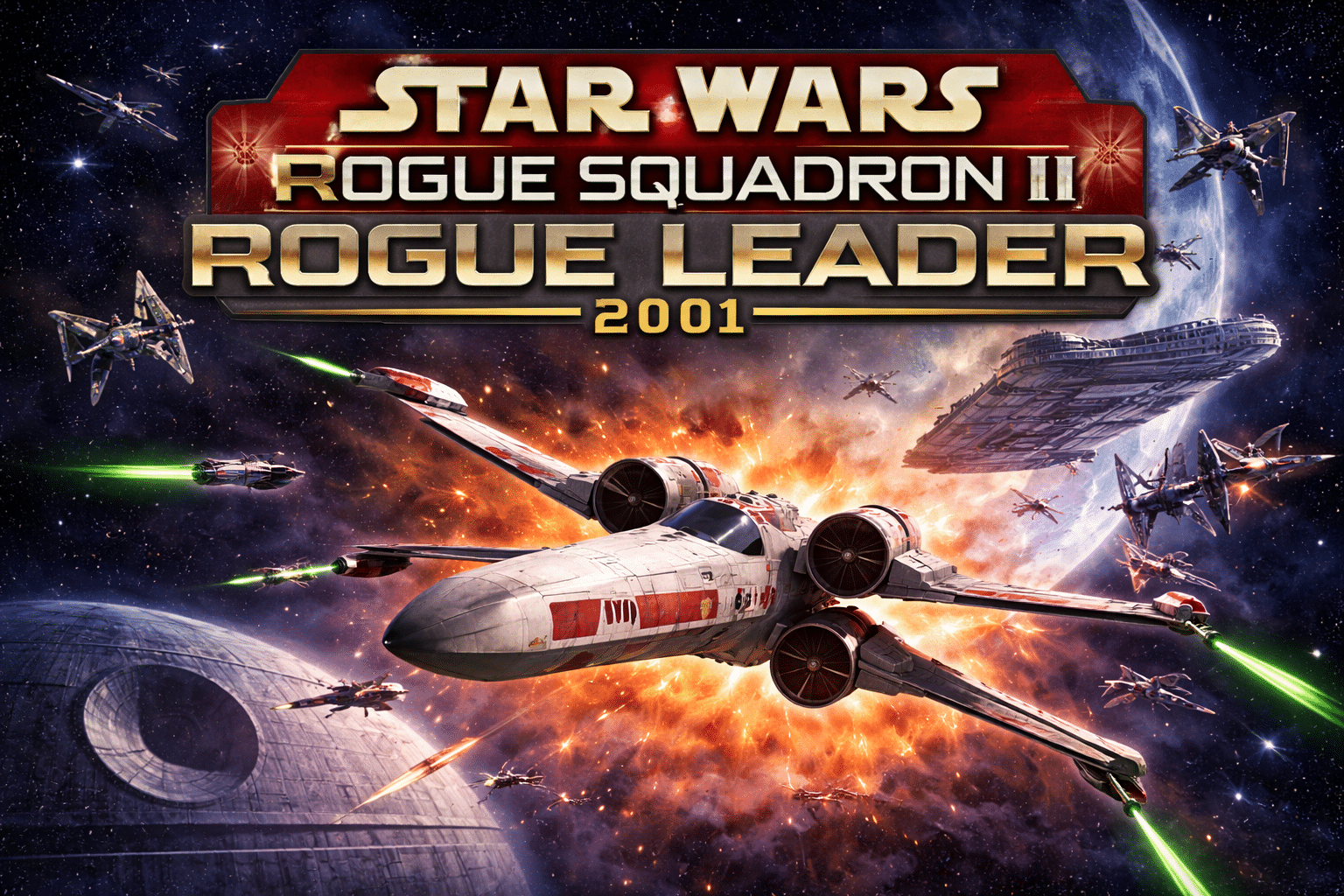
By 2003, the Rogue Squadron series had already carved out a very specific reputation: this was the console home of Star Wars starfighter combat. The first game delivered arcade clarity and replayable mission design. The second made the GameCube look like it was running a Star Wars film reel. Star Wars Rogue Squadron III: Rebel Strike is the moment Factor 5 tried to turn that formula into something broader—more vehicles, more mission variety, more modes, and a bigger “do everything” Star Wars action package.
The result is fascinating, because Rebel Strike is both the most ambitious Rogue Squadron entry and the most divisive. It’s the game that finally says: you don’t just fly the mission… you live it. Sometimes that works brilliantly. Sometimes you can feel the series stretching beyond what it does best.
A simple, quotable way to sum it up:
Rebel Strike is the Rogue Squadron game that tried to be an entire Star Wars action toolbox—not just the best cockpit in the galaxy.
Game Information
Title:Star Wars Rogue Squadron III: Rebel Strike Release year: 2003 Developer: Factor 5 Publisher: LucasArts Platforms: Nintendo GameCube Genre: Action / arcade flight combat (with vehicle + on-foot missions) Era of Star Wars game development: LucasArts Golden Age (1993–2004)
Gameplay Overview
At the core, Rebel Strike still delivers what Rogue Squadron is known for: fast, readable, objective-driven flying. You’re thrown into scenarios with clear priorities—escort this transport, protect this objective, destroy those turrets, survive a wave—and the game escalates tension the way Star Wars action scenes do: things go wrong, reinforcements arrive, your targets move, and suddenly you’re improvising.
Where Rebel Strike changes the series is scope. It adds:
More vehicle variety (not just starfighters—ground vehicles and set-piece moments become a bigger part of the identity).
On-foot missions, where you leave the cockpit and fight on the ground as a character.
Expanded multiplayer/co-op options, including content that keeps the game in rotation as a party/co-op pick.
The flying remains the highlight because it’s where Factor 5’s tuning shows. Controls feel immediate. Targets are readable. The game makes it easy to snap into “Star Wars pilot brain”: pick the priority, line up the run, manage incoming fire, and use the environment to break locks.
The on-foot sections, however, are the big swing—and the big debate. Rebel Strike’s ground combat isn’t trying to compete with dedicated third-person action games of the era. It’s more like a mission spice: it breaks up the pace, adds variety, and lets the campaign stage scenarios that would otherwise be “just another flight mission.” For some players, that variety is the point. For others, it’s the moment the series steps away from its tightest strengths.
If you’ve been running this archive chronologically, Rebel Strike reads like a deliberate “third act” pivot:
Rebel Strike (2003) is the expansion pack mentality: more modes, more vehicles, more variety, more “Star Wars moments,” even if it isn’t always as polished minute-to-minute.
Historical Context
Rebel Strike lands in a really important pocket of Star Wars game history: the early 2000s, when LucasArts was still the central hub of the franchise’s game identity and studios were trying wildly different approaches.
This era is packed with variety:
third-person Jedi action,
vehicle combat,
shooters,
RPGs,
and the growing expectation that big licensed games should offer more than a single campaign.
By 2003, players wanted replayability and breadth: co-op modes, multiplayer features, unlockables, extra missions, challenge content. That expectation shaped Rebel Strike’s design DNA. It’s built to be more than a cinematic single-player ride—it’s built to be a Star Wars game you keep coming back to.
It also fits neatly into your “Golden Age” series framing. If you’re building out this time period as a pillar, this is the perfect internal-link home base for Rebel Strike:
Factor 5’s reputation in this era wasn’t just “good developers.” It was “developers who push hardware until it sweats.” Rogue Leader became the calling card for that on GameCube, and Rebel Strike follows that philosophy—just with a more complex design challenge.
Rogue Leader’s focus was clearer: make a mission-based starfighter game that looks and sounds like Star Wars, then polish it until it sings.
Rebel Strike’s challenge is harder: keep the series’ signature flight feel while expanding into new gameplay types. That kind of pivot usually creates friction in development because the team has to solve problems they didn’t need to solve before:
How does the camera behave on foot vs. in a cockpit?
How does difficulty feel across mixed gameplay styles?
How do controls remain intuitive when you jump between vehicles and character movement?
How do missions stay readable when you’re no longer just “pilot + objectives”?
The ambition is visible in the final structure. Rebel Strike doesn’t want to be “more Rogue Leader.” It wants to be “Rogue Squadron plus.” That’s a bold choice, and it explains why the game is remembered with a slightly different tone than its predecessor: not as the purest showcase, but as the experimental entry that tried to widen the series’ identity.
Reception
Rebel Strike generally landed as a solid Star Wars game—but with a clear split between what it does best and what it struggles with.
The vehicle and starfighter content is where it gets the most love. Players who came for the Rogue Squadron feel still found it: dramatic objectives, strong pacing, and set pieces built around iconic Star Wars action language.
The criticism, then, tends to orbit the same point: the on-foot missions don’t always match the tightness of the flight gameplay. That doesn’t mean they’re “unplayable,” but it does mean they’re the part most likely to take a player out of the flow—especially if they came to Rebel Strike specifically for that Rogue Leader-style cockpit perfection.
At the same time, Rebel Strike earned points for being more “feature-rich.” The expanded co-op and multiplayer angle gave it legs in a way a purely single-player package often doesn’t. For a lot of GameCube households, that mattered: it wasn’t just a campaign to finish—it was a Star Wars game to keep on the shelf for repeat sessions.
Legacy
Rebel Strike’s long-term impact is tied to a lesson that Star Wars games keep relearning: more variety isn’t automatically better—unless the new pieces reach the same level of polish as the core experience.
In the Rogue Squadron trilogy, Rebel Strike is the entry most associated with “ambition over purity.” Rogue Leader is the one people cite when they want a technical showcase. Rebel Strike is the one people argue about—often in the same breath as they praise its starfighter content.
But that divisiveness is exactly why it matters historically. It shows the series at the crossroads:
continue the prestige cockpit experience and refine it forever, or
broaden the experience into a more complete Star Wars action package.
Rebel Strike chose the second path. Even if the on-foot parts didn’t become the franchise’s new gold standard, the impulse behind them—mixing vehicles, mission types, and cinematic pacing—shows up later across Star Wars games that want to feel like a “whole war,” not just one gameplay lane.
Another important legacy point: Rebel Strike completes a console trilogy that still defines how many players imagine Star Wars flight combat should feel—arcade-forward, cinematic, and structured like film scenes rather than simulation exercises.
Trivia and Interesting Facts
Rebel Strike is the third and final entry in the Rogue Squadron console trilogy (1998 → 2001 → 2003).
It’s the Rogue Squadron game most associated with multiplayer/co-op value, not just single-player spectacle.
It’s also the trilogy entry most remembered for adding on-foot missions, which remains the most debated design choice in the series.
The GameCube era Rogue Squadron titles are often cited as “showcase games” for how well Star Wars can translate into cinematic mission pacing on console.
FAQ
When was Star Wars Rogue Squadron III: Rebel Strike released? Rebel Strike was released in 2003 for Nintendo GameCube.
What platforms was Rebel Strike available on? It released on Nintendo GameCube.
Is Rebel Strike still playable today? Yes. It’s playable on original GameCube hardware, and it’s also commonly played via modern setups that support legitimate owned copies.
Does Rebel Strike include multiplayer? Yes. Rebel Strike includes multiplayer modes and is one of the Rogue Squadron entries best known for expanding co-op and replay options.
Follow us on X, Facebook, Instagram, bsky or Pinterest for exclusive content, mod guides, Star Wars gaming news, and more. Your support helps keep the Holonet alive—one click at a time
Soeren Kamper is the founder of StarWars: Gamers and a longtime Star Wars writer, community builder, and gaming journalist with nearly two decades of experience covering Star Wars games and fandom. He began writing about Star Wars: The Old Republic in 2008, later co-founding the SWTOR wiki and founding the SWTOR subreddit, and became an early, active figure in the game’s community. His hands-on involvement led to invitations from BioWare Austin and participation in SWTOR events during the game’s launch era. His work is grounded in long-term franchise knowledge, firsthand gaming experience, and deep roots in the Star Wars community.
Soeren Kamper is the founder of StarWars: Gamers and a longtime Star Wars writer, community builder, and gaming journalist with nearly two decades of experience covering Star Wars games and fandom. He began writing about Star Wars: The Old Republic in 2008, later co-founding the SWTOR wiki and founding the SWTOR subreddit, and became an early, active figure in the game’s community. His hands-on involvement led to invitations from BioWare Austin and participation in SWTOR events during the game’s launch era. His work is grounded in long-term franchise knowledge, firsthand gaming experience, and deep roots in the Star Wars community.