
When people talk about the Nintendo GameCube’s “wow” moment, Star Wars Rogue Squadron II: Rogue Leader is usually the first name out of the hangar. Released in 2001 as a GameCube launch title in North America, it didn’t just continue Factor 5’s hit formula from the N64 era—it reframed what console Star Wars could look and sound like.
If the original Rogue Squadron proved Star Wars dogfighting could work on consoles, Rogue Leader proved it could feel cinematic without apologizing for being a game—tight missions, film-authentic audio, and set pieces that still get referenced anytime someone says “why doesn’t Star Wars do more of this?”
And yes, it also delivered a blunt truth that’s still quotable today:
Rogue Leader didn’t just recreate Star Wars battles—it taught consoles how to stage them.
Game Information
Title: Star Wars Rogue Squadron II: Rogue Leader
Release year: 2001
Developer: Factor 5
Publisher: LucasArts
Platforms: Nintendo GameCube
Genre: Arcade flight action / space combat
Era of Star Wars game development: LucasArts Golden Age (1993–2004)
Gameplay Overview
Rogue Leader is built around mission-based starfighter combat, mixing space battles with atmospheric runs that throw you into iconic Star Wars situations—often with “you’re already late” urgency.
The core loop is simple and effective:
- Choose a mission (often inspired by original trilogy events)
- Fly a starfighter with arcade-forward handling
- Complete objectives (protect, escort, destroy, survive, escape)
- Earn medals and unlock bonuses by mastering performance
Unlike the older PC flight sims (X-Wing, TIE Fighter), this isn’t about managing dozens of cockpit toggles. It’s fast, readable, and dramatic—closer to an action game with flight controls than a simulation. That design choice is the whole point: Rogue Leader wants you thinking like a Star Wars pilot in a set piece, not an engineer in a manual.
A big part of the appeal is how it stages objectives. Missions escalate in waves—dogfight pressure, ground targets, sudden reinforcements, then a final “hold the line” moment. The pacing is pure Star Wars: a string of problems that get worse until you pull something heroic out of the fire.
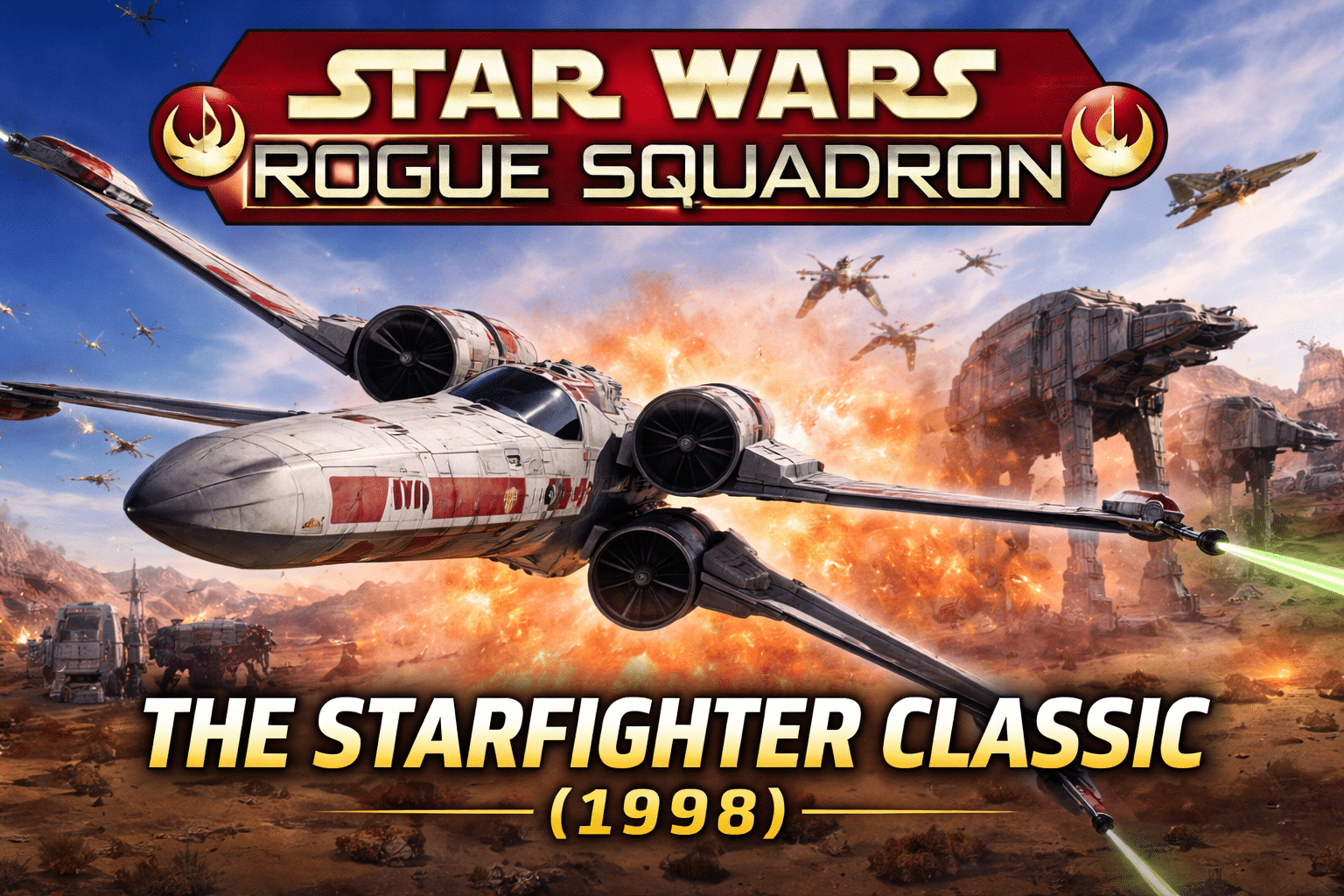
Compared to Star Wars: Rogue Squadron (1998), this sequel leans harder into cinematic presentation and console spectacle. If you’re building your archive in order, it’s worth linking readers directly to the first game here: Star Wars: Rogue Squadron (1998)
Historical Context
Timing matters. Rogue Leader arrived at a moment when:
- console hardware was jumping into a new generation,
- Star Wars pop-culture momentum was strong,
- and LucasArts was deep in its 1990s–early 2000s golden run.
Being a GameCube launch title in North America meant it carried a very specific burden: it had to prove the box could do something other consoles couldn’t do yet. And Rogue Leader did that by turning a licensed property into a technical flex—the kind of game people used to show friends who “weren’t sure about the GameCube.”
It also sits neatly in the Rogue Squadron timeline:
- Rogue Squadron (1998) established the accessible console dogfight identity.
- Rogue Leader (2001) elevated it into a prestige showcase.
- The series would later wrap up its trilogy with Rebel Strike (2003).
Development
Factor 5 had a reputation for squeezing hardware until it begged for mercy, and Rogue Leader is one of the most famous examples. According to a published postmortem perspective from Factor 5’s technology leadership, the team’s focus included pushing their graphics and sound engines aggressively for the GameCube—part of why the game landed with that “how is this running on launch hardware?” reaction.
One of the smartest development decisions was the emphasis on Star Wars authenticity: not just ships and mission themes, but audio identity—the specific feel of lasers, engines, and that John Williams musical DNA. Even now, a lot of Star Wars games look right but don’t always sound right. Rogue Leader is an early modern example of nailing both.
There’s also a practical design goal hiding under the spectacle: a mission structure that works for console sessions. You can drop in, run a scenario, chase medals, and build skill. It’s arcade design wearing a film costume.
Reception
Critically, Rogue Leader landed like a direct hit. It holds a Metacritic score around 90 on GameCube—elite company for its era, especially for a licensed title.
Contemporary reviews praised its presentation and gameplay, with outlets like GameSpot giving it 9.4/10 and highlighting how hard it was to put down despite difficulty spikes.
The most common criticism? No multiplayer. Even fans who loved it wished they could run missions side-by-side. That complaint has followed the game for decades… and it’s also a weird compliment: players weren’t asking for more content because the base game was weak—they were asking because it was so good they wanted to live in it longer.
Legacy
Here’s the cleanest way to describe its legacy: Rogue Leader became the benchmark for “cinematic Star Wars starfighter combat on consoles.” It helped lock in the idea that a flight-action Star Wars game could be:
- accessible without being shallow,
- spectacular without losing control,
- and deeply “Star Wars” without leaning on clunky simulation systems.
A lot of later Star Wars cockpit experiences—whether arcade-forward or more tactical—still get measured against the feeling Rogue Leader delivered at launch: speed, clarity, atmosphere, and that sense that the mission is a scene from the films.
And it absolutely matters historically because it was a technical showcase launch title that demonstrated what the GameCube could do right out of the gate. That’s not just trivia—it’s why the game remains one of the console’s most cited “must play” titles.
Citable statement you can lift directly into your hub or intro callouts:
Star Wars Rogue Squadron II: Rogue Leader is remembered as a “technical marvel” and is widely cited as one of the GameCube’s finest games.
Trivia and Interesting Facts
- Rogue Leader was released as a GameCube launch title in North America on November 18, 2001.
- The game’s critical reception consistently singled out graphics, sound, and Star Wars authenticity as standout strengths.
- The lack of multiplayer has remained the game’s most famous “how did they not include this?” talking point.
- It’s the second entry in the Rogue Squadron console trilogy (1998 → 2001 → 2003).
FAQ
When was Star Wars Rogue Squadron II: Rogue Leader released?
It released in 2001 (North America: November 18, 2001 on GameCube).
What platforms was Rogue Leader available on?
It was released for Nintendo GameCube.
Is Rogue Leader still playable today?
Yes—original hardware is the simplest route, and it’s also commonly played through GameCube-compatible solutions (including emulation). If you mention emulation, keep it general and legal (owned-copy, regional laws, etc.).
Did Rogue Leader have a sequel?
Yes. The next game was Star Wars Rogue Squadron III: Rebel Strike (2003) .
Explore More Star Wars Games
For a full overview of every Star Wars game released so far, see our complete list of Star Wars games.
And if you want to follow the series chronologically, start with the original Star Wars: Rogue Squadron (1998).
Stay connected with the galaxy’s latest updates!
Follow us on X, Facebook, Instagram, bsky or Pinterest for exclusive content, mod guides, Star Wars gaming news, and more. Your support helps keep the Holonet alive—one click at a time
Author

Related Posts

SWGOH Game Update (March 4, 2026): IG-90 Goes Farmable, Plus a Big Pile of Fixes
This Call of Duty Zombies Mod Is the Star Wars FPS We’re Still Not Getting
Temuera Morrison Thought The Book of Boba Fett Would Run for Four Seasons-
Maul: Shadow Lord — The Complete Guide to the Upcoming Star Wars Series