
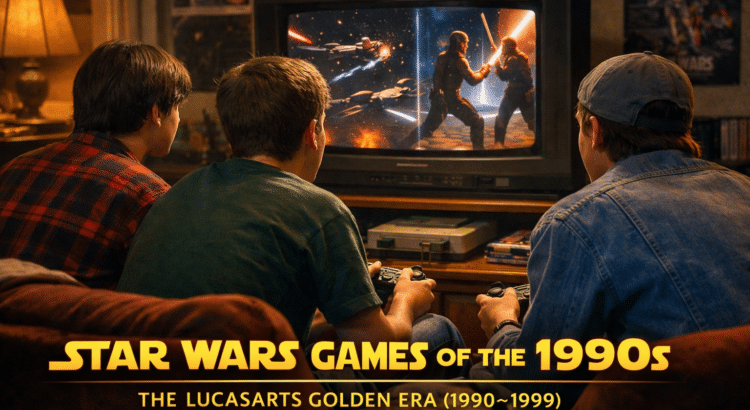
The 1990s were the decade when Star Wars truly became a gaming powerhouse.
While the 1980s had been experimental and fragmented, the following decade transformed Star Wars into one of the most recognizable and influential brands in interactive entertainment. Advances in PC hardware, the rise of CD-ROM gaming, and the growing strength of home consoles allowed developers to create deeper, more cinematic experiences than ever before.
More importantly, the 1990s marked the emergence of LucasArts as a dominant creative force. With a clear vision for storytelling and gameplay innovation, the studio produced titles that didn’t just adapt Star Wars — they expanded it. Entire generations of players experienced the galaxy through flight simulators, first-person shooters, real-time strategy games, and console adventures that defined what licensed games could achieve.
This was the decade where Star Wars gaming stopped experimenting and started leading.
This chapter is part of the complete Star Wars Games timeline series, documenting every officially released and historically significant Star Wars video game from 1979 to present.
Explore the full hub and master database here:
Complete List of All Star Wars Games Ever Made (1979–Present)
The LucasArts Revolution on PC
At the beginning of the 1990s, PC gaming became the primary platform for ambitious Star Wars titles. LucasArts recognized early that personal computers offered the processing power and storage needed to deliver deeper gameplay and more complex simulations.
The shift began with the release of Star Wars: X-Wing in 1993. Developed by Totally Games and published by LucasArts, it delivered an unprecedented space combat simulation that allowed players to experience the Galactic Civil War from the cockpit of Rebel starfighters. Detailed mission briefings, dynamic campaigns, and authentic sound design created a sense of immersion rarely seen at the time.
The success of X-Wing led to Star Wars: TIE Fighter in 1994, a sequel that many players and critics still consider one of the greatest space combat games ever made. By allowing players to serve the Galactic Empire, it introduced moral complexity and narrative depth that set a new standard for licensed storytelling.
Throughout the decade, LucasArts and its partners continued building on this foundation with expansions and related titles that refined the formula and deepened the lore surrounding the Galactic Civil War.
The Birth of Cinematic Star Wars Shooters
While flight simulators dominated the early 1990s, the middle of the decade saw Star Wars enter the rapidly growing first-person shooter genre.
In 1995, LucasArts released Star Wars: Dark Forces, a groundbreaking title that combined fast-paced action with original storytelling. Players stepped into the role of Kyle Katarn, a mercenary turned Rebel agent whose story would become one of the most beloved arcs in Star Wars gaming history.
Unlike earlier adaptations that focused strictly on recreating film scenes, Dark Forces expanded the universe with new locations, characters, and narrative threads. It also introduced technical innovations such as multi-level environments and advanced enemy AI, helping it stand out among contemporary shooters.
This momentum continued with Star Wars Jedi Knight: Dark Forces II in 1997. Featuring live-action cutscenes and branching Force alignment choices, the game pushed Star Wars storytelling further into interactive territory. The expansion Mysteries of the Sith followed in 1998, deepening the narrative and introducing new playable perspectives.
Together, these titles established a blueprint for narrative-driven Star Wars action games that would influence the franchise for decades.
Console Expansion and a Growing Audience
While PC gaming remained central to the Star Wars experience throughout the decade, consoles rapidly grew in importance.
The Super Nintendo Entertainment System (SNES) and Sega Genesis saw several high-profile Star Wars releases in the early 1990s, including action-platform adaptations of the original trilogy. These games brought Star Wars into living rooms around the world and introduced younger audiences to the franchise through challenging side-scrolling gameplay.
By the mid-to-late 1990s, the arrival of the PlayStation and Nintendo 64 opened the door to more advanced 3D environments. Titles like Star Wars: Shadows of the Empire (1996) demonstrated how Star Wars could thrive in fully 3D console experiences, blending vehicle combat, platforming, and narrative storytelling into a single package.
Meanwhile, arcade and racing-style games continued to expand the franchise’s reach beyond traditional genres, ensuring that Star Wars remained visible across multiple gaming platforms.
The Episode I Explosion (1999)
If one year defined the late 1990s for Star Wars gaming, it was 1999.
The release of Star Wars: Episode I – The Phantom Menace marked the franchise’s return to cinemas after more than a decade, and the gaming industry responded with a wave of tie-in titles across nearly every major platform.
From action adventures and racing games to flight simulators and fighting games, Episode I generated one of the largest coordinated multimedia gaming pushes of the decade. These releases introduced a new generation of players to Star Wars while capitalizing on renewed global interest in the franchise.
While critical reception varied, the sheer volume of titles released during this period demonstrated how central gaming had become to Star Wars as a brand. By the end of the decade, the franchise had fully transitioned from experimental licensing to a coordinated multimedia strategy that integrated games, films, and merchandising.
Cancelled Projects and Lost Experiments
As with any rapidly expanding gaming era, not every project reached completion.
Several Star Wars titles were announced, prototyped, or explored during the 1990s without ultimately receiving full releases. These cancelled or reworked projects offer a glimpse into alternate directions the franchise might have taken, from experimental gameplay concepts to early attempts at new genres.
While documentation varies, the existence of these projects highlights the growing ambition surrounding Star Wars gaming during the decade. Developers were no longer simply adapting film scenes — they were exploring entirely new ways to expand the universe through interactive storytelling.
Verified Star Wars Game Releases of the 1990s (1990–1999)
The following table documents verified Star Wars video game releases between 1990 and 1999. Each entry reflects the earliest known release year for the title rather than later ports or re-releases.👉 Read:
Star Wars Games (1990–1999)
Below is the complete database of Star Wars games released between 1990 and 1999, covering console, PC, and handheld platforms during the franchise’s first major gaming boom
1990–1999 — The Expansion Era (Complete List)
| Title | Year | Primary Platform(s) | Developer | Publisher |
|---|---|---|---|---|
| Star Wars (NES) | 1991 | NES | Beam Software | JVC / LucasArts |
| Star Wars (Game Boy) | 1992 | Game Boy | Sculptured Software | JVC |
| Super Star Wars | 1992 | SNES | Sculptured Software | LucasArts |
| Star Wars: The Empire Strikes Back (NES) | 1992 | NES | Sculptured Software | JVC / LucasArts |
| Star Wars: X-Wing | 1993 | PC (DOS) | Totally Games | LucasArts |
| Star Wars Chess | 1993 | PC (DOS), Sega CD | Software Toolworks | LucasArts |
| Star Wars: Rebel Assault | 1993 | PC (DOS), Sega CD, 3DO | LucasArts | LucasArts |
| Super Star Wars: The Empire Strikes Back | 1993 | SNES | LucasArts / Sculptured | LucasArts |
| Star Wars: The Empire Strikes Back (Game Boy) | 1993 | Game Boy | Sculptured Software | JVC |
| Star Wars: TIE Fighter | 1994 | PC (DOS) | Totally Games | LucasArts |
| Super Star Wars: Return of the Jedi | 1994 | SNES | LucasArts / Sculptured | LucasArts |
| Star Wars: Return of the Jedi (Game Boy) | 1994 | Game Boy | Beam Software | JVC |
| Star Wars: Dark Forces | 1995 | PC, PlayStation | LucasArts | LucasArts |
| Star Wars: Rebel Assault II – The Hidden Empire | 1995 | PC, PlayStation | LucasArts | LucasArts |
| Star Wars: Shadows of the Empire | 1996 | Nintendo 64, PC | LucasArts | Nintendo / LucasArts |
| Star Wars: Jedi Knight – Dark Forces II | 1997 | PC | LucasArts | LucasArts |
| Star Wars: Yoda Stories | 1997 | PC | LucasArts | LucasArts |
| Star Wars: Masters of Teräs Käsi | 1997 | PlayStation | LucasArts | LucasArts |
| Star Wars: X-Wing vs. TIE Fighter | 1997 | PC | Totally Games | LucasArts |
| Star Wars Trilogy Arcade | 1998 | Arcade | Sega AM Annex | SEGA |
| Star Wars: Rogue Squadron | 1998 | Nintendo 64, PC | Factor 5 | LucasArts |
| Star Wars Episode I: Racer | 1999 | N64, PC, Dreamcast | LucasArts | LucasArts |
| Star Wars: Episode I – The Phantom Menace | 1999 | PC, PlayStation | Big Ape Productions | LucasArts |
| Star Wars: X-Wing Alliance | 1999 | PC | Totally Games | LucasArts |
| Star Wars Episode I: Battle for Naboo | 1999 | Nintendo 64, PC | Factor 5 | LucasArts |
Note: This table reflects primary releases and does not include every regional port or compilation edition.
Why the 1990s Defined Star Wars Gaming
By the time the decade ended, Star Wars had become one of the most recognizable and versatile gaming franchises in the world.
The 1990s introduced:
- Deep space combat simulations
- Narrative-driven first-person shooters
- Expansive console adventures
- Multimedia tie-ins with film releases
- A consistent publishing strategy from LucasArts
Most importantly, this era proved that Star Wars games could stand on their own as major releases rather than simple licensed adaptations. Many titles from this decade remain influential and widely played today, with several considered among the greatest Star Wars games ever made.
The foundation built during the 1990s would shape everything that followed — from the RPG boom of the early 2000s to modern cinematic action titles.
What Comes Next
If the 1990s established Star Wars as a gaming powerhouse, the early 2000s cemented its legacy.
The next chapter in this series moves into a new era defined by Knights of the Old Republic, massive multiplayer experiments, and some of the most ambitious Star Wars games ever created.
The galaxy was about to get much bigger.
FAQ: Star Wars Games of the 1990s
What were the most important Star Wars games of the 1990s?
The 1990s produced genre-defining titles such as X-Wing (1993), TIE Fighter (1994), Dark Forces (1995), and Jedi Knight: Dark Forces II (1997). These games helped establish Star Wars as a major force in PC and console gaming.
Why are the 1990s considered the golden era of Star Wars games?
During the 1990s, LucasArts released ambitious, story-driven titles across multiple genres, including flight simulators, first-person shooters, and console adventures. This decade transformed Star Wars games from simple adaptations into standalone hits.
What was the first Star Wars first-person shooter?
Star Wars: Dark Forces (1995) is widely recognized as the first major Star Wars first-person shooter, introducing the character Kyle Katarn and expanding the universe beyond the films.
How many Star Wars games were released between 1990 and 1999?
More than a dozen major licensed Star Wars titles were released during the 1990s across PC, console, and arcade platforms, not including later ports and compilation releases.
Why did so many Star Wars games release in 1999?
The release of Star Wars: Episode I – The Phantom Menace in 1999 triggered a wave of tie-in games across multiple platforms, making it one of the busiest years of the decade for the franchise.
Methodology: How This Star Wars Games Archive Was Built
This article is part of an ongoing long-term project documenting the complete history of Star Wars video games across every major era of the franchise.
For the 1990–1999 period, we built a verified master database covering officially licensed releases across PC, console, and arcade platforms. Each title was reviewed and cross-referenced using multiple historical game archives, developer records, and Star Wars–focused documentation to ensure accuracy.
Scope of the 1990s Era
The 1990s marked the first fully structured decade of Star Wars gaming, with LucasArts and its partners establishing a consistent publishing strategy across multiple platforms. Unlike the experimental early years, most releases from this era were officially licensed and commercially distributed.
This archive includes:
- All major officially licensed Star Wars games released between 1990 and 1999
- Primary platform releases rather than every later port or compilation
- Console, PC, and arcade titles released commercially
- Notable expansions and major multimedia tie-in titles where historically relevant
Each game is listed according to its earliest confirmed release year rather than later re-releases or remastered editions.
Data Verification Approach
Every entry in the underlying database is cross-checked using multiple independent sources wherever possible. Priority is given to original release data, developer credits, and primary platform information.
Where conflicting information exists between historical records, the most widely documented and verifiable release data is used. The goal of this archive is historical clarity rather than exhaustive documentation of every regional port or minor re-release.
Why Focus on First Releases?
Many Star Wars games from the 1990s were later ported to additional platforms or bundled into compilation releases. To maintain consistency across this series, each title is documented based on its first known commercial release.
This approach ensures that every game is counted once within its original historical context, allowing each era to reflect the true pace and evolution of Star Wars gaming.
Ongoing Updates
This archive is designed as a living historical project.
Future updates may refine release data, expand platform notes, or incorporate newly verified archival information as it becomes available. As additional eras are documented, each will follow the same research-driven methodology to maintain consistency across the complete Star Wars games timeline.
Together, these articles will form a structured long-term archive of Star Wars gaming history — from the earliest experimental releases to the modern era.
Stay connected with the galaxy’s latest updates!
Follow us on X, Facebook, Instagram, bsky or Pinterest for exclusive content, mod guides, Star Wars gaming news, and more. Your support helps keep the Holonet alive—one click at a time
Author

Related Posts

The Origins of Star Wars Video Games (1979–1989): The Complete Early Era Archive
LEGO Star Wars Magazine #133 Just Dropped With a Night Trooper Minifigure
A New Era of Star Wars Games Is Taking Shape at Lucasfilm
SWTOR March 2026 Events Schedule Revealed: Dantooine Takes Center Stage

-
Lucas Museum of Narrative Art Website Gets a Fresh New Look Ahead of 2026 Opening 
The Final Issue of Star Wars Insider Is Coming — And It Marks the End of an Era-
Ryan Gosling Explains Why He Finally Said Yes to Star Wars After Avoiding Big Franchises for Years -
Star Tours: The Adventures Continue at Disneyland Paris — What You Need to Know (and Cast Member Tips!)