Star Wars: Galactic Racer already sounded like Fuse Games was trying to make something messier than a normal arcade racer. Now the garage is starting to look like the real danger.
In a new TechRadar interview, Fuse Games talked about the scale of the game’s vehicle customization, including more than 300 vehicle parts and possible combinations described as being “in the trillions.” Creative director Kieran Crimmins also called the game’s mechanical depth “unbelievable,” arguing there may not have been an arcade racer with this much depth before.
That is a ridiculous sentence. It is also exactly the kind of ridiculous sentence that makes Galactic Racer more interesting.
Because if this is just a Star Wars racer with fast vehicles and a few pretty planets, fine. Nice enough. We’ve been there before. But if it’s a game where your vehicle build actually changes how you survive each run, each track, and each planetary hazard then suddenly this thing has teeth.
The Garage Might Be the Real Game
The key detail here is not just the big number. Big numbers are easy. Any game can throw “millions of combinations” into a press beat and hope nobody asks whether 98 percent of them are ugly paint jobs.
What matters is whether those parts actually change how the vehicle feels.
TechRadar’s interview suggests Fuse is thinking beyond simple stat upgrades. The “trillions” figure reportedly comes from combinations across vehicle parts, racer styles, abilities, and environmental effects. That sounds less like a standard upgrade ladder and more like a buildcraft system duct-taped to an arcade racer at high speed.
Which, honestly, is a pretty good Star Wars idea.
A fast but fragile machine. A heavier build that can survive shunts but hates corners. A stupid boost setup that works beautifully until the track gets hot and your vehicle starts cooking itself from the inside. That’s the kind of chaos a Star Wars racing game should be playing with.
This also fits neatly with what we’ve already covered about Galactic Racer leaning into buildcraft, crashes, roguelite-style runs, and track hazards. The game isn’t just asking players to race better. It seems to be asking them to make better bad decisions.
Planet Hazards Make the Parts Matter
The customization only gets interesting if the tracks push back.
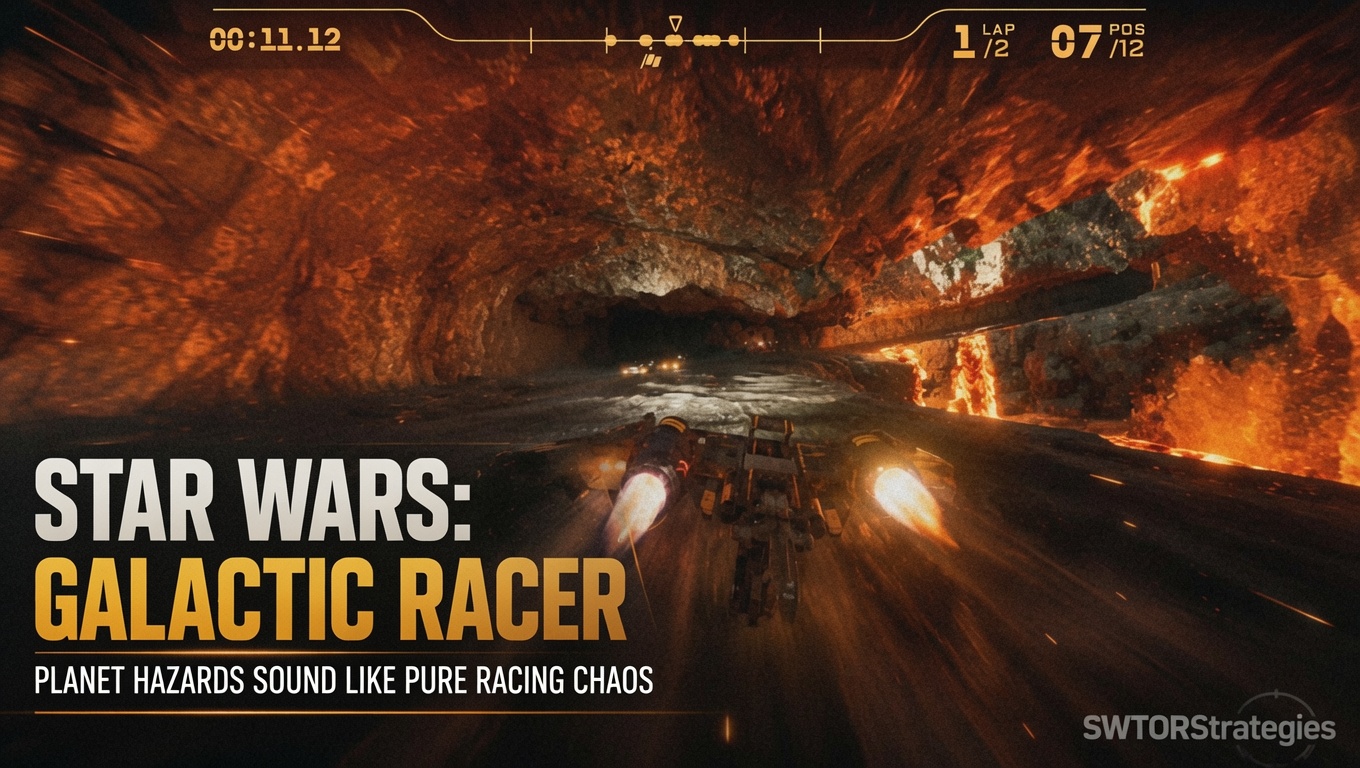
Fuse has already talked about planets having status effects that can hit your vehicle. TechRadar previously reported examples like freezing on Ando Prime and overheating on Lantaana, with environmental counters such as water cooling your vehicle down after heat buildup.
That’s where this whole thing starts to click.
If planetary effects matter, then the best vehicle build is not just the fastest one. It is the one that can handle the route, the weather, the hazards, and whatever nonsense your current run throws at you.
That could make Galactic Racer feel less like a straight arcade racer and more like a high-speed survival problem. Still arcade. Still punchy. Still readable. But with just enough mechanical spite to make every setup feel personal.
And yes, it could also become a balancing nightmare.
There is always a danger with systems this big. Sometimes “deep customization” means meaningful choices. Sometimes it means three good builds, 500 bad ones, and a YouTube guide everyone copies by week two.
Fuse has to make the differences obvious in your hands. Not buried in menus. Not trapped in tiny stat changes. You should feel when a build corners badly, boosts too aggressively, shrugs off hits, or becomes a flaming liability on the wrong planet.
This Is a Better Hook Than Nostalgia
The smartest thing about this direction is that it gives Galactic Racer an identity beyond “remember podracing?”
That nostalgia is powerful, sure. Episode I: Racer still has a grip on people because it was fast, dangerous, and weirdly committed to making every machine look like it might explode before the finish line.
But a new Star Wars racing game needs more than memory.
It needs a reason to exist now.
A runs-based campaign, planetary hazards, vehicle classes, and a massive parts system could give Galactic Racer that reason. TechRadar has also reported that the campaign is built around consequential decision-making, with Fuse saying it wants every decision to matter.
That is the right kind of ambition. Not safe. Not clean. Maybe not even sensible.
But if Fuse can make those “trillions” of combinations feel real on the track, Star Wars: Galactic Racer might become the rare licensed game where the most interesting thing is not the logo.
It might be the terrible machine you built yourself.
Author

Related Posts

Star Wars Heroes vs. Villains Abilities Guide – Full List, Best Characters, and Team Combos
Monopoly: Star Wars Heroes vs. Villains Is Out Now
Star Wars: Rebel Assault (1993): The CD-ROM Star Wars Game That Wanted to Be a Movie
Star Wars: Zero Company’s $50 Price Tag Might Be Its Smartest Move

Galaxy of Heroes Update 6-29-2026 Fixes Krayt Dragon Textures, Rotta Materials, and Some Confused Clone Troopers
SWTOR’s Nar Shaddaa Nightlife Returns June 30 With New Casino Rewards
Star Wars: Zero Company Might Be the Clone Wars Game We Didn’t Know We Needed
Star Wars: Galactic Racer’s Planet Hazards Sound Like Pure Racing Chaos