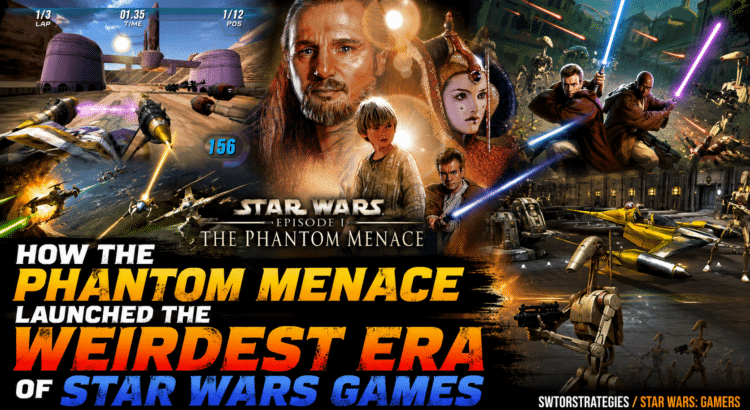
On May 19, 1999, Star Wars: Episode I – The Phantom Menace arrived in theaters and detonated like a merchandised thermal bomb.
The film itself is still debated, memed, defended, roasted, rewatched, and quoted with suspicious enthusiasm. But for Star Wars gaming, The Phantom Menace did something far more important than introduce midi-chlorians and senate procedure to a confused generation.
It opened the floodgates.
The prequel era gave LucasArts a new toybox: podracers, Naboo starfighters, battle droids, Gungan battlefields, Sith assassins, Republic cruisers, bounty hunters, clone armies, Jedi starfighters, and planets that did not look like the same three Original Trilogy backdrops wearing different hats.
And the games got weird. Gloriously weird.
The Movie Was Only the Beginning
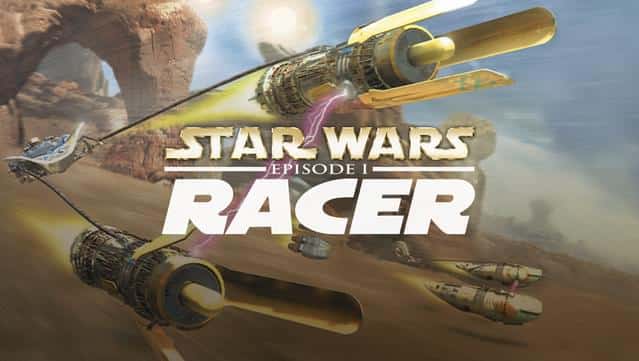
The gaming push started immediately. Star Wars: Episode I – Racer launched for Nintendo 64 and Windows right as the film hit theaters, turning the podrace into one of the fastest and most beloved Star Wars games ever made. Wired reported at the time that LucasArts planned multiple Phantom Menace-based games, with Racer and The Phantom Menace arriving alongside the film as part of a much larger prequel-era gaming rollout. (Wired)
That mattered because Racer did not try to be the whole movie. It simply took one great sequence and went all in. Boosting through canyons, repairing engines mid-race, and trying not to become a very expensive smear on a rock wall — that was enough.
Then came Star Wars: Episode I – The Phantom Menace, the action-adventure tie-in that let players stumble through the film’s events with Jedi robes, blasters, awkward dialogue, and late-’90s polygon confidence. It was messy, strange, and exactly the sort of thing movie tie-ins did before every licensed game had to pretend it was prestige television.
Naboo, Jedi, and Beautiful Chaos
The ripple effect kept going.
Battle for Naboo turned Episode I’s planetary conflict into a spiritual cousin to Rogue Squadron, with air and ground missions built around the Trade Federation occupation. MobyGames lists the Nintendo 64 release in December 2000, a reminder that The Phantom Menace did not just get a launch-window push — it fed Star Wars gaming for years afterward. (MobyGames)
Then the wider prequel mood really took over. Jedi Power Battles gave players arcade-style Jedi chaos. Starfighter and Jedi Starfighter leaned into Naboo and Republic-era space combat. Bounty Hunter turned Jango Fett into a playable bridge toward Attack of the Clones. The Clone Wars gave us vehicle-heavy battlefield action before the animated series made the era feel deeper and stranger.
None of these games were the same thing. That is the point.
The prequel era was not one neat genre. It was a pile of experiments with lightsabers sticking out of it.
A Stranger, Wider Galaxy
For all the jokes about trade disputes and Jar Jar Binks, The Phantom Menace gave Star Wars games something precious: variety.
Before Episode I, most games were understandably tied to the Original Trilogy, X-wings, TIE fighters, stormtroopers, Rebels, and Imperial bases. Great material, absolutely. But familiar.
The prequels widened the canvas. Suddenly, games could be about podracing, Naboo security forces, Sith duels, Gungan shields, Coruscant politics, Kamino mysteries, bounty hunting, clone warfare, and Jedi pilots with questionable survival rates.
That expansion is one reason the 1999–2005 period still feels so rich in Star Wars gaming history. You can see the full spread in our Complete List of All Star Wars Games Ever Made, especially across our 1990–1999 era hub and the Star Wars games golden age of 2000–2005.
The Weirdness Was the Gift
Not every prequel-era game was a masterpiece. Some were clunky. Some aged like blue milk left beside a podracer engine. Some made choices that only 2000s licensed games could make with a straight face.
But that is part of the charm.
The Phantom Menace gaming wave was messy because Star Wars itself was suddenly expanding again. LucasArts and its partners were trying to figure out what this new era could be in interactive form. Racing game? Sure. Jedi brawler? Fine. Flight combat? Absolutely. Bounty hunter action game? Why not. Vehicle battlefield game? Get in.
That willingness to try things gave Star Wars gaming a strange, lively, unpredictable energy.
Twenty-Seven Years Later, It Still Matters
Twenty-seven years after The Phantom Menace hit theaters, its gaming legacy may be easier to appreciate than ever.
The movie did not just restart Star Wars on the big screen. It gave game developers permission to explore a different galaxy — one with stranger vehicles, flashier Jedi, shinier cities, uglier politics, and a lot more battle droids to slice through.
Without The Phantom Menace, we do not get the same run of prequel-era experiments.
And honestly, Star Wars gaming would be poorer without them.
Messier? Yes.
Weirder? Definitely.
Worth remembering? Absolutely.
Now this is podracing, lawsuits from nostalgia pending.