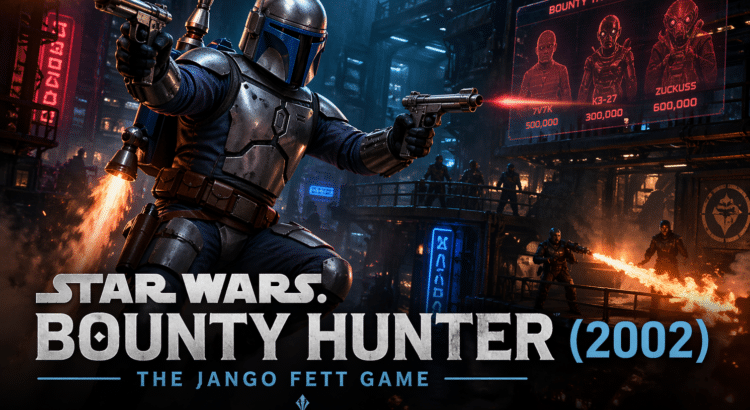
There is a certain kind of Star Wars game that arrives in a clean, polished starfighter and asks you to save the day with elegance.
Star Wars: Bounty Hunter is not that game.
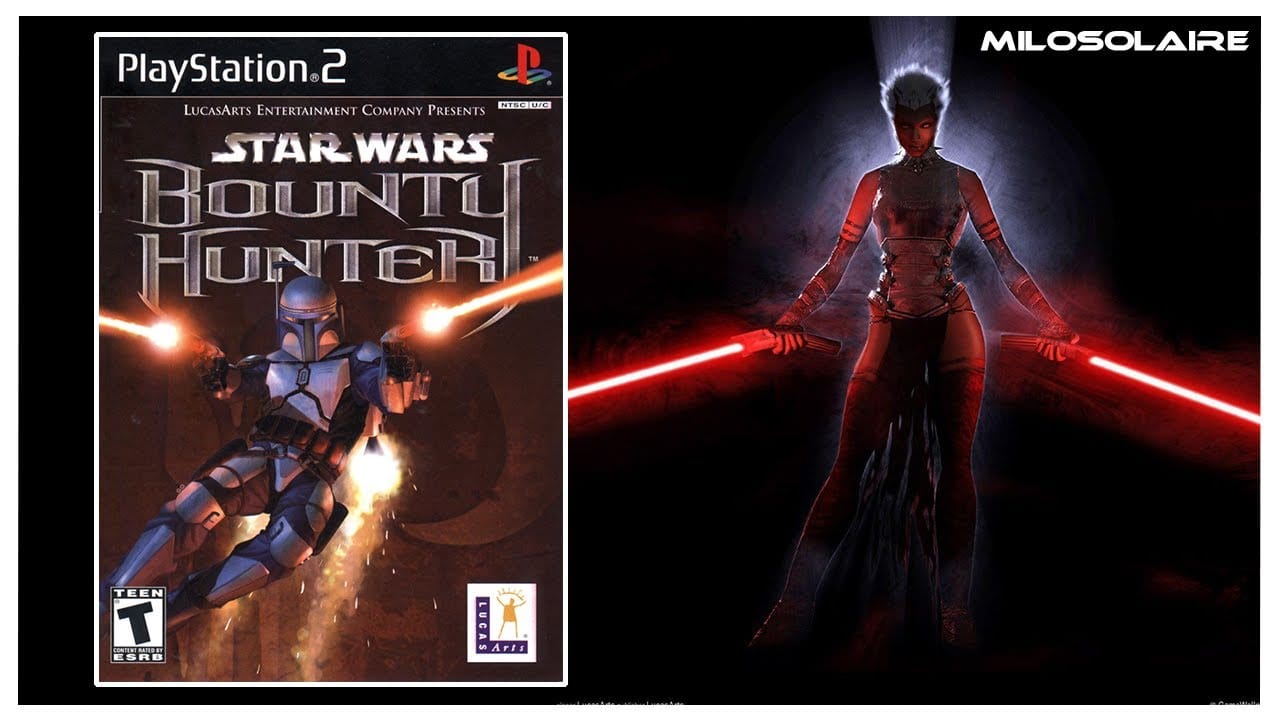
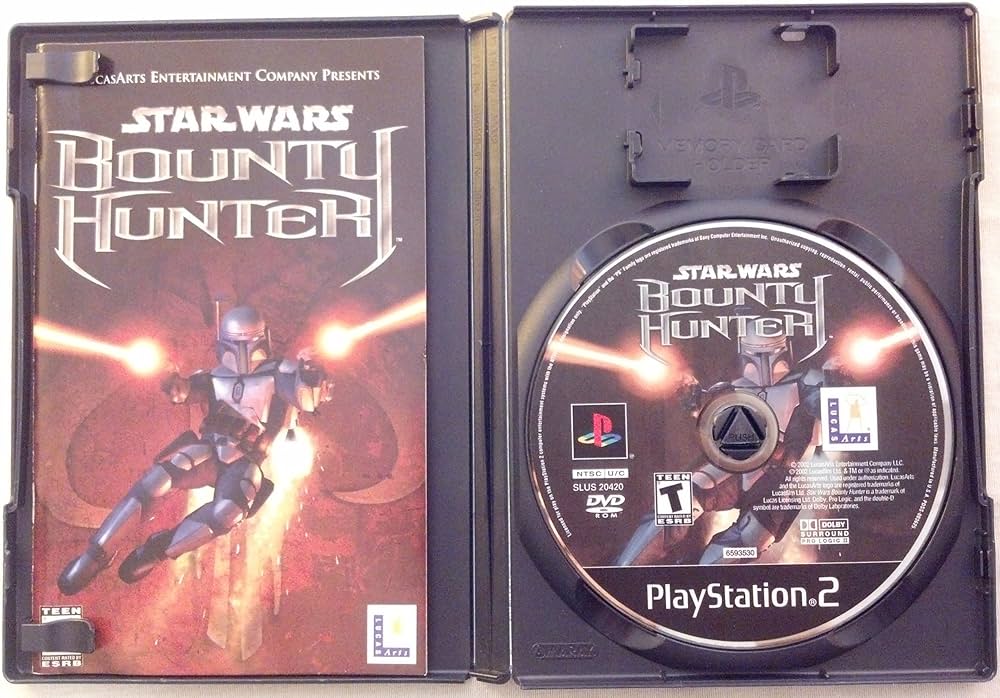
This one kicks the door open, lights the flamethrower, and asks whether you would like to spend the next several hours being Jango Fett at peak menace. And honestly, that was a pretty smart pitch in 2002. Released for PlayStation 2 in November 2002 and for GameCube in December 2002, Bounty Hunter came from LucasArts and put players in the boots of the galaxy’s most dangerous hired gun just as Attack of the Clones had made Jango one of the coolest bad ideas in the entire prequel era.
That timing matters. We had just spent time in the skies with Star Wars: Starfighter (2001) and Star Wars: Jedi Starfighter (2002), watching the prequel era expand through sleek ships, laser fire, and a lot of Naboo shine. Bounty Hunter takes that same broad era and drags it down into the underworld — into grimier corridors, criminal dens, bounty scans, and the kind of jobs where everyone involved probably needs therapy and definitely has a blaster. That makes it a perfect fit for both the Complete List of All Star Wars Games Ever Made (1979–Present) and the Star Wars Games (2000–2005) hub. It is one of the clearest examples of the prequel-era games realizing they did not just have to orbit the films — they could build out the whole messier galaxy around them.
Jango Fett was the whole point, and LucasArts knew it
The easiest thing to say about Bounty Hunter is also the truest: this game understood that Jango Fett was cool.
Not philosophically interesting. Not morally complicated. Just cool.
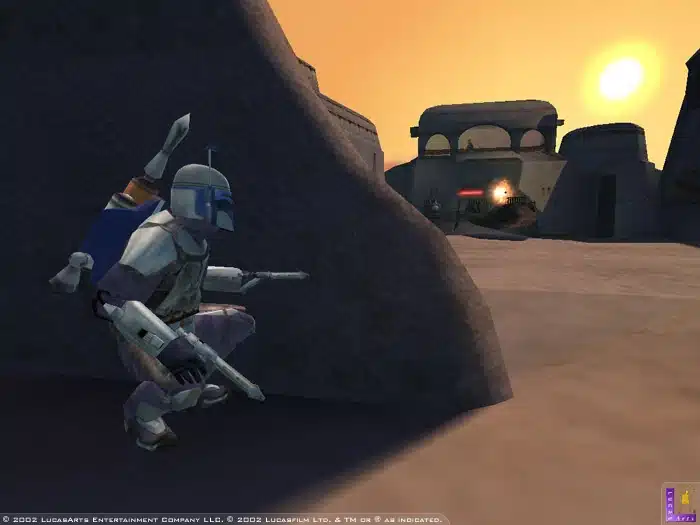
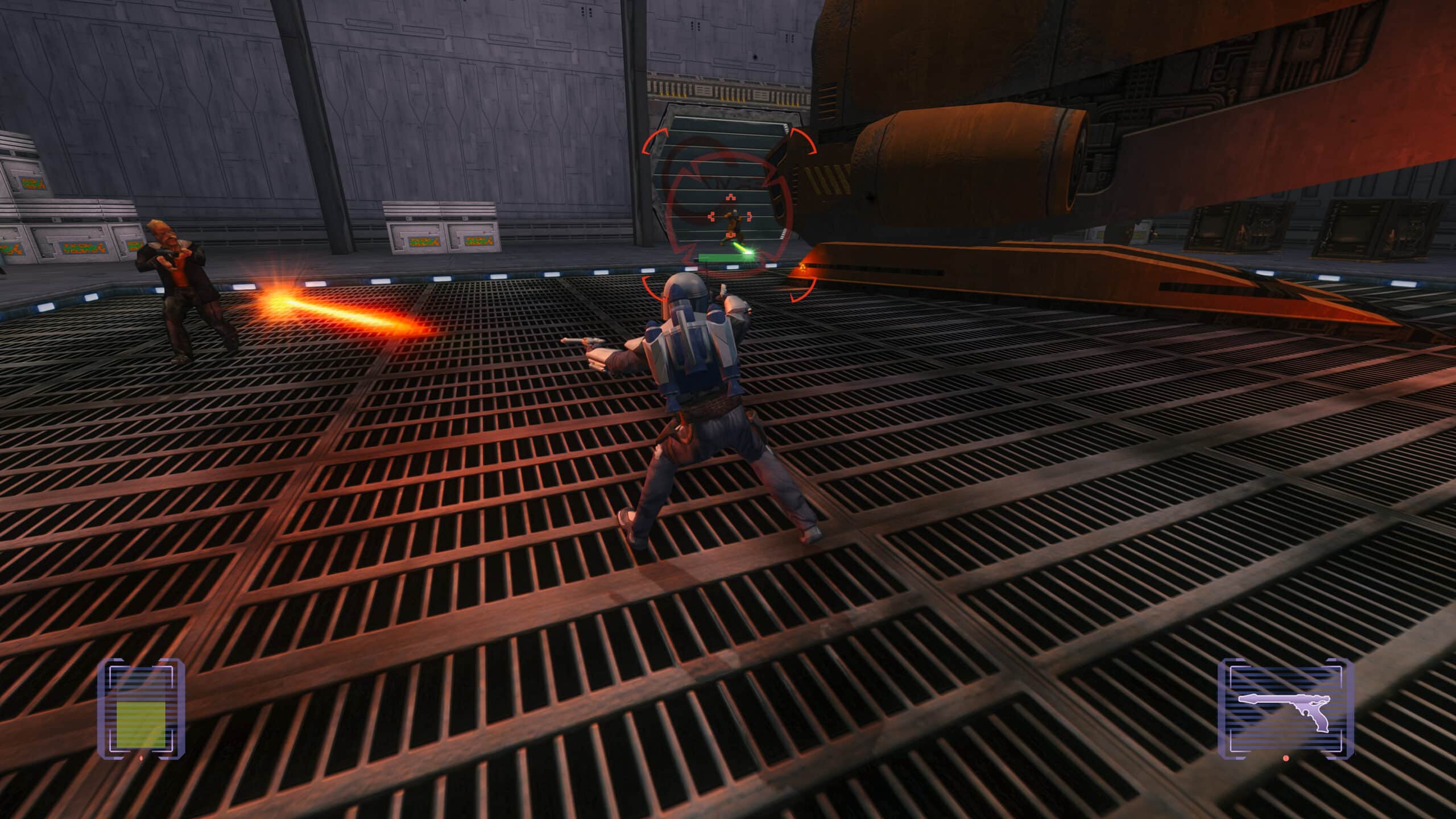
He had the armor, the dual pistols, the jetpack, the bad attitude, the absurdly efficient murder-dad energy, and the small but meaningful advantage of being played in the film by Temuera Morrison, who also voiced Jango in the game. LucasArts leaned into all of that. In its pre-release coverage, GameSpot said the studio wanted Jango’s animations to feel stylized, fast, and exaggerated, and stressed that he should never seem helpless or separated from his gear. He could climb, hang from ledges, keep shooting, toss grenades, and use his jetpack fluidly rather than feeling like a character constantly waiting for permission to be awesome.
That was the right instinct. Because let’s be honest: nobody bought into a Jango Fett game hoping for a delicate meditation on restraint. Players wanted to fly around, chain attacks together, scan targets, and look like the most dangerous person in a room full of dangerous people. Bounty Hunter gets a surprising amount of mileage out of simply committing to that fantasy as hard as possible. You are not a reluctant hero here. You are a working professional in a very unhealthy line of work. That gives the whole game a different flavor from a lot of other Star Wars titles of the time.
The story did more than just ride Jango’s popularity
One reason Bounty Hunter has held onto a certain cult affection is that it was not content to be “Jango Fett does cool flips for 10 hours.” It actually tried to slot him into the wider prequel story in a meaningful way.
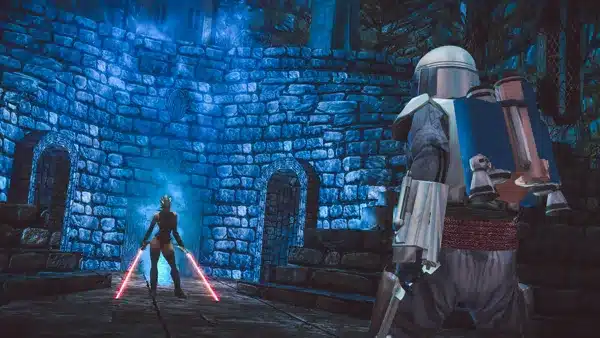
The setup, as LucasArts described it and as GameSpot summarized at the time, takes place about 10 years before Episode II. Jango is hired by Darth Tyranus / Count Dooku to bring down Komari Vosa, a fallen Dark Jedi and leader of the Bando Gora cult. In the process, the game fills in how Jango came to be selected as the template for the Republic’s clone army — a detail the movies treat as mysterious background information and the game turns into a full action-story spine.
That made the game more interesting than a lot of licensed action titles from the period. Instead of just replaying movie moments, it works as a kind of dirty little prequel side-story. You already know where Jango ends up in Attack of the Clones. You already know the clone army is coming. So there is a nice bit of dramatic irony in playing a guy who thinks he is chasing a lucrative contract while the audience knows he is basically being maneuvered into becoming one of the most important biological photocopy machines in galactic history. It is very Star Wars, really: one man takes a job, accidentally helps doom democracy. Classic franchise stuff.
The actual hook was not just shooting — it was hunting
This is where Bounty Hunter gets more interesting than people sometimes remember.
Yes, it is a third-person action game. Yes, there is a lot of shooting. Yes, Jango has enough weapons strapped to his body to make airport security cry. But LucasArts also built in a proper ID scanner system and secondary bounty mechanic. Pre-release hands-on coverage described the scanner as a tool for identifying optional targets in the crowd, which could earn extra credits and unlockables if you captured or eliminated them. That did not magically turn the game into Hitman in a Mandalorian helmet, but it did give it a nice extra layer of personality.
That matters because the title is Bounty Hunter, not Guy With Guns. The scanner mechanic helped sell the fantasy that Jango was not just mowing through cannon fodder on instinct. He was working. Tracking marks. Picking the right target. Making money. The game is still action-first, absolutely, but those little systems gave it a sense of profession. It is one thing to blast your way through a room. It is another to pause, scan the crowd, realize one nervous idiot is worth extra credits, and decide his day is about to get much worse.
LucasArts threw a lot of production weight at it
Another reason Bounty Hunter stood out in 2002 is that LucasArts did not treat it like some disposable side project. The studio handled development itself, while Industrial Light & Magic worked on the CG cutscenes and Skywalker Sound handled audio. GameSpot’s early coverage also noted contributions from Jeremy Soule for character and environment music, alongside familiar Star Wars themes. That is a serious pile of Star Wars production muscle for a third-person action game about shooting criminals in ugly rooms.
And you can feel that ambition in the presentation. The game wanted its cutscenes to matter. It wanted its voice cast to help the story land. It wanted the whole thing to feel connected to the larger prequel-era machine instead of like an odd little budget tie-in skulking around the edges. Even if the final gameplay did not always live up to the cinematic aspirations, the effort is obvious. LucasArts clearly believed there was room for a Star Wars game that was less about Jedi nobility and more about underworld grime, and it spent real resources trying to make that version of the galaxy feel authentic.
The moveset was half the fun
When Bounty Hunter works, it works because Jango feels good to be.
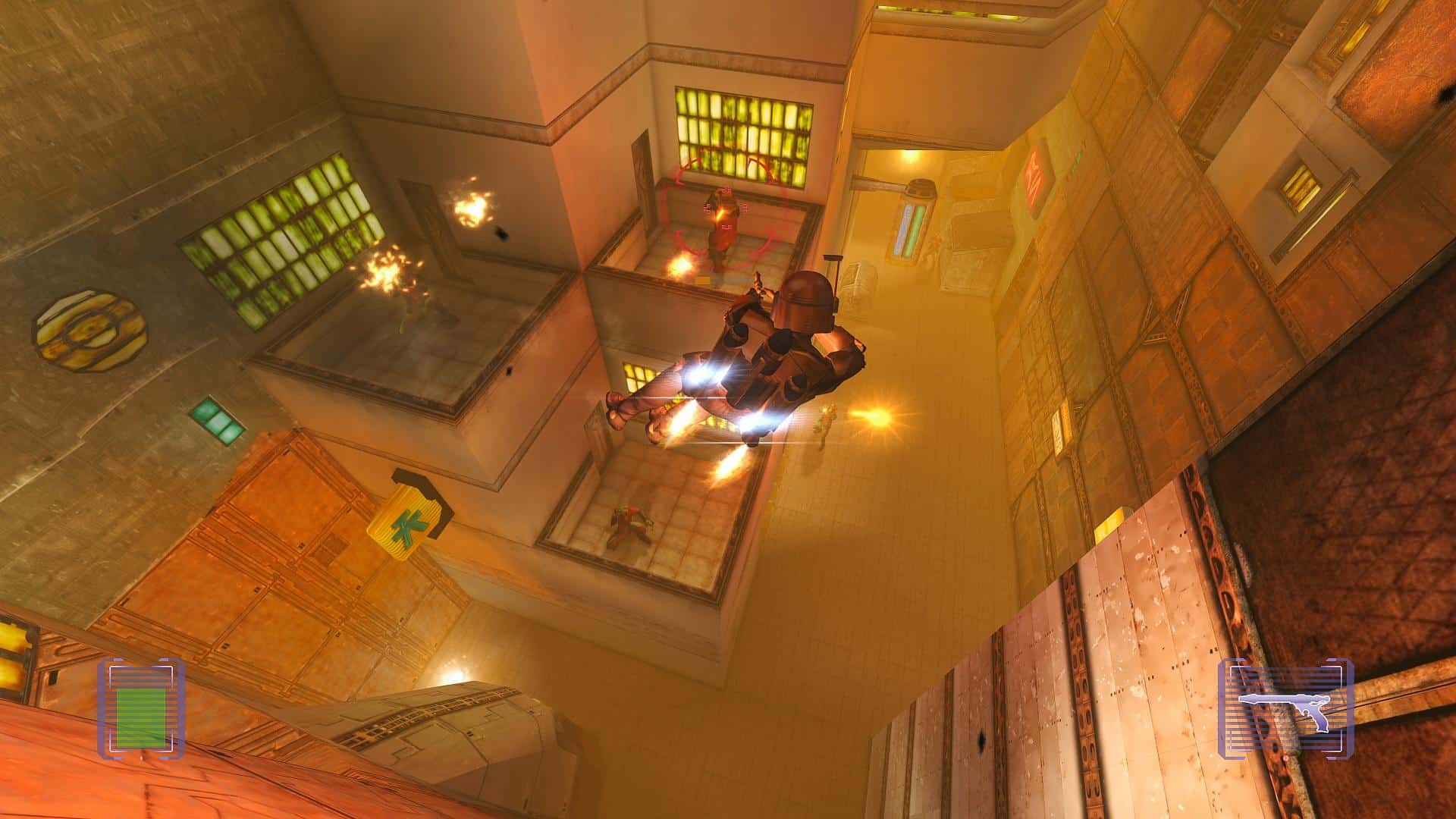
He has the dual pistols, the jetpack, the flamethrower, the whipcord, grenades, sniper options, and a general vibe of being perfectly happy to solve every problem with either violence or more stylish violence. GameSpot’s preview described him as being able to target multiple enemies with his blasters, fly with his jetpack, use weapons while hanging from ledges, and chain movement with enough speed that he always looked aggressive rather than clumsy. The review later agreed that some of those tools — especially the jetpack and auto-targeting — set up some genuinely good action sequences.
That is probably the game’s enduring appeal in one sentence: Jango feels cool even when the game around him is occasionally trying very hard not to cooperate.
You are not just running and shooting in straight lines. You are hopping ledges, boosting across gaps, locking onto multiple enemies, and generally causing the kind of public disturbance that should absolutely get you removed from several planets. The best moments in Bounty Hunter are when all of those systems line up and you briefly feel like the galaxy’s most expensive problem-solver. For a game about Jango Fett, that counts as a pretty big win.
Unfortunately, the camera also wanted a speaking role
Now for the less flattering part.
If Bounty Hunter had simply been “Jango Fett feels fantastic and all systems sing,” it would probably be remembered as a much bigger classic. But a lot of the contemporary criticism centered on technical and control frustrations, especially the camera. GameSpot’s review was blunt about it, calling out major headaches in tighter environments, collision problems, and a tendency for the camera to swing into unhelpful positions at exactly the wrong time. Metacritic’s review summary for the PS2 version reflects that broader split: a 65 Metascore with critics divided between “flawed, but fun” and much harsher complaints about clumsy control and awkward traversal.
That criticism was not nitpicking. It was the central problem.
This is a game that asks you to jump, hover, aim, scan, and navigate spaces with some verticality, all while staying stylish. If the camera behaves like it is on its own bounty contract, things get messy fast. That is why Bounty Hunter has always occupied this funny middle ground in Star Wars memory. People remember the fantasy very fondly. They remember the actual friction pretty clearly too. The game could make you feel like a badass one minute and then immediately remind you that your greatest enemy might in fact be architecture.
Even so, the GameCube version had a case to make
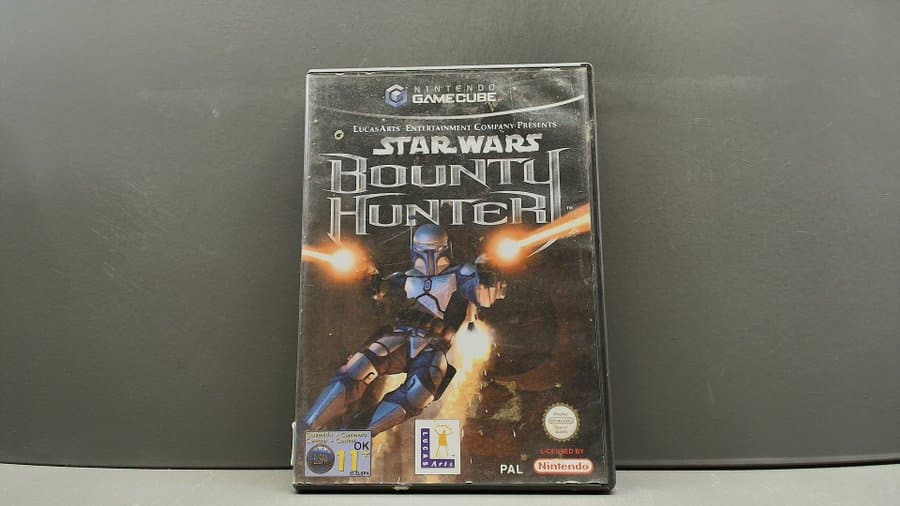
One of the more interesting bits of period history is that the GameCube version was often seen as the better-performing release. GameSpot’s GameCube review said it was “markedly better” than the PlayStation 2 version, and pre-release reporting had already noted that LucasArts expected the GameCube build to run at 60 frames per second with higher-resolution textures, compared with a 30 fps target for PS2. In other words, this was not just fanboy message-board mythology; there really were technical differences in the way the two versions were positioned.
That does not completely transform the game, of course. A smoother version of an occasionally awkward action game is still an occasionally awkward action game. But it is part of the title’s story. Bounty Hunter arrived in that very early-2000s console moment where platform differences could still matter in a visible way, and players noticed. If you had the GameCube version, you had at least a slightly better shot at enjoying Jango’s bad behavior without wanting to fight the hardware.
What reception looked like then — and why fans never fully let it go
On paper, Bounty Hunter was not a critical juggernaut. The PS2 version sits at 65 on Metacritic, while the GameCube version sits a bit higher at 67. Reviewers praised the story setup, the commitment to Jango’s toolset, and the broad idea of playing through the Star Wars underworld from the bad-guy side. But they kept coming back to the same rough edges: camera trouble, clumsy spots, and repetition.
And yet, the game never disappeared.
Part of that is simple character appeal. Jango Fett was, and remains, one of those Star Wars characters who can coast a long way on armor, competence, and the ability to walk into a room like he already won the argument. Part of it is also that Bounty Hunter was doing something a little different. It was not another Jedi game. It was not another starfighter game. It was not trying to rehash the rebellion-versus-Empire comfort food people already knew. It was Star Wars from the perspective of someone who absolutely does not work for the light side and has no interest in your moral speech. That angle helped the game age into cult status even when the original reviews were mixed. Later re-releases on PlayStation and modern 2024 ports by Aspyr also kept it visible enough for newer players to rediscover it.
Why it still matters in the archive
This is really the part that matters most.
Star Wars: Bounty Hunter deserves a place in the archive not because it was perfect, but because it expanded what Star Wars games could be in the early 2000s. Right after Jedi Starfighter, it gives the same broader prequel era a completely different texture. Instead of sleek cockpit heroics, you get urban filth, bounty contracts, cult weirdness, and a protagonist who would probably laugh if someone called him a role model. That contrast is part of what makes the 2000–2005 period so much fun. LucasArts and friends were not just making one kind of Star Wars game over and over. They were trying things. Sometimes glamorous. Sometimes grubby. Sometimes both.
And that is why Bounty Hunter has more value than its review averages suggest. It gave Jango Fett a real starring role. It deepened the prequel-era timeline. It took the idea of bounty hunting seriously enough to build systems around it. It brought in ILM, Skywalker Sound, Morrison, and a full cinematic push. Yes, the camera could be a menace. Yes, the game can feel rough. But it also has an identity. A strong one. You remember it. That counts for a lot in a franchise this crowded.
The verdict from the helmet
There are better-controlled Star Wars games. Better-reviewed ones. Bigger legends.
But Star Wars: Bounty Hunter still has a pulse because it understood one very simple truth: if you hand players Jango Fett, a jetpack, two pistols, and a license to be unpleasant, they will put up with more nonsense than they probably should.
That is not a flaw in the audience. That is just good character casting.
The game is rough around the edges, sometimes rough in the middle, and occasionally rough in places that really should not be rough at all. But it also has swagger, atmosphere, and a point of view. It helped prove that prequel-era Star Wars games could be more than podracing or starfighters. They could go into the alleyways too.
And honestly, Star Wars is usually more interesting when it is a little dirty.
FAQ
What is Star Wars: Bounty Hunter?
It is a 2002 third-person action game from LucasArts starring Jango Fett, built around a mission to capture the fallen Dark Jedi Komari Vosa.
What platforms did Star Wars: Bounty Hunter release on originally?
It launched on PlayStation 2 in November 2002 and on GameCube in December 2002.
How does the game connect to Attack of the Clones?
The story is set before Episode II and helps explain how Jango Fett came to be chosen as the template for the Republic’s clone army.
What made the gameplay stand out?
The big hooks were Jango’s gear — dual pistols, jetpack, flamethrower, whipcord, scanner — plus optional bounty targets that could be identified for extra credits.
Was Star Wars: Bounty Hunter well reviewed?
Reviews were mixed to average overall, with Metacritic listing a 65 for PS2 and 67 for GameCube. Critics liked the premise and story more than the camera and control frustrations.
Why is Star Wars: Bounty Hunter worth revisiting now?
Because it is one of the clearest examples of LucasArts expanding the prequel era beyond the films, giving Jango Fett a real spotlight and building a grimier, more underworld-focused kind of Star Wars action game.
Author

Related Posts

The Acolyte Has Quietly Reappeared on Disney+’s Top 10-
Andor Season 2 Lands a Hugo Nomination — and It’s the Only TV Series in Its Category 
What Makes HTML5 Games Fast and Accessible on Any Device
Looking Back at Every Star Wars Celebration Ahead of 2027 Ticket Sales

-
Why PicEditor AI Feels Helpful Even If You Are Not “Good at Editing” 
“May the Science Be with You” in Las Vegas will bring science and the Star Wars universe together- Why Faster Video Editing Matters for Gaming Creators and Community Teams

Star Wars Zero Company Just Got a Proper Official Home — and Wider Wishlisting