
There is a very specific kind of sequel that does not try to reinvent the wheel. It just looks at the first game, tightens a few bolts, paints some flames on the side, and says, “Right. Now let’s make this thing louder.”
That is Star Wars: Jedi Starfighter.
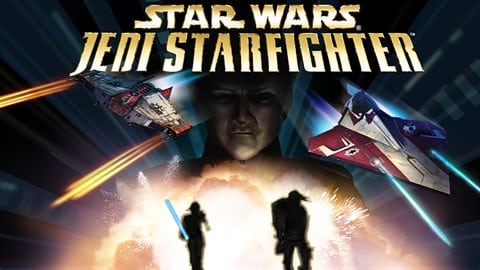
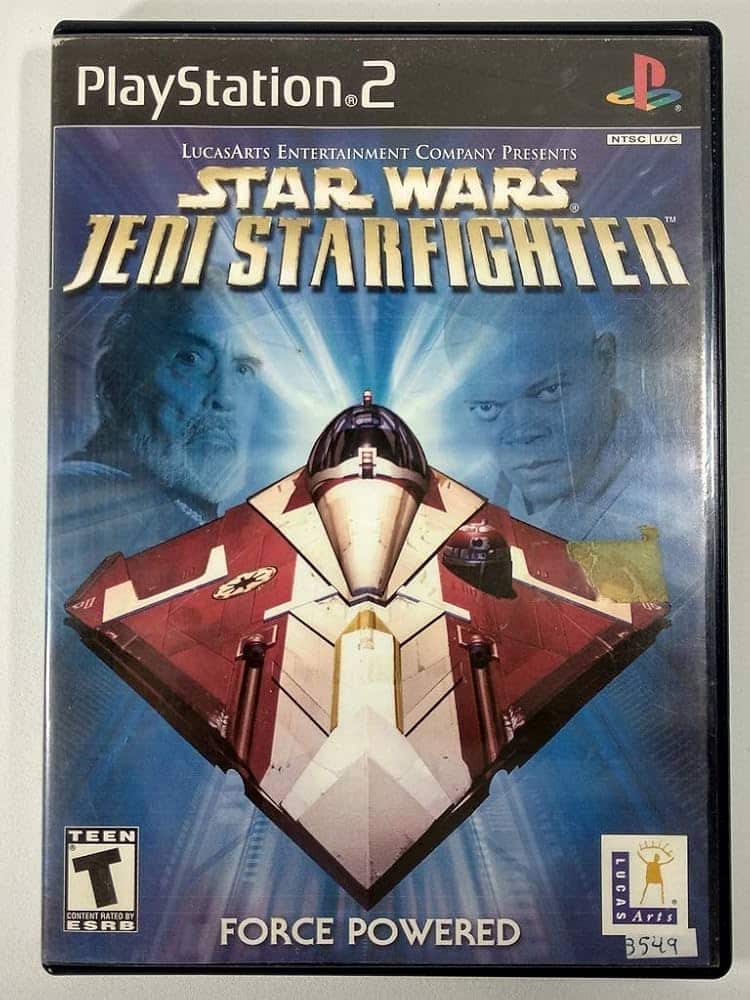
After Star Wars: Starfighter (2001) gave the prequel era its first proper flight-combat game, LucasArts came back a year later with a sequel that kept the same broad formula but shifted the mood. This time, the game was tied more directly to Attack of the Clones, brought in Jedi Master Adi Gallia, kept fan-favorite pirate Nym around, and added Force powers to starfighter combat because apparently regular lasers were no longer enough. It launched first on PlayStation 2 on March 10, 2002, with an Xbox version following later that year.
And honestly? That was a pretty solid idea.
If Episode I: Racer (1999) was the prequel era’s first big gaming flex, and Star Wars Racer Arcade (2000) was the version that wanted your coins and your hearing, then Jedi Starfighter was part of the moment when LucasArts started treating the prequel era like a full playground instead of a single highlight reel. It fits neatly into both our Complete List of All Star Wars Games Ever Made (1979–Present) and the Star Wars Games (2000–2005) hub, because this is exactly the kind of game that makes that period so much fun to revisit: slick, slightly overconfident, and very determined to make starfighters feel cool. Which, to be fair, is not exactly the worst creative mission statement.
A sequel that knew what to keep
One of the smartest things Jedi Starfighter does is not overthink the follow-up.
It keeps Nym, which was a genuinely good call. The first Starfighter had three main pilots, but Nym was the one who really stuck in memory: big rogue energy, a permanent air of “I will help, but I am going to complain about it,” and the exact kind of character LucasArts was weirdly good at inventing in this era. GameSpot’s review of the sequel noted that LucasArts dropped the other two original leads and narrowed the story around Nym and newcomer Adi Gallia, which gave the game a more focused storyline than the first game.
That tighter focus helps a lot. The original Starfighter had charm, but it was also doing that early-PS2 thing where developers were still figuring out how much story, structure, and spectacle they could reasonably jam into one package. Jedi Starfighter feels more confident. It is still very much an action-heavy console flight game, but it has a cleaner center of gravity. Nym brings the scoundrel swagger. Adi Gallia brings Jedi authority and Force abilities. Between them, the game suddenly has a lot more personality.
And yes, giving players a Jedi pilot in a starfighter game was always going to sell itself. LucasArts did not need Yoda-level foresight to figure that one out.
The prequel tie-in that actually felt like a game first
There is also something very 2002 about the way this game was positioned.
LucasArts clearly wanted Jedi Starfighter to connect with Attack of the Clones. The story was designed to move in and out of events from the upcoming film, including the Battle of Geonosis, and the game used Adi Gallia’s new Jedi starfighter as an early showcase for one of Episode II’s sleek new vehicles. GameSpot’s preview at the time made that link explicit, presenting the game as both a sequel to Starfighter and an early gateway into the movie’s world.
That could have gone badly. Movie-adjacent games do not exactly have a spotless record. Some are classics. Some feel like contractual obligations with menus.
But Jedi Starfighter mostly avoids that trap because it still feels like a LucasArts action game first and a promotion second. Yes, it borrows hype from the movie. Yes, it uses Episode II hardware and timing. But the campaign still has its own little war story going on, with Count Dooku lurking in the background, the Karthakk system under threat, and Adi Gallia and Nym getting pulled into a conflict that overlaps with the growing Separatist crisis.
That gives the game a useful amount of breathing room. It is not just reenacting film beats like a nervous intern trying not to get anything wrong. It is adding texture around them. That is usually where Star Wars games are at their best.
Force powers were the big gimmick, but also the big personality boost
The headlining addition in Jedi Starfighter was obvious: Force powers in a starfighter.
Adi Gallia’s craft traded the broader secondary-weapon style of more conventional ships for a Jedi-flavored combat kit. As GameSpot’s preview laid out, the game gave her four Force powers over the course of the campaign: Force lightning, Force shield, Force reflex, and Force shockwave. These were tied to timing, with better execution producing stronger results, and they ran on a Force meter to keep players from just mashing mystical nonsense at every problem.
Was it a little silly? Of course it was a little silly.
But it was also the right kind of silly.
This is where Jedi Starfighter separates itself from being merely “Starfighter again.” The first game already had the basic loop down: dogfights, escort missions, capital ship strikes, lots of laser fire, and the occasional reminder that your piloting confidence may not be fully supported by your actual skill level. The Force powers gave the sequel a different rhythm. Suddenly combat had this extra layer of timing and flair. You were not just blasting your way out of trouble. You were slowing time, throwing out shockwaves, and zapping clusters of enemies like a Jedi who had decided the Geneva Conventions were someone else’s problem.
It was a smart twist because it made Adi feel mechanically distinct, not just cosmetically important. And that matters. If you are going to put “Jedi” in the title, the Jedi part should probably do more than just sit there looking official.
Still very much a Starfighter game, for better and worse
For all its upgrades, though, Jedi Starfighter is still very recognizably built on the original game’s bones.
GameSpot’s preview said the sequel kept the same basic structure as the first game, with 15 levels, unlockable bonus content, and alternating character use. It also added a cooperative mode that let a second player join missions in supporting roles, either as another ship or, in some setups, by handling a turret.
That means if you liked the first Starfighter, you were in pretty safe hands. The sequel did not suddenly transform into a sim or try to become an RPG because somebody in a meeting said “broader demographics” too many times. It stayed focused on accessible console flight combat, mission-based progression, and cinematic Star Wars action.
The downside is that some of the old issues stayed in the cargo hold too.
Critics were generally positive, but even the positive reviews tended to admit that the game was not radically new. IGN’s review, as collected by Metacritic, praised the reward system and improved two-player features, but noted that players would not find anything “terribly new.” GameSpot was a bit cooler on it, arguing that bland visuals, a sketchy frame rate, and frustrating targeting kept the game from being great.
That sounds about right. Jedi Starfighter is one of those sequels where the improvements are real, but they live in refinement rather than revolution. If you wanted LucasArts to completely redraw the map, this was not that game. If you wanted a more polished, more focused, more Jedi-flavored version of Starfighter, then yes, welcome aboard.
The PS2-era confidence is all over it
A lot of what makes Jedi Starfighter charming now is that it feels extremely of its moment.
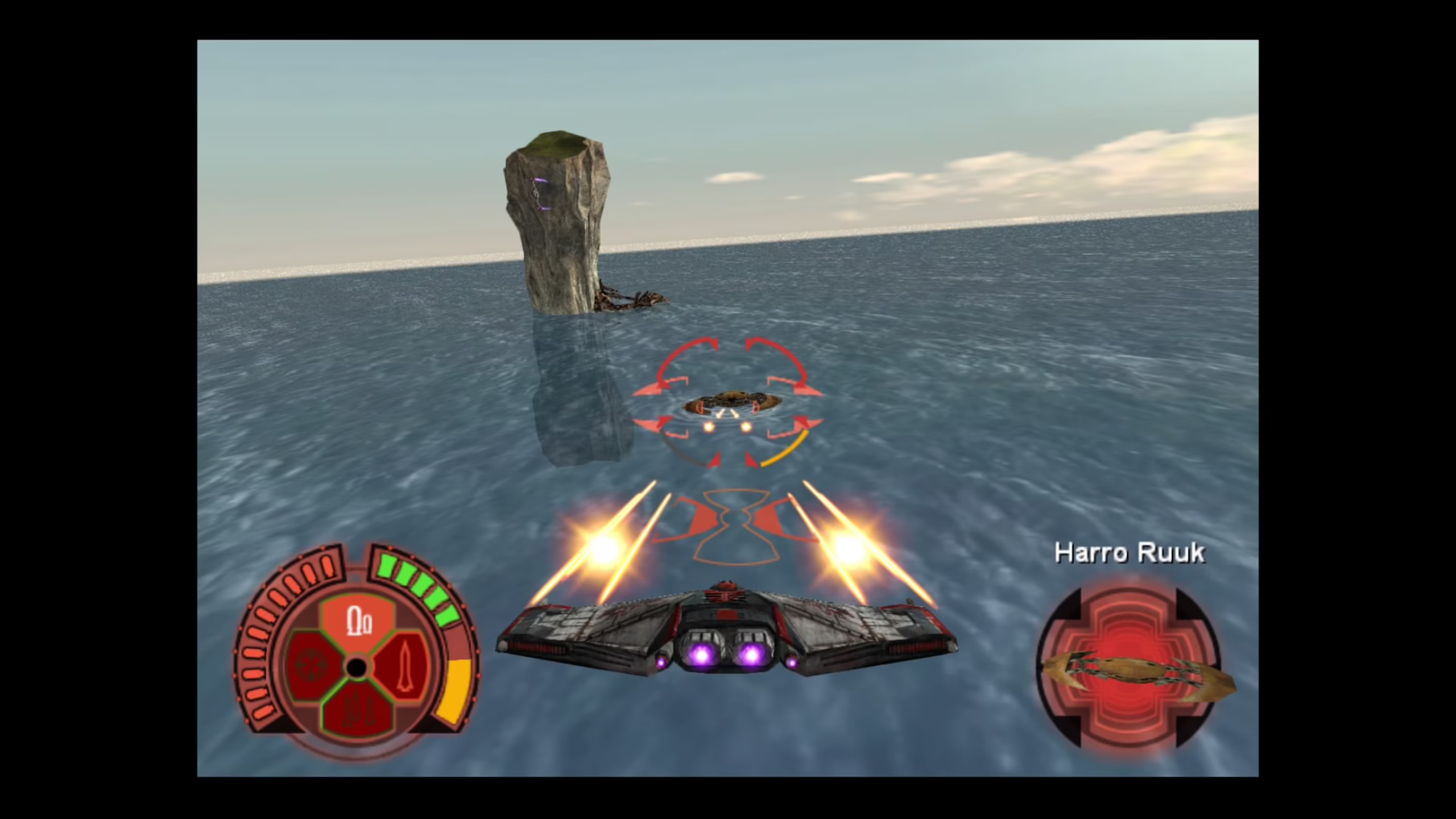
This is an early-2000s console game in the best, most LucasArts way. It likes spectacle. It likes unlockables. It likes split-screen co-op. It likes giving you a reward system and a campaign that moves briskly enough to keep you from getting bored, even when the mission types occasionally drift into familiar territory. Critics highlighted exactly that mix: intuitive controls, easy pick-up-and-play action, and a generally polished package, even when some reviewers thought the formula needed a fresher spark.
That PS2-era confidence matters because it shaped the entire feel of the game. This was not trying to be the heir to X-Wing or TIE Fighter, where part of the pleasure came from a more demanding cockpit fantasy. Jedi Starfighter was built for a different crowd: players who wanted to jump into a Star Wars ship quickly, start blowing things up, and feel like the soundtrack in their head was doing half the work.
And honestly, that audience deserved feeding too.
By 2002, Star Wars gaming had enough room for multiple flight-combat flavors. You could have the old-school sim tradition. You could have Rogue Squadron-style console action. And you could have this prequel-era lane, where everything was a little shinier, a little more acrobatic, and a lot more willing to give a Jedi a starfighter and say, “Go make a scene.”
Reception: good enough to matter, not iconic enough to coast
This is probably the fairest way to describe how the game landed.
On Metacritic, the PlayStation 2 version holds a score of 81, while the Xbox version sits at 78, both in positive territory. That puts it in the respectable middle ground where a game is clearly liked, but still leaves room for people to argue over whether it should have done more. IGN scored the PS2 version at 90, while GameSpot gave it 70, which tells you pretty much everything you need to know about the critical split: some people saw a polished, entertaining Star Wars action game; others saw a good sequel that did not quite iron out all its weaknesses.
That range actually makes the game more interesting in retrospect.
Because Jedi Starfighter is not one of those easy, universally canonized classics. It is not sitting on the throne next to Knights of the Old Republic. It is not automatically the first name shouted in every Star Wars gaming debate. It has to be revisited on its own terms.
And on its own terms, it is a pretty likable success.
It took a solid foundation, introduced a genuinely fun Jedi twist, gave the prequel era more gaming identity, and kept LucasArts’ early-2000s run of “they were making a lot of stuff, and quite a bit of it was actually good” alive for another year.
That is not a small achievement.
Why it still deserves a place in the archive
The best argument for Jedi Starfighter is not that it was the most important Star Wars game ever made.
It was not.
The best argument is that it helped make the prequel era feel like a real place in games rather than a collection of licensed tie-ins orbiting the films. It connected back to Starfighter, it carried Nym forward instead of tossing him overboard, and it leaned into the broader Clone Wars tension building around Episode II. It also showed that LucasArts understood something useful: if you want players to care about a corner of Star Wars, let them inhabit it through mechanics, not just cutscenes.
That is what Jedi Starfighter gets right.
It does not just say “here is a Jedi starfighter.” It gives that Jedi starfighter its own feel. It does not just say “here is a sequel.” It gives the sequel a clearer identity. It does not just wave Episode II in your face and hope that is enough. It builds a campaign around that era’s tension and lets you participate in it.
And yes, sometimes it is a little repetitive. Sometimes it is a little too comfortable. Sometimes you can feel the sequel machinery turning under the hull.
But there is a difference between a sequel that plays it safe and a sequel that knows exactly what its audience wanted. Jedi Starfighter is much closer to the second category.
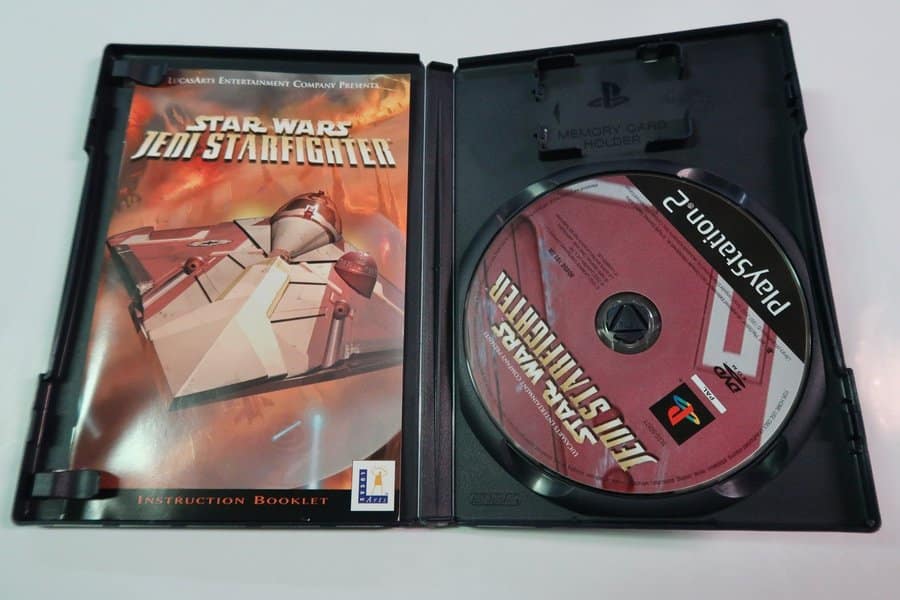
The view from the cockpit
There are Star Wars games with bigger reputations. More swagger. More myth.
But Star Wars: Jedi Starfighter still has a lot going for it because it understood the assignment so clearly. It took a working formula, sharpened the cast, added Force powers, leaned into the prequel-era hardware, and delivered a fast, polished, very 2002 kind of Star Wars adventure.
That may not sound legendary.
It does sound fun.
And fun, in this case, goes a long way.
If Star Wars: Starfighter (2001) was the moment the prequel era took off, then Jedi Starfighter was the point where LucasArts looked at that first clean launch and said, “Good. Now let’s make it a little flashier, a little stranger, and a little more Jedi.”
You can argue about whether it surpassed its predecessor.
You cannot really argue that it knew exactly what game it wanted to be.
FAQ
What is Star Wars: Jedi Starfighter?
It is a 2002 LucasArts flight-action sequel to Star Wars: Starfighter, centered on Adi Gallia, Nym, and a story that connects to the build-up and events of Attack of the Clones.
What platforms was Jedi Starfighter released on?
It launched first on PlayStation 2 in March 2002 and later came to Xbox. It was also re-released years later on PlayStation platforms.
What makes Jedi Starfighter different from the first Starfighter?
The biggest additions were Adi Gallia as a playable Jedi lead, Force powers in combat, a tighter story focus around Adi and Nym, and cooperative play options.
What Force powers are in the game?
Adi Gallia’s starfighter uses Force lightning, Force shield, Force reflex, and Force shockwave, all tied to timing and a recharge meter.
Was Jedi Starfighter well reviewed?
Generally yes. The PS2 version has a Metacritic score of 81, while the Xbox version sits at 78, with critics praising the polish and accessibility more than the level of innovation.
Why is Jedi Starfighter worth revisiting?
Because it is one of the better examples of early-2000s LucasArts: stylish, approachable, tied neatly into the prequel era, and just confident enough to let a Jedi solve starfighter combat with lasers and mysticism at the same time.
Author

Related Posts

The Mandalorian & Grogu Score Is Up for Pre-Order — and Yes, Fans Will Want This One
The Mandalorian & Grogu and Ahsoka Season 2 Are Clearly Connecting
Star Wars Celebration 2027 Tickets Go on Sale May 6 — Here’s What They Cost
Disneyland’s New Leia Look Has a Battlefront II Twist




All LGBTQ+ Characters in Star Wars: The Galaxy Is Gayer Than the Empire Would Like-
Star Wars: Starfighter (2001): The Moment the Prequel Era Finally Took Off 
Spaceballs: The New One Is Real — and Star Wars Fans Should Absolutely Care
This New Mandalorian & Grogu Hot Toys Reveal May Be Hiding a Battlefront Surprise