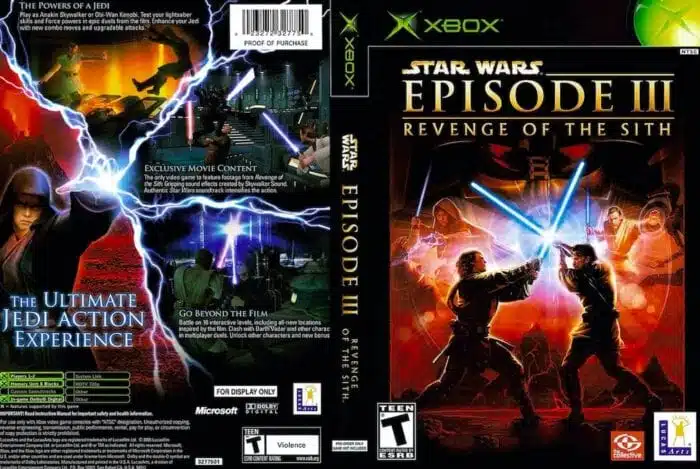
Before Revenge of the Sith reached theaters and emotionally ruined an entire generation of prequel kids, LucasArts let players swing the lightsaber themselves.
On May 4, 2005, Star Wars: Episode III – Revenge of the Sith launched for PlayStation 2 in North America, according to MobyGames and GameFAQs listings, with the Game Boy Advance version also listed for the same date. The wider multi-platform rollout is often cited as May 5, but May the 4th gives the PS2 and GBA releases a perfect little Star Wars history stamp.
A Movie Tie-In From the Last Great LucasArts Rush
The early 2000s were a very different era for Star Wars games. LucasArts was still firing out titles with the confidence of a studio that owned half your childhood: Knights of the Old Republic, Republic Commando, Battlefront, Rogue Squadron, Jedi Knight, and then this — a full action-game adaptation of the final prequel film.
Developed by The Collective for PlayStation 2 and Xbox, with handheld versions handled by Ubisoft, Revenge of the Sith was built around third-person Jedi action. Players controlled Obi-Wan Kenobi and Anakin Skywalker through the final days of the Clone Wars, slicing through droids, dueling major villains, and marching toward the inevitable lava-flavored friendship collapse on Mustafar.
It was not subtle. It was not especially elegant. But it knew exactly what players wanted in 2005: lightsaber combat, Force powers, boss fights, and the chance to play through the movie’s darkest moments before the film had even landed in cinemas.
The Game Spoiled the Movie, Gloriously
One of the strangest things about the Revenge of the Sith game today is how aggressively it belonged to the old movie tie-in era. The game arrived before the film’s May 19 theatrical release, meaning anyone who played it early was walking directly into spoilers with a controller in hand.
Modern studios would treat that like a containment breach. In 2005, it was marketing.
The game even included movie footage and recreated key action beats from the film, giving players an early, interactive taste of Anakin’s fall. That made it part adaptation, part promotional weapon, and part “please enjoy this emotional disaster in playable form.”
The Combat Was Messy, But Memorable
Critics were mixed at the time. GameFAQs lists the PS2 version as a linear action-adventure title, while MobyGames classifies it as an action game with direct-control beat-’em-up elements. Wired’s 2005 review was less charitable, calling out the hack-and-slash repetition while noting the game’s dark dynamic and short runtime.
And honestly? That sounds about right.
Revenge of the Sith was never the deepest Star Wars game. It was not KOTOR with better hair, and it was not Jedi Academy with a movie license. But it did have a direct, arcade-like appeal. You fought through corridors, upgraded Force abilities, chained saber combos, and repeatedly discovered that the best solution to galactic tragedy was pressing attack until everyone stopped moving.
The duel mode also gave it extra life. Being able to throw characters into lightsaber battles outside the main campaign made it feel like a tiny pre-Jedi: Fallen Order arena fantasy with far less restraint and far more early-2000s energy.
The Handheld Versions Had Their Own Charm
The Game Boy Advance version deserves a small salute too. GameFAQs lists Ubisoft as both developer and publisher on GBA, and contemporary coverage described it as a side-scrolling action game with lightsaber moves, Force abilities, and boss-focused duels.
That was the beauty of Star Wars gaming in this period: the same movie could become several different games depending on the hardware. On console, it was a 3D lightsaber brawler. On handheld, it became a compact side-scrolling Jedi punch-up for the bus, the back seat, or whatever corner of 2005 you were hiding in with dying batteries.
A Very 2005 Star Wars Artifact
Today, Star Wars: Episode III – Revenge of the Sith feels like a time capsule from the end of a specific era: the theatrical Star Wars tie-in game.
It came from a moment when a major movie almost automatically meant a companion game, strategy guides, rental copies, cheat codes, split-screen arguments, and at least one cousin insisting they were unbeatable as Darth Vader.
Was it perfect? Absolutely not.
Was it exactly the kind of slightly clumsy, deeply nostalgic, very playable Star Wars game that people still remember two decades later? Completely.
And on May the 4th, that feels worth celebrating. Before Star Wars games became massive open-world projects, live-service platforms, and carefully spaced publisher announcements, Revenge of the Sith simply showed up, handed players a lightsaber, and said: go make the tragedy interactive.
For more from this chaotic golden age, browse our Complete List of All Star Wars Games Ever Made and the Star Wars Games 2000–2005 Golden Age hub.
Author

Related Posts

Nielsen Says Star Wars Viewing Is Still Movie-First — Even in the Disney+ Era-
Star Wars: Galaxy of Heroes Launches 2026 Extra Life Charity Events With New Donation Packs 
Star Wars Outlaws Gold Edition Can Drop to $17.50 in Ubisoft’s May Sale-
Star Wars: The Arcade Game (1983): The Cabinet That Let You Blow Up the Death Star



-
Monopoly: Star Wars Heroes vs. Villains PC Specs Revealed — And Your Rig Can Probably Handle It -
Star Wars Battlefront II Just Got New Content in 2026, Because the Community Refuses to Let It Die 
George Lucas’ Museum Reveals Its First Exhibitions — And Star Wars Is Only Part of the Story
Hasbro’s Star Wars Fanstream Went Heavy on Gaming, Clones, and Deep-Cut Chaos