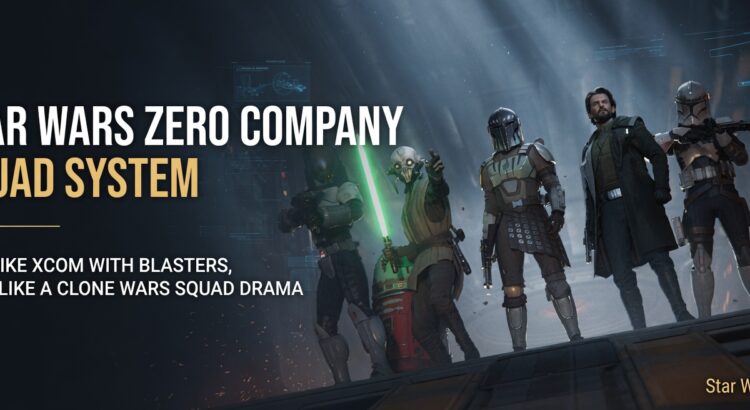
The easiest way to describe Star Wars Zero Company is still “Star Wars XCOM.”
It’s useful shorthand. Everyone gets it. Turn-based tactics, cover, squad management, bad decisions, probably at least one mission where you stare at the screen and whisper, “I’ve ruined everything.”
But the more EA, Bit Reactor, and Lucasfilm Games show of Zero Company, the less that comparison feels complete.
Yes, this is a tactics game built by people who know the genre inside out. Bit Reactor was founded by former Firaxis developers, and creative director Greg Foertsch and lead designer James Brawley both worked on modern XCOM projects.
The bones are there. The experience is there. The danger of losing someone because you got greedy with a flank is almost certainly there too.
But Zero Company is starting to sound like it wants players to care about the squad in a much more personal, messy, BioWare-ish way.
Not just “my sniper has 94 aim and a funny helmet.”
More like: “these people have history, tension, bonds, grudges, and now I’m sending them into a nightmare because the Clone Wars apparently didn’t have enough problems already.”
Zero Company Is Built Around People, Not Just Classes
EA describes Star Wars Zero Company as a single-player, turn-based tactics game set in the twilight of the Clone Wars, with players stepping into the role of Hawks, a former Galactic Republic officer leading an unconventional squad of Operators for hire.
That squad includes a hardened Clone Trooper, a Mandalorian warrior from Clan Verminoth, a Jedi Padawan, an Umbaran sniper, and more.
That’s already more interesting than a blank roster of disposable soldiers.
To be fair, custom squads are great. Half the appeal of tactics games is giving someone a stupid name, watching them survive four impossible missions, and then becoming emotionally compromised when a droid with a basic blaster ruins your week.
Zero Company seems to understand that part.
The game uses both authored Operators and custom Operators. Authored Operators join naturally as the story unfolds, while custom Operators can be recruited by the player and customized with appearance, clothing, voice, and name.
That combination is smart.
Authored characters give the campaign personality. Custom characters give players ownership. One side makes the story feel written. The other makes the squad feel yours.
We already dug into this in our piece on why Star Wars Zero Company’s best idea might be making your squad actually matter, and the point still stands. The squad is not just the delivery system for tactical abilities. It looks like the emotional spine of the whole game.
The Bond System Could Be the Real Hook
The most interesting system so far is not cover. It is not action points. It is not even permadeath, though that one is obviously sitting in the corner looking very pleased with itself.
It is the squad bond system.
Squad members improve as they deploy together, building relationships that can unlock new combat synergies. Lead designer James Brawley has explained that characters track relationships with each other across the roster, and those bonds can improve through missions, support actions, assists, and choices made on the strategy layer.
That is a very good tactics idea.
It means squad composition is not just about roles. It is about relationships.
You might bring the best medic because the mission demands it. But maybe your clone trooper has built stronger synergy with someone else. Maybe two characters who started badly together eventually become a terrifying pair. Maybe the squad that makes tactical sense is not the squad that makes emotional sense.
Good.
That’s where these games live.
A perfect tactics mission is not just “I used the right ability at the right time.” It is “these two characters bailed each other out because I had forced them through hell together for ten hours.”
It also explains why the lack of romance is not necessarily a weakness. We covered that separately in Star Wars Zero Company Has No Romance, and That Might Be the Right Call. This game seems less interested in dating-sim energy and more interested in battlefield trust, found family, and the kind of bonds that are built while everything around you is on fire.
Very Star Wars, really.
Permadeath Makes Those Bonds More Dangerous
Here is where it gets mean.
Zero Company does not just want you to care about the squad. It also seems perfectly happy to put them in danger.
Permadeath has already been confirmed as part of the game, including for custom and story characters. That changes everything. Suddenly bonds are not just a nice progression system. They become a risk.
The longer two characters fight together, the more valuable they become. The more valuable they become, the worse it feels when you misread a battlefield and one of them does not come home.
We wrote more about that in Star Wars Zero Company’s scariest feature is not combat, it’s who can die, and it may still be the game’s sharpest design choice.
A tactics game with disposable units can be stressful.
A tactics game with squad bonds, authored characters, custom operatives, and permanent loss can become personal.
That is a much better fit for Clone Wars storytelling than it first sounds. The era is already built around soldiers, loyalty, doomed causes, and people trying to survive inside a war that has been rigged from the start.
The Den Makes It More Than a Mission List
Between missions, Zero Company sends players back to the Den, the squad’s base of operations.
That matters more than a menu screen usually should.
This is where players manage the squad, gather intel, build toward the next operation, and deal with the wider war around them. The best squad games understand that downtime matters. You need the mission, sure. But you also need the place where your crew breathes, argues, recovers, upgrades, plans, and quietly turns into a found family with explosives.
The Den is where Zero Company could stop feeling like a string of tactical boards and start feeling like a campaign.
A base gives the squad somewhere to belong. A place to return to. A place that makes the next mission feel like more than another objective marker.
That also fits the wider pre-order and customization push around the game. We already put together a Star Wars Zero Company pre-order bonuses guide, and while the extras are cosmetic, they do point toward how much the game wants players to shape the look and identity of their team.
For a squad tactics game, that is not fluff.
That is part of the fantasy.
The Villain Side Sounds Weird in the Right Way
The squad may be the heart of Zero Company, but the enemy matters too.
The game’s central threat is tied to the Infinite Coil, a Separatist-aligned cult led by Kundri Fathom. That is a much better hook than simply “go fight more battle droids.”
We already wrote about why Zero Company’s Separatist cult villain might be its most interesting detail, because that kind of weird Clone Wars threat gives the game room to breathe.
The Clone Wars era is packed with familiar pieces. Jedi generals. Clone troopers. Separatist commanders. Battle droids. Mandalorians. Political collapse. Excellent helmets.
But a tactics campaign needs more than recognizable scenery.
A cult gives the story something stranger to chew on. Something that can sit between military conflict, dark side weirdness, and the ugly little corners of the war that never make it into heroic Republic briefings.
That is exactly the kind of Star Wars problem a squad like Zero Company should be sent to deal with.
Probably badly, at first.
Still a Tactics Game, Thankfully
None of this means Zero Company is abandoning tactics for drama.
The combat still sounds very much like the point. The game is built around squad positioning, battlefield roles, enemy units as turn-by-turn problems, and a shared resource called Advantage that players can build and spend on stronger abilities.
That sounds promising.
A Star Wars tactics game needs spectacle, but it also needs restraint. You want rockets, Jedi moves, sniper shots, droid support, Mandalorian nonsense, and very bad plans that somehow work. But if every turn is just fireworks, none of it matters.
A shared resource that forces players to choose when to make the big play gives the combat a better chance of staying tense.
There is also a clean practical reason Zero Company is getting attention: it is launching as a focused $50 release, not a giant $70 or $80 blockbuster. We covered that in Star Wars Zero Company’s $50 price tag might be its smartest move, and the price still helps the whole pitch feel sharper.
This does not need to be the biggest Star Wars game in the galaxy.
It needs to be the right size, with the right systems, for the audience that has wanted this kind of game for years.
This Is the Right Star Wars Shape for the Genre
The reason all of this works on paper is simple: Star Wars is not just about battles.
It is about crews.
The Ghost crew. Rogue One. Clone squads. Mandalorian clans. Jedi and clones who should not trust each other but somehow do. Scoundrels, soldiers, idealists, cowards, believers, cynics, and weird little droids all getting thrown into the same problem until something either breaks or becomes family.
That is the lane Zero Company should be driving in.
A pure tactical Star Wars game would already be interesting. We have wanted that for years. But a tactical Star Wars game where squad relationships feed combat, and combat feeds story, has a much better shot at becoming something players remember for more than clean mechanics.
The XCOM comparison will not go away.
It shouldn’t. It is useful, and the lineage is real.
But if Star Wars Zero Company works, people may stop describing it as “XCOM with blasters” and start talking about the specific squad they built, the characters they lost, the bonds they forged, and the terrible mission where everything went wrong because someone got heroic at exactly the worst time.
That sounds much more Star Wars.
And much more dangerous.
Author

Related Posts

Star Wars Zero Company Pre-Order Bonuses Guide: Is the Crystalline Astromech Pack Worth It?
The Untold History of Spider Solitaire, the Game That Quietly Outlasted Every AAA Launch of Its Era
Star Wars: Starfighter Leak Points to Jedi Refuge, Lightsaber Duel, and a Very Different Post-Skywalker Story
Star Wars: Rebel Assault II – The Hidden Empire (1995): The Sequel That Let Star Wars Get Even More Cinematic


Star Wars Battlefront II’s New Kyber Update Sounds Like the Biggest One Yet
Star Wars Battlefront II Is Back in the PS4 Charts, Because This Game Refuses to Die
Star Wars Battlefront II’s Hero Starfighters Update Still Deserves a Small Victory Lap
SWTOR’s 8.0 Era Is Starting to Take Shape After Legacy Reborn