Not every Star Wars game arrives with the same kind of cultural blast radius as Knights of the Old Republic, Battlefront, or Empire at War. Some games land in a quieter lane, tied to a specific platform, a specific moment, and a fanbase that only really discovers later that something interesting was hiding there all along. Star Wars: Lethal Alliance is one of those games.
Released in late 2006 for PSP and Nintendo DS, Lethal Alliance came from Ubisoft during a period when Star Wars games were branching into all kinds of directions. On one end of the spectrum, the franchise had blockbuster strategy and shooter titles. On the other, it had handheld experiments like this one: an original story, a new lead character, and a mission set in the volatile gap between Revenge of the Sith and A New Hope. Ubisoft positioned it as the first original Star Wars game built specifically for handheld play, which instantly gave it a distinct place in the wider history of the franchise.
That alone makes it worth revisiting. For a big archive project like the complete Star Wars games list, Lethal Alliance is exactly the kind of title that keeps the timeline from turning into a highlight reel of only the biggest names. It represents a different kind of Star Wars game: smaller in scale, more platform-specific, and deeply tied to the mid-2000s handheld boom. It also belongs firmly in the Star Wars Games (2006–2012) era, where the franchise was experimenting with genre variety, new publishing relationships, and new corners of the galaxy.

Introduction
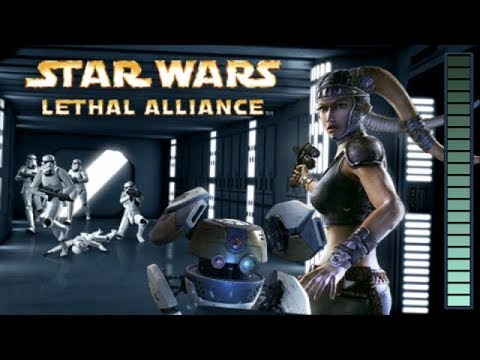
Star Wars: Lethal Alliance follows Rianna Saren, a Twi’lek mercenary, and Zeeo, her droid partner, in a story set just a few months before Episode IV. Early in the game, Rianna is pulled into Rebel operations, with the mission gradually circling around Imperial secrets and the Death Star. That setup placed the game in one of the most compelling narrative windows in the franchise, years before Disney-era projects turned the post-prequel timeline into a major storytelling goldmine.
What makes Lethal Alliance stand out is that it did not center a Jedi, a clone trooper, or a direct movie retelling. Rianna was a new character made specifically for the game, and Ubisoft leaned into the idea of telling a portable Star Wars story through a blaster-wielding operative rather than another lightsaber hero. That choice gave the game a slightly grittier, more underworld-adjacent tone, even when the mechanics stayed accessible and clearly built for handheld play.
In other words, this was not trying to be KOTOR on a tiny screen. It was trying to be a cinematic handheld action game with a clean hook, a fresh duo, and just enough mythology to make longtime fans pay attention. It did not fully break through, but it absolutely earned a place in the archive.
Game Information
Star Wars: Lethal Alliance was published by Ubisoft and released in December 2006 for the PlayStation Portable and Nintendo DS. The PSP version was developed by Ubisoft Montreal, while the DS version was handled by Ubisoft Casablanca. GameFAQs lists the PSP release in the US as December 7, 2006, and the DS release in the US as December 14, 2006. Contemporary reporting around the announcement described it as part of a new long-term licensing partnership between Ubisoft and LucasArts.
Genre-wise, it sits in the action-adventure space, with a mix of third-person shooting, traversal, gadget use, platforming, and light puzzle-solving. The game was designed around the partnership between Rianna and Zeeo, rather than around Force powers or vehicle combat. That identity matters, because it helped Lethal Alliance avoid feeling like a stripped-down imitation of bigger console Star Wars games. Instead, it tried to build its own lane.
Collectors hunting down a physical copy today can still find the Nintendo DS version through Amazon here: Star Wars: Lethal Alliance – Nintendo DS.
Gameplay Overview
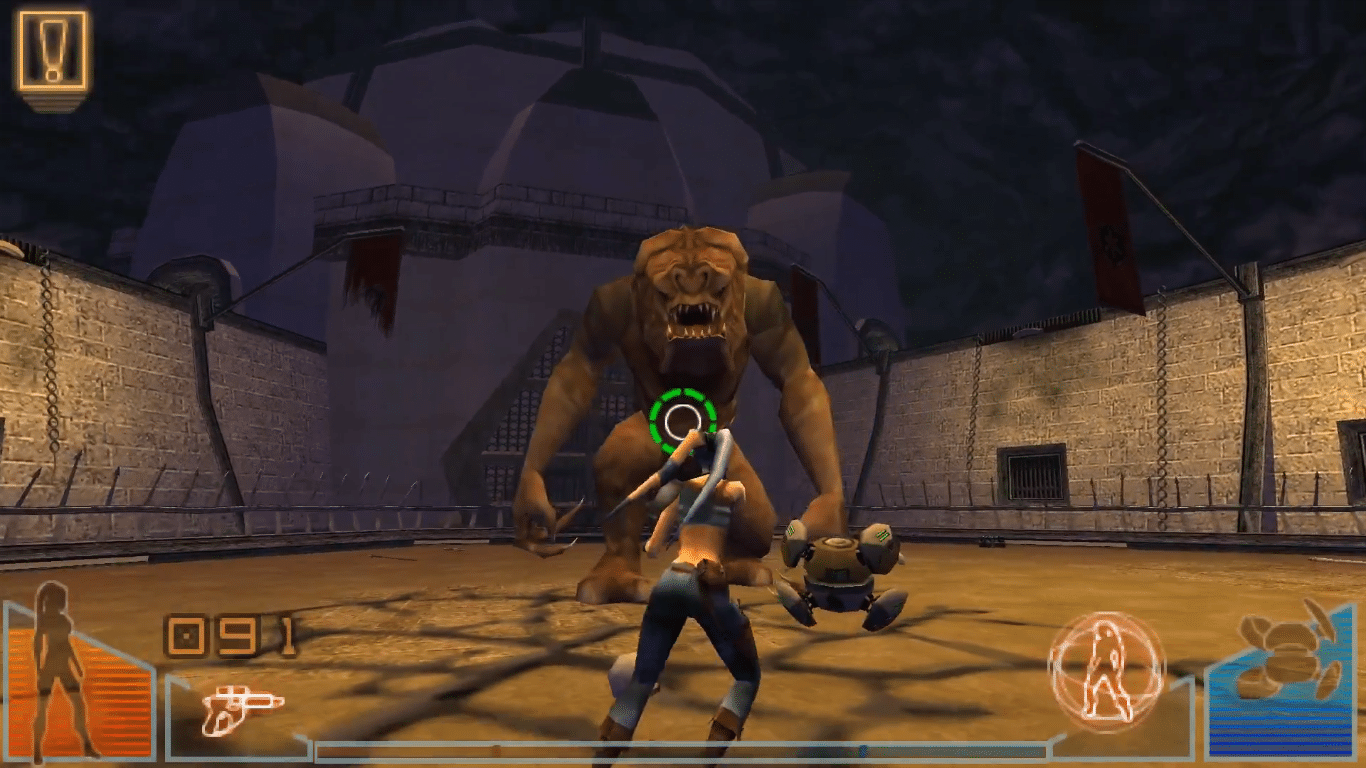
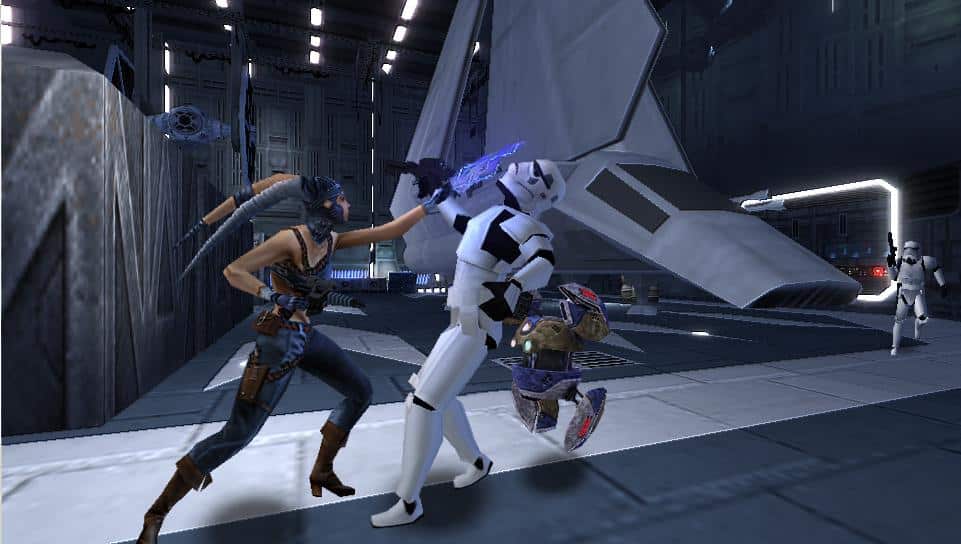
The main gameplay hook in Lethal Alliance is the cooperative relationship between Rianna and Zeeo. Rianna handles combat, movement, acrobatics, and infiltration, while Zeeo serves as both a gameplay tool and story companion. Together, they can slice terminals, trigger special team-based moves, shield against blaster fire, and navigate areas that would be inaccessible to Rianna alone. GameSpot’s review described that partnership as the cornerstone of the gameplay, and that is really the most accurate summary of what the game is trying to do.
That design gives the game a more gadget-driven feel than many of its contemporaries. Rianna is not a Jedi and never pretends to be one. She fights more like a resourceful operative, with blasters, agility, and environmental interaction doing the heavy lifting. Review coverage at the time pointed out that the game’s co-op mechanics, context-sensitive actions, and movement gave it a slight Prince of Persia or Tomb Raider flavor, especially during traversal and puzzle-like sections.
Ubisoft also built the two handheld versions around the strengths of their hardware. The PSP version focused more on presentation and traditional controls, while the DS release leaned into platform-specific features and multiplayer options. The overall structure was the same, but the platforms were clearly not treated as interchangeable boxes. That was common in 2006 handheld development, but it is still worth noting because it helped Lethal Alliance feel more tailored than many licensed games of the time.
The game’s missions move players through recognizable Star Wars environments and story beats, including classic locations like Tatooine and the Death Star, alongside places created or expanded for this adventure such as Despayre, Danuta, and Alderaan. The result is a game that feels connected to film-era iconography without being fully trapped inside movie retread territory.
Historical Context
To understand why Lethal Alliance matters, it helps to look at 2006 as a whole. This was not a sleepy year for Star Wars games. It gave players the acclaimed strategy experience of Star Wars: Empire at War, then followed it with Empire at War – Forces of Corruption, while also delivering LEGO Star Wars II and Lethal Alliance. That is a remarkably varied spread: real-time strategy, expansion content, family-friendly co-op action, and a portable original adventure all in the same calendar year.
That diversity says a lot about the state of the franchise. LucasArts was not just leaning on one template. Star Wars games in the mid-2000s could be tactical, cinematic, comedic, military, or portable. Lethal Alliance sits inside that broader pattern as proof that publishers still saw room for experimentation, especially on devices like the PSP and DS that were exploding in popularity.
The game is also notable for its timeline placement. Senior producer Bertrand Helias told GameSpot that the team chose the space between Episodes III and IV because there were still mysteries and untold stories in that part of the saga. In hindsight, that feels almost prophetic. Modern Star Wars storytelling has spent years mining that same era, but Lethal Alliance was already there in 2006, exploring a galaxy under Imperial rule while the Rebellion was still taking shape in the shadows.
There is also a nice continuity thread here for fans of Kyle Katarn. Lethal Alliance features him as part of its story, which makes it a natural companion piece to earlier archive entries like Star Wars Jedi Knight II: Jedi Outcast and Star Wars Jedi Knight: Jedi Academy. He is not the star here, but his presence helps tie the game into the wider Legends-era fabric that so many mid-2000s fans still remember fondly.
Development
Ubisoft announced Lethal Alliance in August 2006 as the first official title in an ongoing long-term licensing partnership with LucasArts. That gave the project importance beyond its platform footprint. Even though it was “just” a handheld game to many players at the time, it was also a visible sign that Ubisoft was stepping into the Star Wars publishing space in a meaningful way.
The developers emphasized close collaboration with LucasArts when shaping both the story and the game’s mechanics. According to Helias, the goal was to respect the complexity of the Star Wars universe while still having room to create original gameplay systems and an original lead character. That tension between canon-minded caution and creative freedom is obvious in the finished product. Lethal Alliance plays it relatively safe in broad narrative terms, but it does try to carve out a fresh perspective through Rianna and Zeeo rather than simply reusing better-known archetypes.
Ubisoft’s messaging also pushed the idea that this was a handheld-first Star Wars experience, not a compromised port. The company explicitly described it as the first original Star Wars game built to take full advantage of both PSP and DS capabilities. In practice, that meant a design built around collaborative mechanics, device-specific features, and a slightly more compact action-adventure structure.
From an archive perspective, that matters. Handheld games are often treated like side notes in franchise histories, but Lethal Alliance was not an afterthought. It was positioned as a deliberate attempt to expand Star Wars gaming onto platforms that were booming in the mid-2000s, while also testing whether original characters could carry a game outside the shadow of the films.
Reception
Critical reception for Star Wars: Lethal Alliance was mixed, which is probably the cleanest and fairest way to frame it. Metacritic lists the PSP version at 61 and the DS version at 57, both in the “mixed or average” range. That tells the story pretty quickly: reviewers generally saw enough good ideas to avoid writing it off entirely, but not enough polish or surprise to rank it among the stronger Star Wars releases of the era.
The praise usually centered on the Rianna-and-Zeeo partnership, the variety in movement and mission design, and the fact that the game at least attempted something a little different. GameSpot’s review said the shooting was uninspired but argued that the overall variety was enough to please action and Star Wars fans. Other reviews highlighted Rianna as a refreshing alternative to the usual lightsaber formula.
The criticism, meanwhile, focused on targeting issues, bland mission structure in places, and a general sense that the game never fully rose above solid handheld competence. Some outlets described it as mediocre, while others said it was enjoyable primarily for dedicated Star Wars fans rather than for the broader action-adventure audience. That may sound harsh, but it is also why the game remains interesting. It was not a disaster. It was a mid-tier experiment with just enough personality to avoid being forgotten entirely.
Legacy
Lethal Alliance never became a major pillar of the Star Wars gaming canon, and nobody is pretending it did. It did not launch a long-running subseries. Rianna Saren did not become a mainstream franchise icon. The game also arrived in an era stacked with bigger and more celebrated titles, which meant it was always going to have trouble commanding the spotlight.
And yet, its legacy is better than its reputation. It is one of those archive entries that becomes more valuable with distance. Looking back, Lethal Alliance stands as an example of how flexible Star Wars gaming had become by the mid-2000s. Not every title needed to be a sprawling RPG, a full-scale shooter, or a strategy game. There was room for a compact, character-driven, handheld action story set in a meaningful corner of the timeline.
It also anticipated later franchise habits in subtle ways. The idea of telling smaller-scale stories between major film events, using new protagonists to fill in the gaps around Imperial rule and Death Star secrecy, is now a familiar Star Wars move. Lethal Alliance was doing that years earlier, even if it did so within the constraints of a PSP/DS release.
For collectors, handheld historians, and longtime Legends fans, that makes it more than a curiosity. It makes it a snapshot of a particular Star Wars design philosophy: one where even the side roads of the franchise still had something interesting happening on them.
Collectors who want to add it to the shelf can grab the DS version here: Star Wars: Lethal Alliance – Nintendo DS.
Trivia and Interesting Facts
One of the most notable facts about Lethal Alliance is that Ubisoft marketed it as the first original Star Wars game created specifically for handheld systems, rather than as a scaled-down adaptation of something built elsewhere first. That made it an important milestone in Ubisoft’s early Star Wars history.
Rianna Saren was introduced as a brand-new character for the game, and Ubisoft clearly wanted her to feel different from the traditional Jedi-led formula. GameSpot even framed her more as a Han Solo-style mercenary than a Luke Skywalker archetype. That comparison gets at the game’s tone pretty well.
The story’s connection to the Death Star is especially interesting in hindsight. Years before Rogue One made stolen Death Star plans one of the most famous mission premises in Star Wars, Lethal Alliance was already playing in that narrative neighborhood. It did so in Legends continuity, of course, but the overlap is hard to ignore.
The game also pulled in recognizable names like Princess Leia, Darth Vader, Boba Fett, and Kyle Katarn, mixing familiar faces with original material in a way that felt very typical of mid-2000s Expanded Universe storytelling.
FAQ
What is Star Wars: Lethal Alliance?
It is a 2006 handheld Star Wars action-adventure game released for PSP and Nintendo DS, starring Rianna Saren and her droid companion Zeeo.
When does Star Wars: Lethal Alliance take place?
The story takes place between Revenge of the Sith and A New Hope, specifically just a few months before Episode IV according to Ubisoft’s producer comments at the time.
Who is the main character in Lethal Alliance?
The main playable hero is Rianna Saren, a Twi’lek mercenary created specifically for the game. Zeeo, her droid companion, is central to both the gameplay and the story.
Was Star Wars: Lethal Alliance well reviewed?
It received mixed reviews. Metacritic lists the PSP version at 61 and the DS version at 57, which places both versions in the mixed-to-average range.
Why is Star Wars: Lethal Alliance important in Star Wars game history?
It matters because it was an original handheld-first Star Wars game, part of Ubisoft’s early partnership with LucasArts, and an example of how varied the franchise’s game output had become by 2006.
Where does it fit in the SWTORStrategies archive?
It belongs in the broader complete Star Wars games list and specifically in the Star Wars Games (2006–2012) era hub.
Internal Links
For readers exploring the broader timeline, this article should link naturally to the complete Star Wars games archive hub and the Star Wars Games (2006–2012) era page.
Relevant related archive entries also include:
- Star Wars: Empire at War (2006)
- Star Wars: Empire at War – Forces of Corruption (2006)
- Star Wars Jedi Knight II: Jedi Outcast (2002)
- Star Wars Jedi Knight: Jedi Academy (2003)
And for anyone building out a physical collection, the DS version is here:
Stay connected with the galaxy’s latest updates!
Follow us on X, Facebook, Instagram, bsky or Pinterest for exclusive content, mod guides, Star Wars gaming news, and more. Your support helps keep the Holonet alive—one click at a time.
Author

Related Posts

Hayden Christensen Says His Daughter Still Hasn’t Watched His Star Wars Movies
Marvel’s New Galaxy’s Edge Comic Brings Luke, Leia, and Chewie to Batuu
Star Wars: A New Hope Began Filming 50 Years Ago Today-
Kelly Marie Tran Reflects on The Last Jedi Backlash Nearly 10 Years Later


On This Day in Battlefront: Battlefront II’s Progression Update Released 8 Years Ago-
Star Wars Outlaws and Jedi: Survivor Both Get a PS5 Pro Graphics Boost -
SWG Legends Looks Back on 10 Years of Growth — From “Galaxy Is Full” to New Content Questions -
SWTOR Rolls Out Small 7.8.1a Bugfix Patch After Master’s Enigma Update