
There is something very pure about early Star Wars games.
They did not try to retell entire trilogies. They did not promise open worlds, branching morality, or a hundred hours of side content. Most of them just looked at one great movie moment and said, more or less, “Right, that bit. Let’s make that playable.”
That is exactly what Return of the Jedi: Death Star Battle does.
Released by Parker Brothers in 1983 for the Atari 2600, Atari 5200, and Atari 8-bit computers, and later bundled for the ZX Spectrum+ in 1985, it was one of the earliest Star Wars video games and the first one based on Return of the Jedi.
And if The Empire Strikes Back (1982) showed how early home consoles could turn Hoth into a tiny, scrappy war, then Death Star Battle is the next logical step: same early-console ambition, same movie-to-game instinct, just with the Falcon, the second Death Star, and a lot more panicked flying through space junk. It also sits very naturally beside Star Wars: The Arcade Game (1983), because both games understand the same essential Star Wars truth: if you put players into a famous vehicle assault and keep the pressure on, you are already halfway home. That makes it a strong fit for both the Complete List of All Star Wars Games Ever Made (1979–Present) and the Star Wars Games (1979–1989) hub.
The early Star Wars formula was simple: pick the coolest scene and go
That might sound reductive, but honestly, it was smart design.
In the early 1980s, home hardware was not going to let developers build a fully realized Return of the Jedi experience. Nobody was about to simulate Jabba’s Palace, Endor, speeder bikes, shield bunker sabotage, and the Emperor’s throne room on an Atari cartridge without some very creative lying. So Parker Brothers did the practical thing and focused on one dramatic thread: the Millennium Falcon assault on the second Death Star.
That was exactly the kind of scene these machines could work with. It had motion, danger, clear objectives, and a built-in escalation curve. You start by fighting off enemy ships, then wait for the right opening in the Death Star’s energy shield, then carve a path into the station, then destroy the reactor and somehow survive the resulting explosion. That is not just a strong movie climax. It is a strong arcade-style game loop.
And that is probably the most important thing about Death Star Battle: it shows that early Star Wars developers already understood the assignment. Long before games got bigger, they knew Star Wars was at its best in interactive form when it gave players one concentrated fantasy and let them wrestle with it.
You are the Falcon, and the odds are not exactly improving
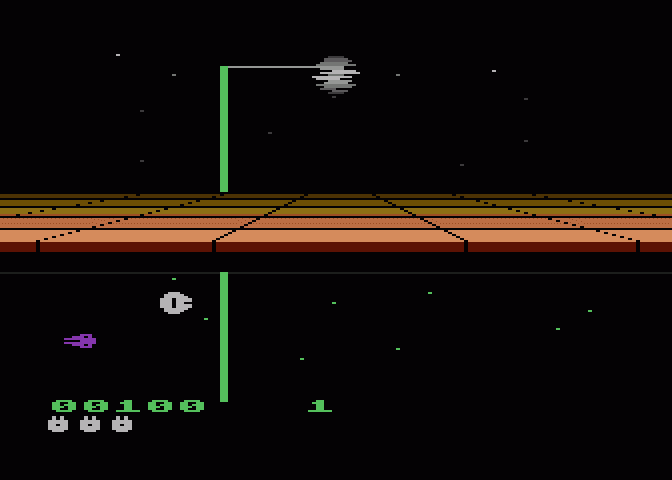
The core gameplay is split into two stages.
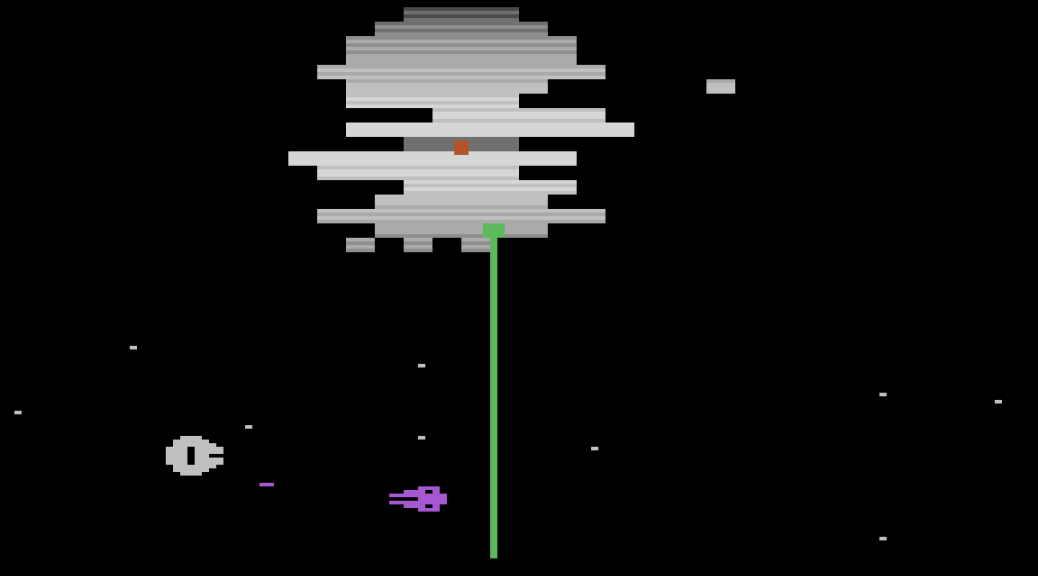
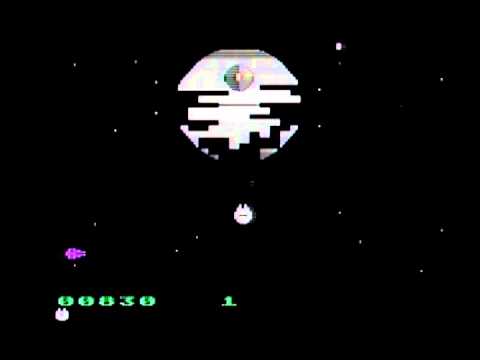
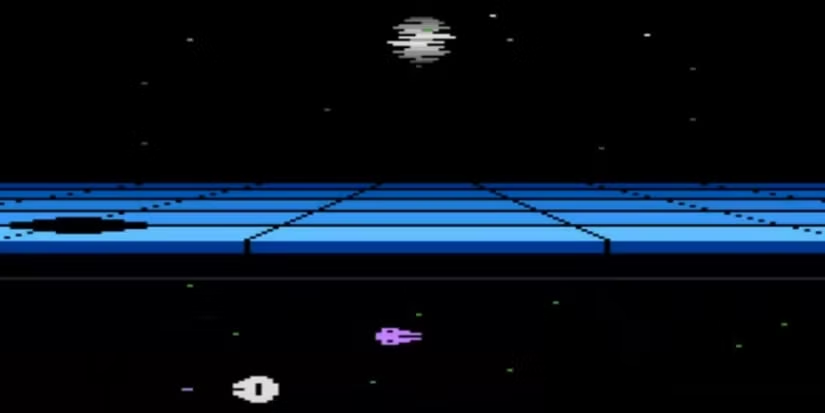
In the first, you pilot the Millennium Falcon and shoot down waves of TIE fighters while waiting for a chance to pass through the Death Star’s energy shield. In the second, you attack sections of the unfinished Death Star until you open a route to the reactor, destroy it, and then try not to get obliterated by the explosive aftermath. Once you succeed, the game loops with a higher difficulty level.
That is a good structure. A very early-’80s structure, sure, but a good one.
It gives the game a sense of progression that feels more dramatic than “score as many points as possible until your hands stop cooperating.” There is a mission arc here, however stripped down. Survive the approach. Slip through the defenses. Attack the weak point. Escape the blast. It is the kind of design that makes a primitive game feel bigger than it really is, because it gives your actions context.
Also, it helps that the fantasy still works. Flying the Falcon through enemy fire toward the Death Star is just inherently appealing. Star Wars did not exactly pick a weak set piece to build around.
It is not subtle, but subtlety was never really the job
One of the most charming things about Death Star Battle is how direct it is.
There is no fake complexity here. No attempt to pretend the Atari 2600 is secretly a NASA computer if you just believe hard enough. The screen tells you what is happening. The threats are obvious. The action is immediate. The rhythm is clear. You shoot, dodge, wait for your moment, and hope the game is feeling generous.
That bluntness is not a weakness. It is part of the craft.
A lot of early licensed games failed because they did not know what to simplify and what to preserve. Death Star Battle makes the right trade. It strips away almost everything except the broad shape of the movie sequence and the feeling of being under pressure in a famous ship. The result is not a deep simulation of the Battle of Endor, but it does not need to be. It just needs to make you feel, for a few minutes, like the Falcon’s survival is somehow resting on your increasingly sweaty thumbs.
And honestly, that is a perfectly respectable use of an evening.
The game also says a lot about Parker Brothers
Like The Empire Strikes Back, this was part of Parker Brothers’ early run at translating giant movie licenses into home-console form. And that makes it historically useful, because you can see the company learning in public.
By 1983, Parker Brothers already had some Star Wars experience behind it, and Death Star Battle feels like a more confident expression of the same basic idea: take one major film moment, reduce it to its most recognizable interactive shape, and build a complete game loop around it. It is not dramatically more sophisticated than The Empire Strikes Back, but it is another clear example of how early licensed design was evolving at home.
It also helps that Parker Brothers chose scenes with obvious motion and tension. Hoth worked because walkers marching toward a base is inherently gameable. The Death Star II attack works because it is basically a pressure sequence with a giant target at the end. In both cases, the company showed a decent instinct for what parts of Star Wars were easiest to convert into gameplay without losing all the flavor.
Not every early movie game had that instinct. Quite a few just had a box.
The cover art was doing a lot of heavy lifting too
This is one of those lovely retro details that deserves more attention.
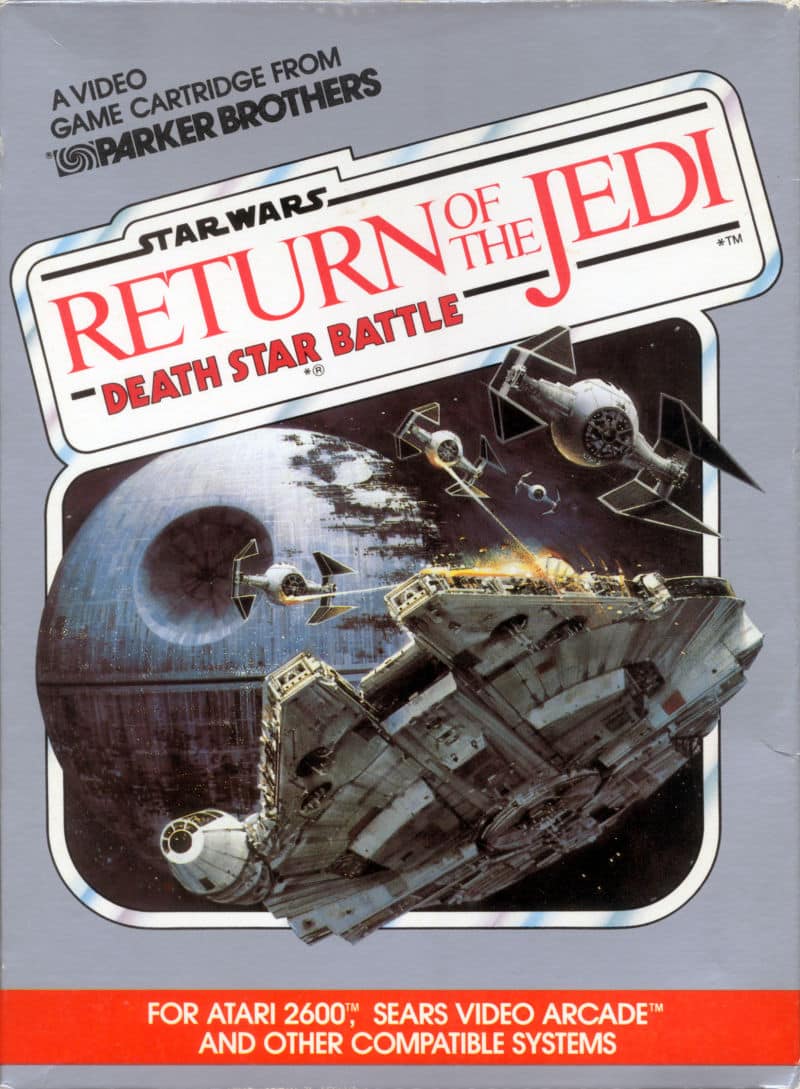
The game’s cover art was created by John Berkey, the science-fiction artist who also produced some of the earliest poster art tied to the original Star Wars film. The cover shows the Falcon fleeing the partially constructed Death Star while being pursued by TIE interceptors, and it looks fantastic in that big, painterly, high-drama sci-fi way Berkey was known for.
And yes, this matters.
Because with early home games, the package was often part of the experience. The artwork helped bridge the gap between the tiny abstraction on screen and the epic fantasy in your head. You looked at the box, then looked at the Atari output, and your brain did the rest. That was the deal. Berkey’s art gave Death Star Battle a lot of that large-scale cinematic energy that the actual hardware could only hint at.
Old-school licensed games were often half cartridge, half imagination. The good ones knew it.
It is an early Star Wars game, but not an early arcade hit in disguise
This is maybe the most useful way to place Death Star Battle historically.
It is not doing what Atari’s Star Wars: The Arcade Game (1983) was doing. That cabinet was all about spectacle, immersion, vector graphics, and making the player feel physically dropped into the Death Star trench run. Death Star Battle is much more domestic than that. Smaller. Simpler. Less theatrical. More cartridge than machine.
But that contrast is exactly why it is interesting.
It shows the two big paths early Star Wars games were taking in parallel. Arcades pushed toward sensation and hardware spectacle. Home consoles pushed toward abstraction and replayable loops. Both were trying to capture movie fantasy. They just had very different tools.
And if you are trying to understand how Star Wars gaming got from 1982 Atari cartridges to things like Battle for Naboo or later vehicle-heavy console games, this contrast matters. The core instinct is already there in both branches: put the player inside a famous Star Wars vehicle sequence and let the pressure do the work.
Was it groundbreaking? Not exactly. Was it important? Absolutely.
This is where retro writing needs a bit of honesty.
Return of the Jedi: Death Star Battle is not some lost masterpiece. It is not secretly the deepest game of 1983. It is not going to overthrow anyone’s all-time favorites list and demand a new throne. It is a small early-’80s shoot-’em-up built around one strong movie scene, and it behaves accordingly.
But importance is not the same thing as scale.
What makes the game worth talking about now is how clearly it fits into the early Star Wars design language. It is one of the first games built around Return of the Jedi. It follows directly after The Empire Strikes Back in Parker Brothers’ little run of home-console Star Wars adaptations. It shows the franchise sticking to its strongest interactive habit very early: translate the most exciting vehicle/action sequences into playable loops as fast as possible.
That makes it less of a giant monument and more of a key brick in the wall. And honestly, archives should care about those too.
The thing it gets right is momentum
If there is one reason Death Star Battle still works better than some other early licensed games, it is momentum.
It moves. The objectives are obvious. The threat is constant. The second stage in particular gives you a satisfying sense of “break through, hit the core, get out,” which is exactly the kind of compact drama old hardware needed. There is not much wasted motion in the concept.
That matters because early games live or die on loop quality. You cannot hide behind production values or deep menus when the machine has almost nothing to spare. The action itself has to pull its weight. Here, it mostly does.
And there is something admirable about how cleanly the game understands its own job. It is not trying to give you all of Return of the Jedi. It is giving you one specific thrill from Return of the Jedi and asking you to chase it over and over. For a 1983 home game, that is a sensible and fairly elegant bit of design.
Why it belongs in the archive
This is the part where Death Star Battle really earns its place.
It helps complete the picture that The Empire Strikes Back (1982) started. That earlier game showed the first officially licensed Star Wars gaming fantasy on a home console: defend Hoth in a snowspeeder. Death Star Battle shows Parker Brothers taking the same approach and applying it to Return of the Jedi’s climactic assault. Together, they form a very clear early pattern. Star Wars games were born not as giant adventures, but as concentrated attempts to let people step into the most playable scenes from the films.
That is useful historically, especially now that we have started moving backward into the late ’70s and early ’80s part of the archive. If you want retro sites to take the work seriously, this is exactly the kind of title you need to cover well. Not because it is flashy, but because it tells the truth about how the medium and the license actually grew together.
Sometimes the history is not in the biggest game.
Sometimes it is in the repeated pattern.
The view from Endor orbit
There are more sophisticated Star Wars games. More famous ones. More technically impressive ones. More beloved ones.
But Return of the Jedi: Death Star Battle still matters because it shows Star Wars gaming in one of its earliest, clearest forms: one ship, one huge target, one escalating problem, and just enough imagination to fill in the rest.
That was enough to build a whole era on.
And if The Empire Strikes Back gave Star Wars gaming its first real Hoth battle, then Death Star Battle gave it another crucial lesson right after: once you find the right scene, players will meet you halfway.
Especially if the Falcon is involved.
FAQ
What is Return of the Jedi: Death Star Battle?
It is a 1983 shoot-’em-up from Parker Brothers based on the Millennium Falcon’s attack on the second Death Star in Return of the Jedi.
What platforms was Return of the Jedi: Death Star Battle released on?
It released in 1983 for the Atari 2600, Atari 5200, and Atari 8-bit computers, and later appeared in 1985 as part of a software bundle for the ZX Spectrum+.
Was it the first Return of the Jedi video game?
Yes. It is recognized as the first video game based on Return of the Jedi.
What do you do in the game?
You pilot the Millennium Falcon, destroy TIE fighters, pass through an opening in the Death Star’s energy shield, blast your way to the reactor, and then try to survive the explosion.
Who made Return of the Jedi: Death Star Battle?
The game was developed and published by Parker Brothers.
Why is it worth revisiting today?
Because it is one of the earliest examples of Star Wars games taking a single great movie action sequence and turning it into a clean, replayable home-console game loop.
Author

Related Posts

Star Wars Zero Company Rating Hints the Empire Is Coming Early
Michael Pennington, Return of the Jedi’s Moff Jerjerrod, Has Passed Away
The Mandalorian and Grogu Is Already Climbing Disney+ Before Theaters-
The Mandalorian and Grogu Is Getting a Prequel Comic — After the Movie



Sam Witwer Says Maul: Shadow Lord Season 2 Has Pressure – Good-
Kathleen Kennedy Says Jon Favreau Is Pushing Star Wars Forward Like George Lucas Did -
Pedro Pascal Wants to Keep Playing Din Djarin After The Mandalorian and Grogu -
Battlefront II’s Battle Point Event Is Live — Reinforcements Are Cheap Today