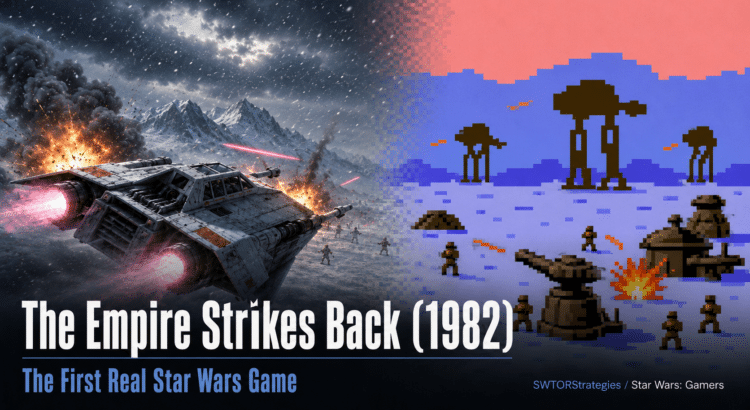
Before Star Wars games became sprawling RPGs, online sandboxes, or massive shooter franchises, they had to solve a much simpler problem: how do you squeeze one of the biggest sci-fi universes on Earth into a home console that could barely keep its own snowstorm together?
The Empire Strikes Back for the Atari 2600 is one of the first answers to that question, and it is still a fascinating one.
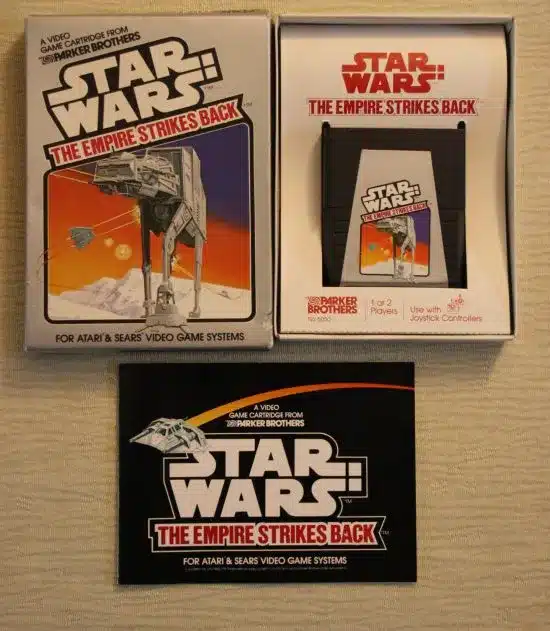
Released by Parker Brothers for the Atari 2600 in July 1982, with an Intellivision version following in 1983, the game is widely recognized as the first officially licensed Star Wars video game. It was programmed by Rex Bradford, based on the Battle of Hoth, and built around one very clean fantasy: you are in a snowspeeder, Imperial walkers are marching toward Echo Base, and your day is getting worse at speed.
That makes it a perfect follow-up to Star Wars: The Arcade Game (1983). Atari’s arcade classic showed how good Star Wars could feel once you dropped players directly into a movie moment. The Empire Strikes Back is even earlier and even rougher, but that is exactly why it matters. It shows the point where Star Wars gaming was still learning how to walk — or, in this case, how to fly low over Hoth and pray the hardware held together. It also earns a very natural place in both the Complete List of All Star Wars Games Ever Made (1979–Present) and the Star Wars Games (1979–1989) hub.
Before trench runs and vector glory, there was Hoth on a cartridge
What makes this game so historically important is not subtle: it got there first.
Not first Star Wars-inspired software in the broadest imaginable sense, maybe, but first as an officially licensed Lucasfilm Star Wars video game. That matters because it means The Empire Strikes Back is where the long, strange, beautiful, occasionally broken Star Wars gaming lineage really starts to feel real. Before developers were building Jedi epics or multiplayer warzones, Parker Brothers was already asking players to hold the line against AT-ATs on Hoth.
And honestly, Hoth was a smart choice.
If you were making a Star Wars game in 1982, you were not going to recreate the whole movie. The hardware was not exactly standing there with infinite memory and a relaxed attitude. You needed one strong scene, one strong idea, and something a player could understand instantly. The opening battle of The Empire Strikes Back gave them exactly that: desperate defense, giant walkers, tiny speeders, and immediate danger. Even in primitive form, that still sells. “Stop the walkers before they reach the base” is a perfectly good video game pitch now. In 1982, it was gold.
The game is simple, brutal, and kind of brilliant
If you have never played it, the basic setup is beautifully blunt.
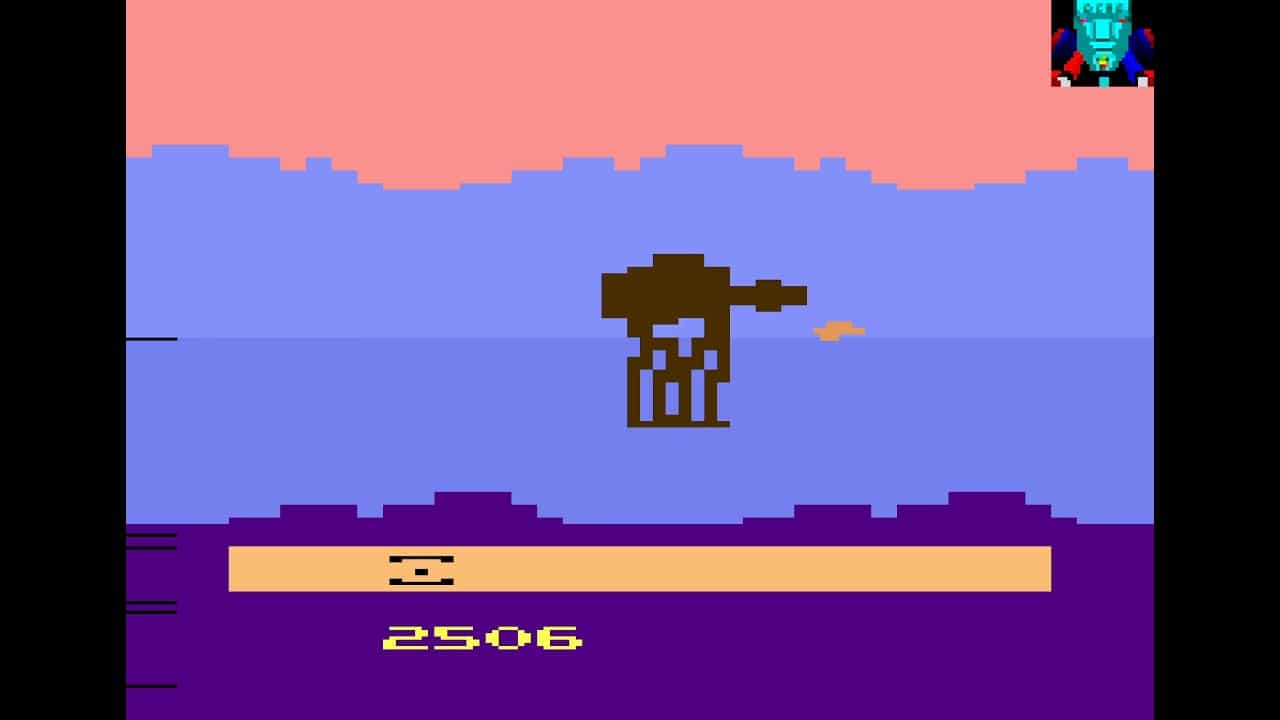
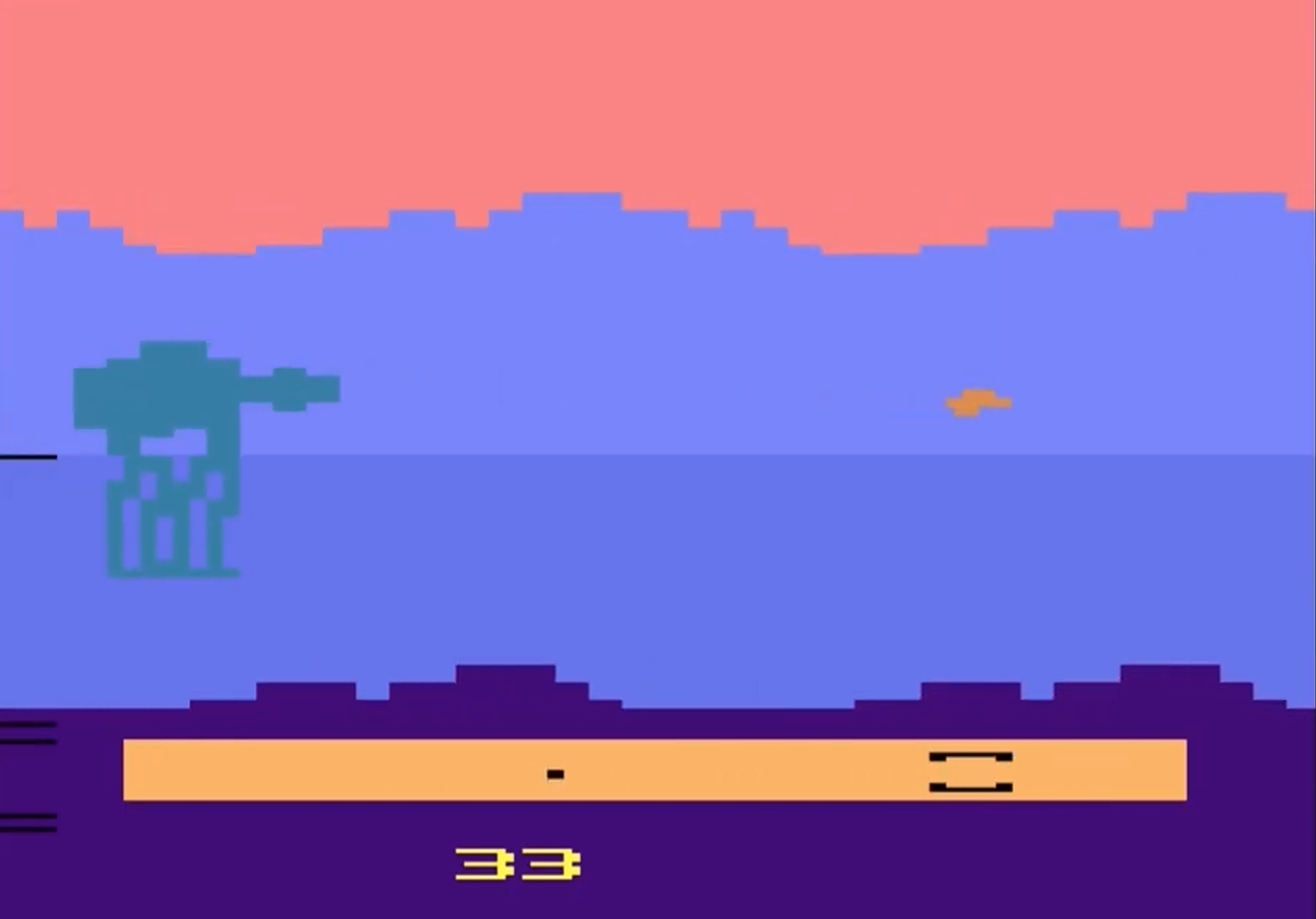
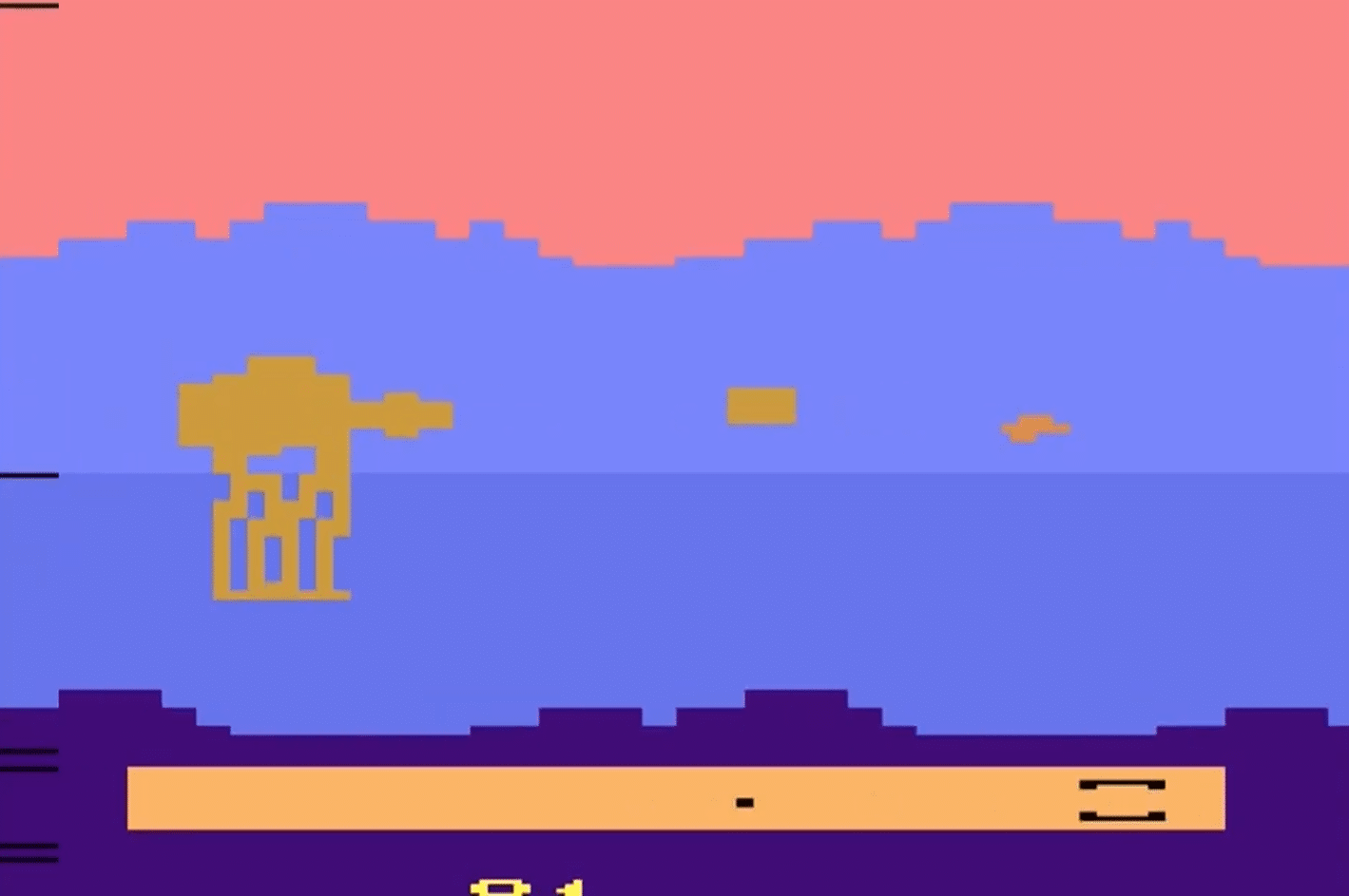
You control a Rebel snowspeeder as AT-AT walkers march relentlessly across Hoth toward Echo Base. You shoot them over and over, because these things are heavily armored and not especially interested in dying quickly. A radar strip at the bottom helps track threats. If the lead walker reaches the base, or if you lose your last speeder, that is game over. No medal ceremony. No inspirational music. Just Imperial efficiency.
The game gets more interesting once you see the little details Parker Brothers and Rex Bradford managed to squeeze in. Your speeder changes color as it takes damage. You can land to repair it. Some versions of the walkers can physically collide with you. Some modes add a “smart bomb” attack launched from a flashing weak point. And if you survive long enough, the Force briefly kicks in, making your speeder invulnerable for a short stretch while it flashes in all kinds of glorious Atari panic colors.
That is one of my favorite things about it, honestly. The game is primitive, yes, but it is not lifeless. It is constantly trying to translate Star Wars drama into tiny system-friendly ideas. Weak points. Shield damage. Last-second survival boosts. It does not have much room to work with, but it still keeps trying to be Star Wars instead of just wearing the logo.
No tow cable, no problem… sort of
Of course, once you start talking about a Hoth game, the obvious question shows up immediately:
Can you wrap the tow cable around the AT-AT’s legs like Luke does in the film?
No. And that is one of those wonderfully early-video-game answers where the real explanation is basically, “We would have loved to, but have you seen this machine?”
In a later interview, programmer Rex Bradford said Parker Brothers only got into Atari 2600 development in fall 1981, and The Empire Strikes Back became the company’s first VCS release. He also explained that the team had wanted to include a power generator and even discussed roping the walkers’ legs, but the Atari VCS constraints got in the way. They simply could not figure out how to fit everything in visually with the way the sprites and missiles were already being used.
That detail is important, because it tells you a lot about the game’s legacy. This was not a case of lazy adaptation. This was a case of developers trying to cram more Star Wars into the cartridge than the cartridge really wanted to hold. They were already thinking in terms of cinematic touches and recognizably Star Wars flourishes. The machine just kept reminding them that 1982 was still 1982.
And really, that is part of the charm. You can feel the ambition straining against the plastic.
Parker Brothers was still learning this craft in public
Another thing that makes The Empire Strikes Back interesting is where it came from.
Parker Brothers was, well, Parker Brothers. A board game company. Monopoly people. Risk people. The sort of brand that, on paper, does not immediately scream “future custodians of the first official Star Wars game.” But Bradford’s later recollection makes it clear that the company was moving into Atari development quickly in the early ’80s, hiring programmers and reverse-engineering the hardware as it went. Bradford even said he wrote a 6502 disassembler for the team’s development process and that Empire was the first game Parker Brothers released for the VCS.
That context matters, because it helps explain why the game feels both impressive and scrappy. This was a company learning how to do this while carrying a huge license. There is a very specific old-school game-development energy in that: no giant live-service team, no endless patch plan, just smart people staring at hard limitations and asking how much Hoth they can get away with.
Quite a lot, as it turns out.
It was not just historically important. It actually sold
One of the easiest traps with early retro writing is treating every old licensed game like a dusty museum piece that people only pretend to care about now.
That is not really the story here.
The Empire Strikes Back was a commercial success. Period reporting, as summarized in later references, says it was one of Parker Brothers’ two best-selling video games of 1982, alongside Frogger, with the two titles reportedly selling a combined 3 million cartridges. That is not trivial success. That is “yes, people absolutely wanted this” success.
And that makes sense. You have to remember what the idea itself meant at the time. For a kid with an Atari 2600 in 1982, the chance to play the Battle of Hoth at home was not some minor curiosity. It was a pretty huge deal. Today we are spoiled rotten by comparison. Back then, if your TV let you pretend to be a Rebel pilot for a few minutes, that was enough to carry a whole afternoon.
Reviewers were split, which feels weirdly appropriate
The reception story is also surprisingly fun.
The game got mixed reviews, and the split says a lot about what it was. According to later summaries of contemporary coverage, Video magazine praised the game’s “zingy graphics” and called its audio-visual effects “absolutely first-rate,” even recommending it for most Atari VCS owners. Meanwhile, science-fiction writer Harlan Ellison, reviewing it for Video Review, absolutely unloaded on it, calling it a “shamelessly exploitative little toy” and a “time-wasting enterprise.” Another reviewer, Ed Driscoll in The Space Gamer, landed closer to the middle, saying the good outweighed the bad and calling it an excellent start for Parker Brothers on the VCS.
Honestly? That all tracks.
This is exactly the kind of game that would divide people. If you came to it wanting a tiny but energetic Hoth shooter on the Atari 2600, there is a lot to like. If you came to it hoping the impossible magic of the film could somehow survive intact in cartridge form, you were probably going to have a rougher time. That tension — between what players imagined and what the machine could do — is basically the whole story of early licensed gaming.
What still works now
The best thing about The Empire Strikes Back is that it still has a pulse.
Not every early ’80s licensed game can say that with a straight face. Some are historically important and actively miserable to revisit. This one is more forgiving. It is fast. It is readable. It has pressure. It has rhythm. It understands escalation. The walkers keep coming, the threat grows, the pace gets meaner, and before long you are not admiring the game as an artifact anymore — you are just trying not to lose. That is a good sign.
It also helps that the game picks one scene and commits. There is no bloat here. No fake depth. No wandering around a menu trying to decide whether your snowspeeder build should focus on survivability. It is just Hoth, panic, and persistence. That sort of design can age very well when the core loop is strong enough.
And here, it mostly is.
Why it matters in the archive
This is why I think The Empire Strikes Back is such a useful next article after Star Wars: The Arcade Game (1983).
The arcade game showed Star Wars becoming immediate, cinematic, and beautifully focused. The Empire Strikes Back shows the earlier home-console version of that same instinct. It is rougher, smaller, less spectacular, and much more bound by the limitations of its machine — but the fantasy is already there. Be the pilot. Stop the Empire. Live the scene.
That is the thread.
It also helps connect the later vehicle-heavy games we have been covering — from Star Wars: Battle for Naboo (2000) back through Atari’s arcade work and now to the first licensed cartridge. You can feel the line running through them. Star Wars games have been obsessed with putting players inside famous vehicle combat ever since the beginning. This is one of the earliest and clearest examples of that instinct in action.
The view from Hoth
There are more advanced Star Wars games. More polished ones. More famous ones. More generous ones.
But The Empire Strikes Back still matters because it got something fundamental right very early: it understood that Star Wars did not need to be fully simulated to feel exciting. It just needed the right scene, the right pressure, and the right sense of being there.
That was enough in 1982.
In a lot of ways, it still is.
FAQ
What is The Empire Strikes Back (1982)?
It is Parker Brothers’ 1982 Atari 2600 game based on the Battle of Hoth from The Empire Strikes Back, and it is widely recognized as the first officially licensed Star Wars video game.
Who made The Empire Strikes Back game?
The Atari 2600 version was published by Parker Brothers and programmed by Rex Bradford, with Sam Kjellman credited as designer in game databases and retrospectives.
What do you do in the game?
You pilot a Rebel snowspeeder on Hoth and try to destroy AT-AT walkers before the lead walker reaches Echo Base or you run out of speeders.
Can you trip the walkers with a tow cable?
No. Rex Bradford later said that ideas like the power generator and tow-cable takedown were discussed, but Atari VCS hardware constraints kept them out of the final game.
Was the game successful?
Yes. Period reporting summarized in later references says it was one of Parker Brothers’ two best-selling video games of 1982, alongside Frogger.
Why is it worth revisiting today?
Because it is not just historically important. It is also one of the earliest examples of a Star Wars game locking onto a single great movie fantasy and building a tight, playable loop around it.