
There are some Star Wars games that feel important because they were polished masterpieces. Then there are some that feel important because they captured a moment — a very specific, very chaotic, very exciting moment in Star Wars history. Star Wars: Shadows of the Empire belongs firmly in that second category.
Released for Nintendo 64 in 1996 and later for Windows in 1997, Shadows of the Empire was much more than just another licensed action game. It arrived as part of the larger Shadows of the Empire multimedia project, a massive Lucasfilm push that included a bestselling novel, comic books, toys, trading cards, a soundtrack by Joel McNeely, and the game itself. StarWars.com later described 1996’s Shadows of the Empire rollout as a “multimedia assault” that gave fans “everything but a film,” which is still probably the cleanest way to explain why this project felt so huge at the time.
That bigger context matters, because Shadows of the Empire was never just selling gameplay. It was selling an era, a mood, and a new corner of the galaxy set between The Empire Strikes Back and Return of the Jedi. Players stepped into the boots of Dash Rendar, a swaggering mercenary who was clearly designed to fill some of the Han Solo-shaped hole left by carbonite. Around him were Prince Xizor, Black Sun, bounty hunters, Imperial intrigue, and one of the most aggressively 1990s Expanded Universe energy fields ever created. And somehow, it worked. Messily, imperfectly, but memorably.
For the SWTORStrategies archive, this is exactly the kind of game that deserves a proper spotlight. It fits naturally into the complete Star Wars games list, and more specifically into the Star Wars Games (1990–1999) hub, where it stands as one of the defining late-90s Star Wars releases.
Introduction
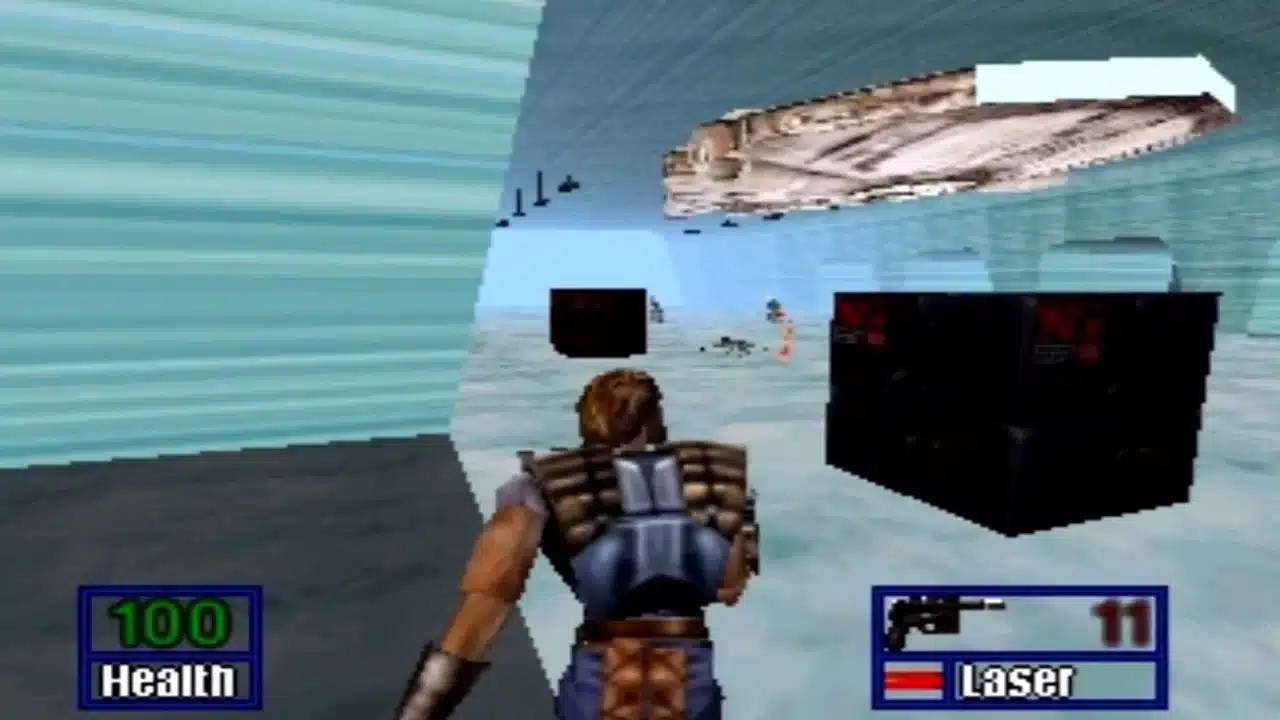
If you were around for the Nintendo 64 era, there is a decent chance you remember Shadows of the Empire for one thing before anything else: the Battle of Hoth opening level. That mission burned itself into a lot of brains for good reason. It dropped players into a snowspeeder, let them strafe walkers across the ice, and delivered one of the earliest truly cinematic “you are in the movie now” feelings that a Star Wars game had managed at the time. GameSpot’s review was almost giddy about that first stage, calling it a “flawlessly executed piece of video gaming” with “outstanding graphics, fantastic sound effects, and a true sensation of flight.”
The rest of the game did not always stay at that altitude, but the opening level told players exactly what LucasArts was aiming for: a varied, technically ambitious Star Wars action game that could jump between on-foot shooting, vehicle combat, platforming, and cinematic set pieces. That ambition is a huge part of why Shadows of the Empire still matters. It was not content to be a simple tie-in. It wanted to feel like a missing chapter of the original trilogy, even if the seams showed.
Game Information
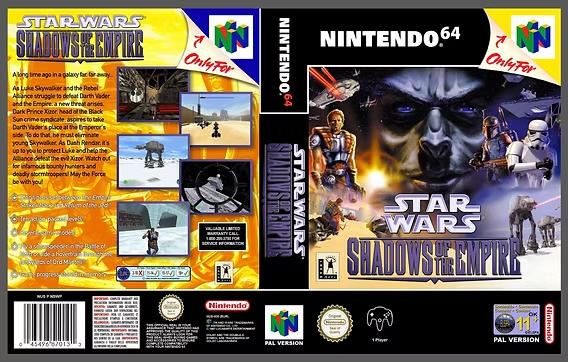
Star Wars: Shadows of the Empire was developed by LucasArts. It launched on Nintendo 64 in 1996, with a Windows version following in 1997. MobyGames lists the original release in 1996 for Nintendo 64 and the Windows release in 1997, while Nintendo’s official product page places it among the early Nintendo 64 releases and describes it as a ten-stage action game starring Dash Rendar.
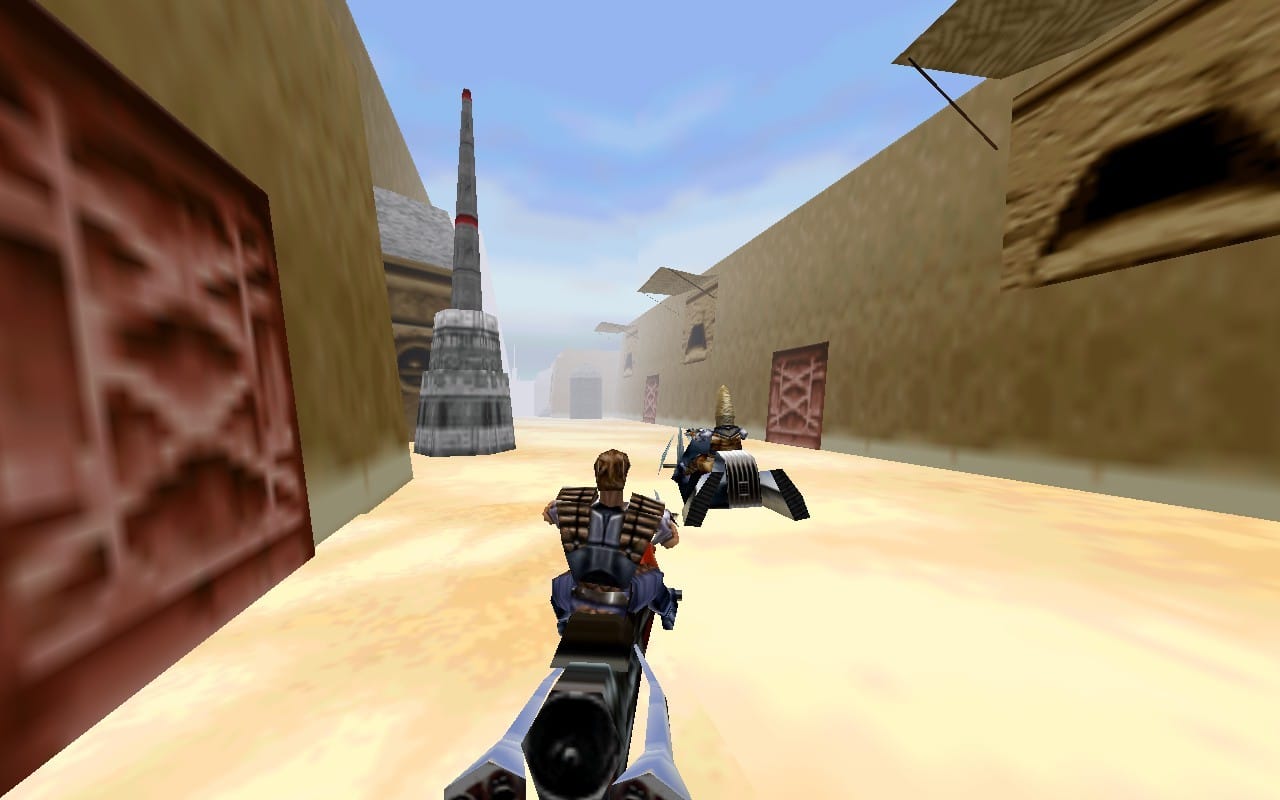
The game is generally classified as action, but that only tells part of the story. It blends third-person shooting, first-person shooting, vehicle missions, platforming, and set-piece traversal. GOG’s store description highlights five gameplay modes and a mix of vehicles and locations, including snowspeeders, speeder bikes, the Outrider, Mos Eisley, Hoth, Imperial City, Xizor’s palace, Gall Spaceport, and Ord Mantell.
For collectors or anyone wanting a physical copy on the shelf, here’s your subtle money link: Star Wars: Shadows of the Empire on Amazon.
Gameplay Overview
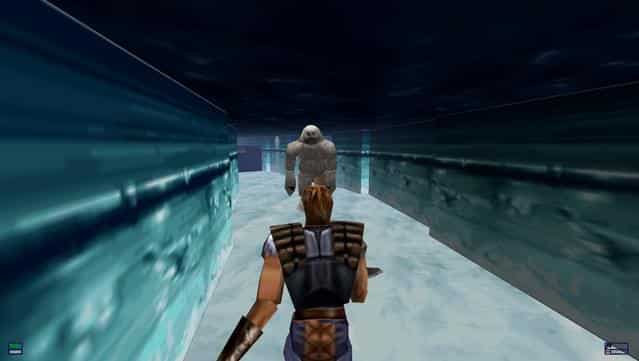
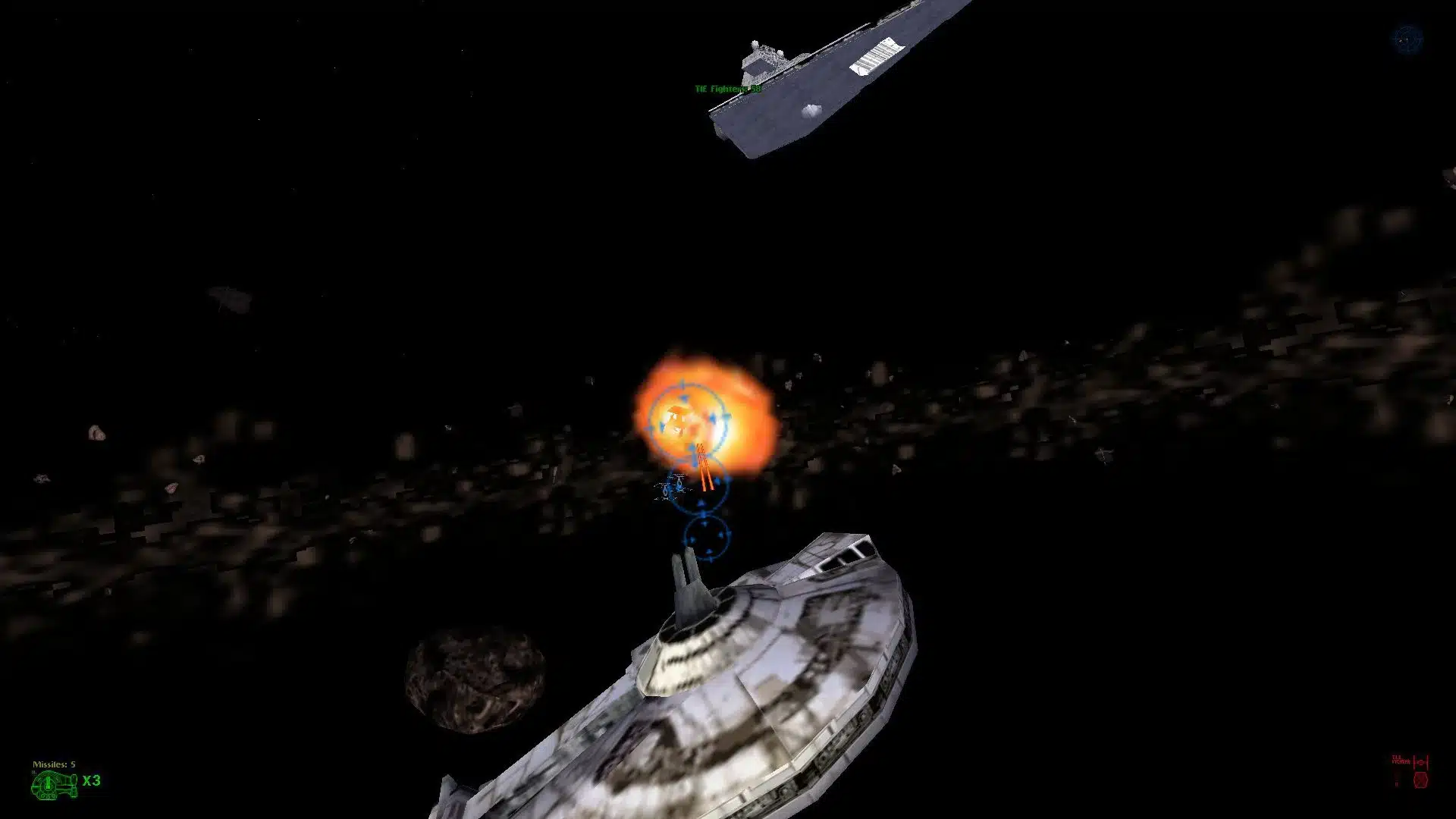
At a mechanical level, Shadows of the Empire is a game that refuses to sit still. One minute it is a flight-combat spectacle over Hoth. The next, it is a third-person shooter with Dash Rendar blasting stormtroopers through industrial corridors. Then it veers into jetpack navigation, speeder bike racing, train combat, or boss encounters that feel like the game is trying three separate design documents at once.
That variety is one of the game’s biggest strengths. Even critics who were lukewarm on the whole package tended to admit that Shadows of the Empire offered an unusual amount of gameplay spread for a 1996 console action title. GameSpot specifically noted that few games of the era offered flying, driving, swimming, and first-person shooting in one package.
There is a reason that still feels impressive. In the mid-90s, 3D game design was still figuring itself out in real time. Camera systems were awkward. Movement in polygonal spaces was not yet standardized. Console shooters were still trying to discover what “comfortable” even meant in a post-Doom, pre-dual-stick world. Shadows of the Empire threw itself into that messy frontier with a lot of confidence and not always enough restraint.
Dash himself controls like a character from that era: capable, but sometimes slippery, especially when platforming or navigating narrow ledges. The game offers different camera views, but GameSpot’s review called out the camera angles as a persistent issue, along with movement problems and a frustrating save system. That criticism has stuck for a reason. Shadows of the Empire can feel exciting one second and mildly aggravating the next.
Still, there is something undeniably charming about how much it tries. The Outrider missions feel like LucasArts wanted to bottle the cinematic rhythm of the films. The speeder bike sections push for speed and danger. The train and sewer levels lean into pulpy sci-fi adventure. Even when individual mechanics are rough, the broader design is always trying to make you feel like you are moving through a bigger Star Wars event, not just clearing disconnected stages.
Historical Context
To really understand Shadows of the Empire, you have to zoom out. In 1996, Star Wars was not yet the permanently roaring machine it is today. The Special Editions were still on the horizon. The prequels had not arrived. Lucasfilm needed a way to make the franchise feel alive again between theatrical milestones, and Shadows of the Empire became one of the boldest answers to that problem.
The project was designed as a multimedia event set between The Empire Strikes Back and Return of the Jedi, exploring the commercial and storytelling possibilities of a major film release without actually producing a movie. That included the novel, comic, soundtrack, toys, trading cards, and the game, all built around one shared story world. StarWars.com’s retrospective and the project overview both reinforce how wide-ranging that rollout was.
That made the game feel bigger than many licensed titles of its era. It was not just “the N64 Star Wars game.” It was the playable arm of a franchise-wide experiment. For many fans, especially in the 90s, Shadows of the Empire felt like a new Star Wars movie that somehow existed everywhere except the cinema.
And because this was 1996, that idea carried a lot of weight. Expanded Universe storytelling was thriving, but there was still novelty in seeing Lucasfilm coordinate books, comics, music, and games so aggressively around one brand-new story. In hindsight, it looks like an early prototype for the kind of cross-media synergy that entertainment companies chase constantly now. Back then, it felt strange, exciting, and a little unreal.
That is also why the game belongs so naturally in the 1990–1999 Star Wars games hub. It is not just representative of late-90s Star Wars gaming. It is representative of late-90s Star Wars as a whole.
Development
LucasArts built Shadows of the Empire as an early Nintendo 64 title, which meant working in a period when 3D console development was still raw and hardware expectations were shifting. The game’s development history reflects that. Contemporary and retrospective material indicates it was planned as one of the early showcase releases for Nintendo 64, with the final launch landing in December 1996 rather than at the North American launch itself.
That context helps explain the game’s split personality. On one hand, it wanted to be cinematic and expansive. On the other, it was wrestling with the limits of early 3D console design. The Nintendo 64 version used still-image story presentation rather than full FMV, while the later Windows release added voiced dialogue and fully animated cinematic scenes. Metacritic’s listing for the PC version explicitly notes those additions, and they remain one of the most noticeable differences between versions.
Music was another area where Shadows of the Empire punched above normal game standards for the era. Alongside the game, Lucasfilm commissioned a full score by Joel McNeely, performed by the Royal Scottish National Orchestra, with portions of that soundtrack used in the game itself. StarWars.com’s retrospective and the project overview both underscore how unusual and ambitious that soundtrack component was inside the wider multimedia push.
The result is a game that often feels like LucasArts trying to stretch beyond what the medium comfortably allowed at the time. Sometimes that ambition created rough edges. Sometimes it created magic.
Reception
Reception to Shadows of the Empire has always been a little split, which honestly feels appropriate for a game like this. MobyGames aggregates critic reception at 76%, while GameSpot’s later review lands at 7.1 and sums up the core problem neatly: the Hoth opener is fantastic, but the rest of the game does not consistently match it.
That pattern shows up again and again in how people remember the game. The praise usually centers on atmosphere, variety, sound design, and the sheer thrill of certain moments. GameSpot praised the ambiance, convincing graphics, strong sound effects, and the way the game could make you feel like you were lurking through “the bowels of the Empire’s darkest corners.”
The criticism, meanwhile, hits many of the same targets every time: camera issues, awkward movement, uneven difficulty, and a save system that could turn boss fights into a repeat-performance punishment ritual. None of that is imagined nostalgia distortion. Those were contemporary complaints too.
And yet, for many players, the roughness never killed the affection. Because Shadows of the Empire was so tied to the broader 1996 phenomenon, the game carried more emotional weight than a similar-quality licensed title might have. It was wrapped in the novel, the soundtrack, the toys, the comic art, and the sense that Star Wars had suddenly become loud again.
Legacy
The legacy of Shadows of the Empire is bigger than its raw mechanical quality. It is not remembered because it perfected third-person shooting. It is remembered because it embodied a particular kind of Star Wars ambition.
Dash Rendar became one of the most recognizable “non-film” Star Wars protagonists of the 90s. Prince Xizor became one of the standout villains of the Expanded Universe. The Outrider became iconic enough that later fans kept looking for it everywhere. The project itself became shorthand for a very specific kind of pre-prequel, Expanded Universe confidence — the era when Lucasfilm could build an entire event around a story wedged between two films and trust fans to show up for all of it.
From an archive perspective, Shadows of the Empire matters because it connects multiple threads at once. It is an important Nintendo 64-era release. It is a key Expanded Universe artifact. It is a snapshot of 90s multimedia marketing before that kind of strategy became standard. And it is also a reminder that Star Wars games were already experimenting with cinematic scale and cross-media storytelling long before modern blockbuster franchise planning made that feel normal.
If you are building out the broader archive through the complete Star Wars games list, this is one of the must-have entries. It is too important, too weird, and too deeply tied to its moment to skip.
Trivia and Interesting Facts
One of the most fascinating things about Shadows of the Empire is that the game was arguably the most visible part of a much larger Lucasfilm push. The project included a bestselling novel by Steve Perry, a Dark Horse comic adaptation, trading cards, toys, and an original soundtrack by Joel McNeely. It was designed to feel like a major Star Wars release even though there was no film attached.
The Windows release added voiced dialogue and animated cinematic scenes, giving it a more film-like presentation than the original Nintendo 64 version. That makes the PC edition an interesting historical footnote rather than just a straightforward port.
The Hoth opener remains the game’s most celebrated sequence by a mile. Even players who are mixed on the full campaign tend to remember that first mission as one of the most effective early attempts at making a Star Wars battle playable.
And yes, Dash Rendar is basically one of the most 90s Star Wars characters ever invented. That is not a complaint. It is almost the whole point.
FAQ
What is Star Wars: Shadows of the Empire?
It is a 1996 LucasArts action game for Nintendo 64, later released for Windows in 1997, set between The Empire Strikes Back and Return of the Jedi.
Who is the main character in Shadows of the Empire?
The game stars Dash Rendar, a mercenary who becomes entangled in the Rebel fight against Prince Xizor and Black Sun.
Why is Shadows of the Empire important?
Because it was part of a much larger 1996 multimedia project that included a novel, comic, soundtrack, toys, and more, making it one of the most ambitious non-film Star Wars releases of the 90s.
Was Shadows of the Empire well reviewed?
Reception was generally mixed-to-positive. Critics praised the atmosphere and the famous Hoth opener, but often criticized the controls, camera, and uneven quality across later levels.
Which hub should this article link to?
It should link to the complete Star Wars games list and the Star Wars Games (1990–1999) hub.
Internal Links
This article should naturally connect to the complete Star Wars games archive and the 1990–1999 Star Wars games hub.
If you want to add a light commerce link for collectors, this one fits naturally in the body or near the end:
Star Wars: Shadows of the Empire on Amazon
Stay connected with the galaxy’s latest updates!
Follow us on X, Facebook, Instagram, bsky or Pinterest for exclusive content, mod guides, Star Wars gaming news, and more. Your support helps keep the Holonet alive—one click at a time.
Author

Related Posts

Star Wars: Galactic Racer’s Internal Codename Appears to Have Been Project Griffin-
Ryan Gosling Says One Star Wars: Starfighter Scene Was “One of the Most Fun” He’s Ever Done 
Epic Hosting Star Wars Toolset Office Hours for Fortnite Creators
A Live Concert at the Lars Homestead Will Mark 50 Years of the Binary Sunset


-
John Boyega Says He’s Had Talks With Dave Filoni About Returning as Finn 
Star Wars: Lethal Alliance (2006): The Handheld Mission That Slipped Between the Films-
Hayden Christensen Says His Daughter Still Hasn’t Watched His Star Wars Movies 
Marvel’s New Galaxy’s Edge Comic Brings Luke, Leia, and Chewie to Batuu