
Most Star Wars games ask you to win a battle.
Star Wars: Rebellion asked you to administer the consequences.
It wanted to know where your ships were built, which planets paid for them, whether the local population supported your government, who was spying on your shipyards, which officer should command the fleet, and whether Luke Skywalker had enough spare time between diplomatic assignments to become a Jedi.
Then it opened another window.
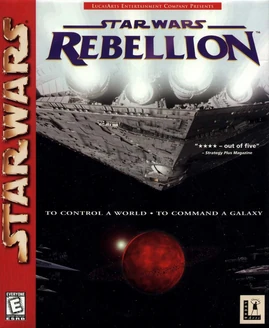
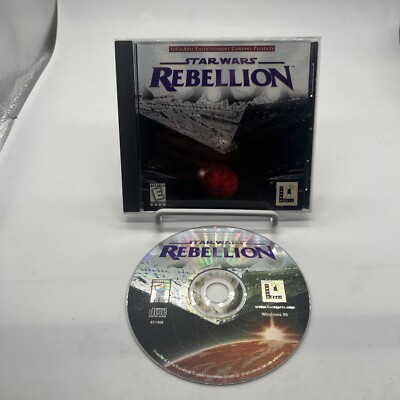
Released for Windows in 1998, Star Wars: Rebellion was developed by Coolhand Interactive and published by LucasArts. In the United Kingdom and Ireland, the same game was released as Star Wars: Supremacy. There are no separate campaigns, altered mechanics, or regional design differences hiding behind the second title. Rebellion and Supremacy are the same enormous, stubborn, fascinating strategy game.
The premise was almost irresponsibly ambitious.
Instead of focusing on one battlefield, one fleet, or one group of heroes, Rebellion attempted to simulate the entire Galactic Civil War after the destruction of the first Death Star. Players could command either the Rebel Alliance or the Galactic Empire across a galaxy containing as many as 200 planetary systems, while handling diplomacy, espionage, sabotage, research, manufacturing, fleet deployment, character development, planetary defense, political loyalty, and 3D space battles.
It was less “be Luke Skywalker” and more “please review the quarterly maintenance capacity of the Sluis sector.”
As part of our complete archive of every Star Wars game ever released, Rebellion belongs in the Star Wars games of the 1990s alongside the decade’s flight simulators, shooters, cinematic experiments, and console adventures.
Few of those games tried to contain this much Star Wars at once.
Even fewer made C-3PO sound like a middle manager delivering bad news about refinery output.
Rebellion or Supremacy?
The regional title difference has caused confusion for years.
North American players generally knew the game as Star Wars: Rebellion, while British and Irish boxes carried the name Star Wars: Supremacy. Contemporary coverage treated Supremacy simply as the UK title, and the underlying game remained unchanged.
That means someone remembering Supremacy is not talking about an expansion, sequel, enhanced version, or unusually serious British edition in which every Imperial officer apologizes before ordering a planetary bombardment.
It is Rebellion.
Same galaxy.
Same characters.
Same interface capable of making a new player feel like they have accidentally opened the control software for an actual military government.
For clarity, we will mainly call it Rebellion here, but both names belong in the archive.
The War Begins After Yavin
Rebellion begins shortly after the Rebel Alliance destroys the original Death Star.
The Empire remains overwhelmingly powerful, but the destruction of its battle station has changed the political balance. Neutral systems may now be persuaded that Imperial rule is not as permanent as it once appeared. The Rebels have momentum, famous heroes, and a hidden headquarters. The Empire still has Coruscant, established infrastructure, enormous military potential, and the ability to respond to political uncertainty with Star Destroyers.
The victory conditions reflect those different positions.
The Rebel player must capture Coruscant and hold Emperor Palpatine and Darth Vader. The Imperial player must locate and destroy the hidden Rebel headquarters while capturing Mon Mothma and Luke Skywalker. A shorter headquarters-only mode removes the character requirements, which is useful for anyone who would like to complete a campaign before their own government collapses.
This is not a scripted retelling of the original trilogy.
There is no requirement that Hoth must fall at the correct moment. Han Solo does not automatically end up frozen in carbonite. The second Death Star may never exist. Luke may be captured early, Vader may spend years running counter-espionage operations, and the Rebel headquarters can move whenever Imperial attention becomes uncomfortable.
The films provide the starting position.
Everything afterward belongs to the simulation.
A Grand Strategy Game Running in Real Time
Rebellion is frequently labelled an RTS, but that description can create the wrong expectation.
This is not Command & Conquer with stormtroopers.
You do not select workers, construct a barracks beside an enemy base, and produce 40 Rebel soldiers before lunch. Rebellion operates at a much larger strategic scale. Its closest relatives are 4X and grand-strategy games, although it combines those ideas with a real-time clock that can be paused or accelerated.
The galaxy is divided into sectors, with ten planetary systems in each. The smallest configuration contains ten sectors and 100 systems, while the largest stretches to 20 sectors and 200 systems. Many Rim systems begin unexplored, while the populated Core worlds usually contain stronger infrastructure, larger resource reserves, and much more political attention.
While you examine production queues or decide where to send Leia, the opposing faction continues acting.
Ships travel.
Missions unfold.
Facilities complete construction.
Neutral worlds shift politically.
Imperial agents discover things you preferred to keep undiscovered.
You can pause the clock, but the sense that the galaxy is constantly moving remains central to the experience.
It is not turn-based galactic chess.
It is galactic chess where every piece files paperwork while you are looking elsewhere.
The Empire and Alliance Play Different Wars
The two factions share the same fundamental systems, but their strategic positions create very different campaigns.
The Empire begins with Coruscant as a fixed and publicly known headquarters. It has the advantage of established authority, major fleets, powerful military units, and the ability to construct weapons the Alliance cannot match. Its problem is scale. Imperial territory must be defended, local loyalty must be maintained, and the Rebel headquarters may be hidden somewhere along the Galactic Rim.
The Alliance begins from a more fragile position.
Its headquarters appears at a randomly selected Rim system, invisible to the Imperial player until intelligence operations reveal it. Unlike Coruscant, the Rebel headquarters can be moved to another friendly system when Imperial pressure becomes dangerous. That makes the Alliance more elusive but also creates a constant strategic anxiety: once the Empire knows where the base is, every incoming fleet suddenly feels personal.
This asymmetry captures the political character of the films remarkably well.
The Empire controls through military presence, industrial power, and fear.
The Alliance survives through mobility, intelligence, diplomacy, and carefully chosen strikes.
Neither side is simply the other with different ship models.
Playing the Empire makes you feel powerful but overstretched.
Playing the Alliance makes you feel clever until three Star Destroyers arrive above the planet where Mon Mothma is currently giving a speech.
Planets Are More Than Places to Build Ships
Planetary control is the foundation of Rebellion, but occupation alone is not enough.
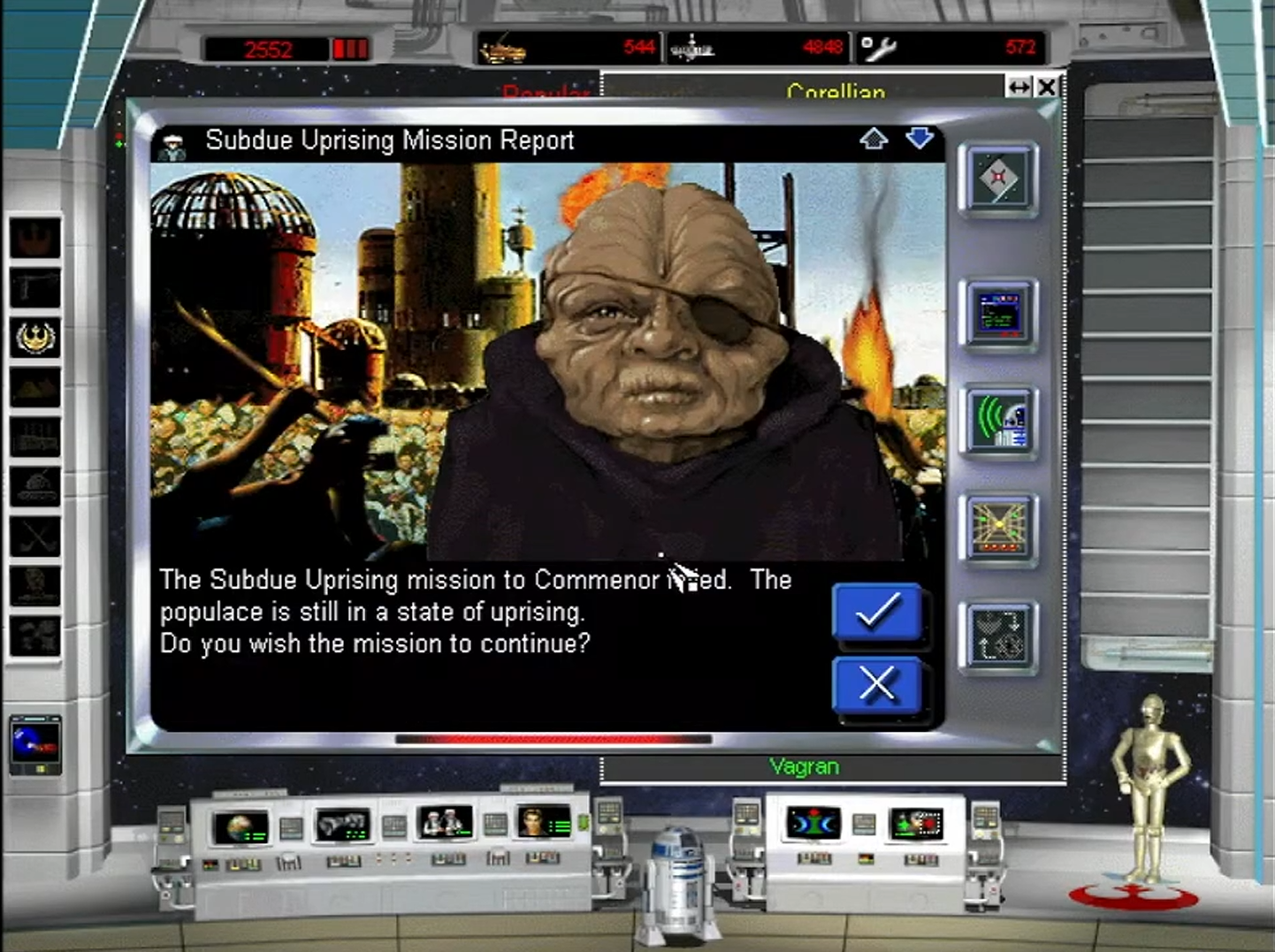
Every populated system has a level of popular support. Neutral worlds can be brought into your faction through diplomacy, while hostile or uncertain systems can be occupied with troops. Military control may deliver the planet immediately, but a population that does not support you can enter an uprising.
That creates a distinction many strategy games ignore.
Owning a planet and governing it successfully are not the same thing.
A skilled diplomat can gradually improve support, lower garrison requirements, and turn a nervous territory into a reliable part of your faction. A badly managed occupation consumes troops, invites rebellion, and forces you to spend resources suppressing people who were apparently not grateful for the arrival of several Imperial regiments.
Diplomacy can only be used on neutral or friendly systems. Uprisings require their own missions, and shifts in galactic support may be influenced by military victories, lost headquarters, captured leaders, and spectacularly poor political decisions.
The war is therefore fought on two maps at once.
One shows fleets and territories.
The other exists inside the loyalty values of the population.
You can conquer the galaxy by force.
Keeping it is another matter.
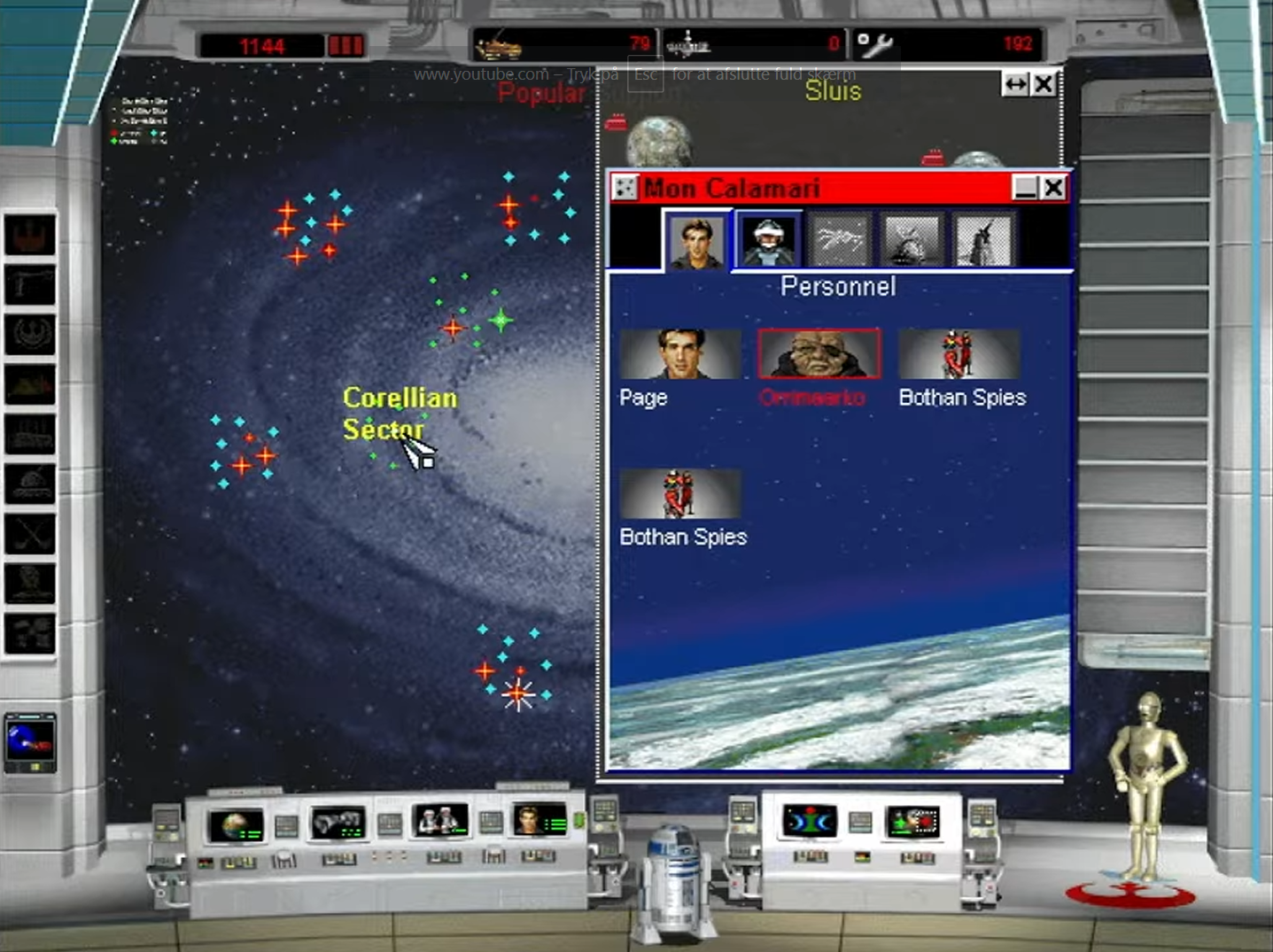
The Characters Turn Statistics Into Stories
The greatest idea in Rebellion is its character system.
The game includes 60 characters, divided evenly between the Empire and Alliance. Each side begins with a core group and recruits additional personnel as the campaign continues. The cast draws from the films and the old Expanded Universe, giving the game access to commanders, politicians, spies, smugglers, soldiers, and Force-sensitive figures rather than treating every important person as a battlefield unit.
The Alliance begins with figures including Mon Mothma, Luke Skywalker, Leia Organa, Han Solo, Chewbacca, Jan Dodonna, and Wedge Antilles. The Imperial core includes Palpatine, Vader, Jerjerrod, Ozzel, Piett, Veers, and Needa, with additional characters selected according to galaxy size.
Characters have abilities in areas such as diplomacy, espionage, combat, and leadership. Some can perform research. Others make effective admirals, generals, or planetary commanders.
That means assigning a character is rarely about finding the person with the largest number.
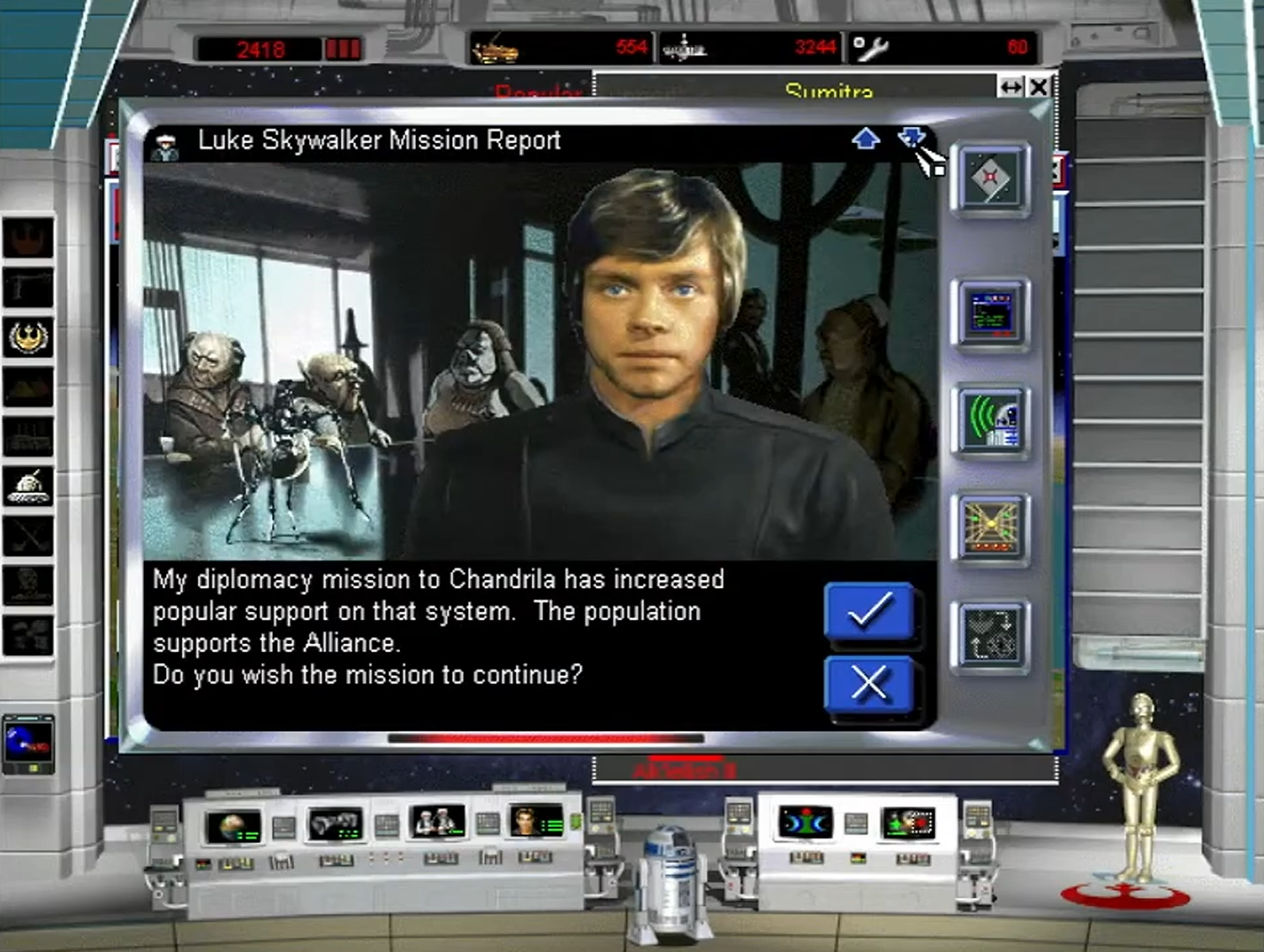
Leia is an obvious choice for diplomacy, but using her to win political support means she cannot simultaneously command troops or help rescue another captured hero. Han is an excellent operative, but he may be too valuable to risk on a poorly supported mission. Vader can hunt Rebel agents and discover potential Force users, but every day spent on espionage is a day he is not commanding an Imperial fleet.
The game turns time into the most important character resource.
Luke Skywalker cannot be everywhere.
Neither can Darth Vader.
Apparently even the Force has scheduling conflicts.
Missions Make the Galactic War Personal
Characters and special-forces units can be assigned to a wide range of missions.
Diplomacy increases support.
Espionage gathers information.
Sabotage destroys facilities or military units.
Abduction attempts to capture enemy personnel.
Rescue operations recover captured allies.
Incite Uprising missions weaken enemy control.
Research missions unlock improved ships, troops, and facilities.
Reconnaissance explores unknown systems.
The player can also attach decoys to dangerous operations, sending additional qualified agents to draw attention away from the real objective.
Success is not guaranteed.
Characters can fail, become injured, be captured, or die. Enemy personnel may foil a mission before it properly begins. Intelligence reports can be incomplete or outdated. A target may move while your operatives are in transit.
That uncertainty produces the game’s best stories.
Han Solo may disappear during an espionage mission.
Leia may be captured while attempting to negotiate with a neutral system.
Vader may arrive to investigate Rebel activity only to discover that the actual operation was occurring somewhere else.
A minor character may become the unlikely hero who rescues Luke Skywalker from an Imperial prison.
None of these outcomes require a cutscene.
They emerge from assignments, travel times, probabilities, skills, and the player’s willingness to take one more risk.
Rebellion is not especially good at traditional storytelling.
It is extremely good at creating incidents you will describe as stories afterward.
Luke Can Actually Grow Into a Jedi
The Force is not merely a combat bonus.
Some characters are known Force users, while others possess hidden potential. Luke and Vader can discover Force-sensitive personnel on their respective sides, and those characters may later receive Jedi training.
Luke begins as a trainee and may leave for Dagobah to study with Yoda. If the training succeeds, he returns with a stronger Force ranking. That journey can even be interrupted by events connected to Han Solo’s capture, allowing a familiar piece of film history to emerge through the strategic simulation rather than through a fixed campaign script.
There are five Force levels: Novice, Trainee, Jedi Student, Jedi Knight, and Jedi Master.
Training improves more than a decorative Force statistic. It can strengthen leadership, espionage, and combat abilities, making a trained character considerably more useful across the broader war.
This is a wonderful example of Rebellion’s design philosophy.
Luke becoming a Jedi is important, but the game immediately asks the most administrative possible follow-up question:
What should we assign him to do now?
Traitors, Captures, and the Galaxy’s Worst Performance Reviews
Not every recruited character is completely trustworthy.
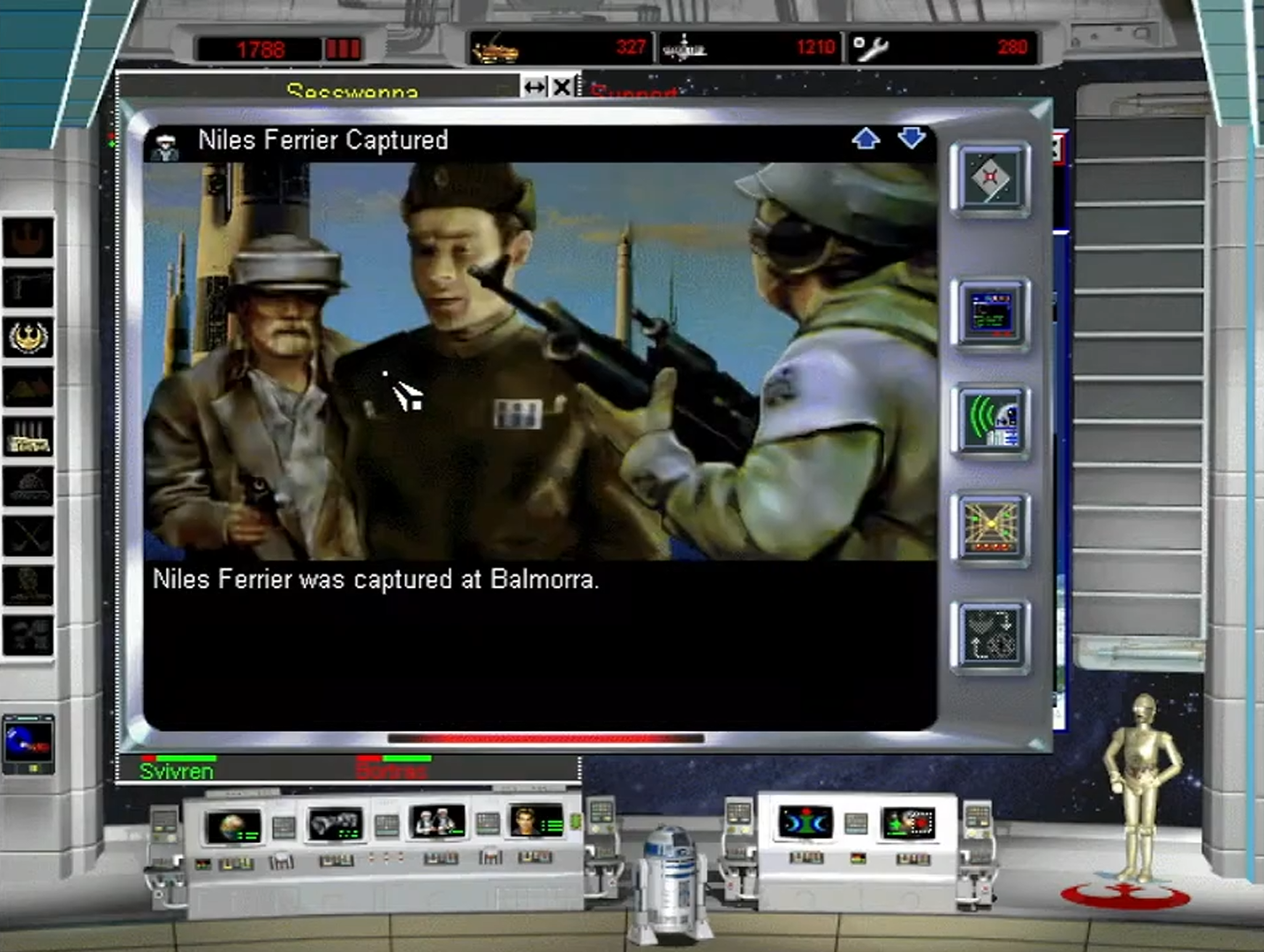
Secondary characters may possess loyalty values that change according to the progress of the war. Defeats, lost systems, destroyed headquarters, and shifts in galactic support can weaken loyalty. A traitorous character may compromise a mission or betray the faction entirely.
Force-sensitive characters can help identify potential traitors, but perfect certainty is rare.
This creates another layer of paranoia.
You are not merely asking whether an operative is skilled enough.
You are asking whether they genuinely intend to complete the assignment.
The feature is not always transparent, and many players may complete campaigns without fully understanding why a particular operation collapsed. But thematically, it fits beautifully. The Galactic Civil War is filled with secret loyalties, hidden identities, informants, defectors, and people who suddenly realize that working for Palpatine may not offer the healthiest long-term career path.
The interface may show them as portraits and numbers.
The system makes them feel dangerous.
The Economy Is Built from Mines, Refineries, and Maintenance
Galactic conquest requires industry.
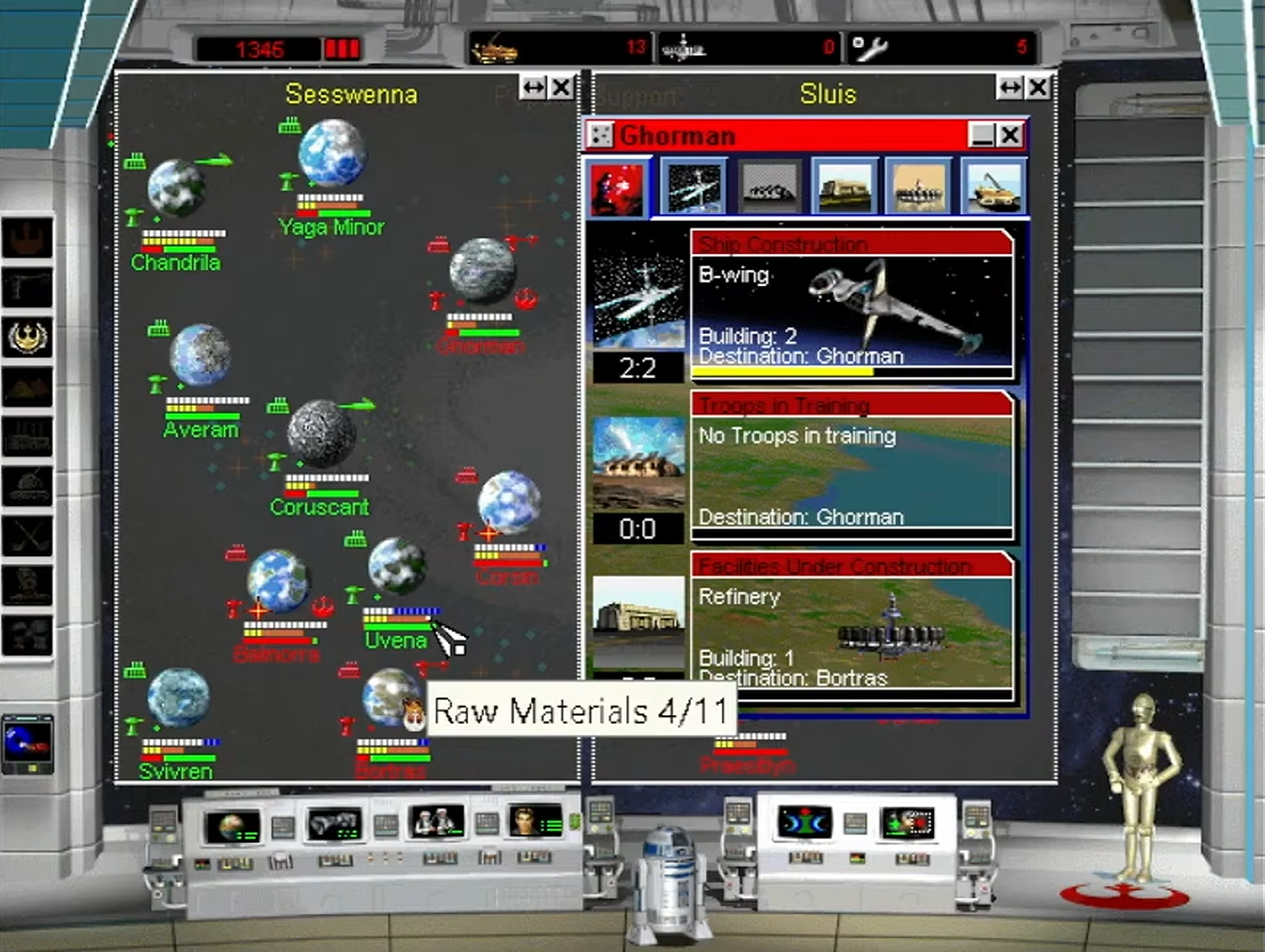
Systems contain raw materials that can be extracted through mines. Refineries convert those materials into the capacity needed to construct and maintain military units. Construction yards build infrastructure, training facilities produce troops and special forces, and shipyards manufacture capital ships and fighters.
The important limit is maintenance capacity.
Building a ship is not the end of the cost. Your economy must continue supporting every vessel, regiment, facility, and fighter squadron already in service. Expand beyond that capacity and units may have to be removed.
It is a sensible system.
It is also one of the reasons opening Rebellion for the first time can feel like receiving an Imperial audit.
You need enough mines.
You need enough refineries.
You need construction facilities to build more mines and refineries.
You need shipyards to build ships.
You need systems loyal enough to protect those facilities.
You need fleets to defend those systems.
And somewhere in the middle of all this, C-3PO has another message.
The economic design is not intuitive, but it creates genuine strategic pressure. A massive fleet means nothing if your industrial base collapses. Destroying an enemy refinery can therefore matter more than winning a flashy battle.
Rebellion understands that wars are often decided somewhere far away from the shooting.
Usually by someone staring at a production queue.
Research Makes the War Escalate
Players do not begin with access to every ship, troop, or facility.
Research and development is divided into ship design, troop training, and facility design. Characters with the appropriate expertise must be assigned to research missions at suitable locations, gradually unlocking new technology.
This creates a strategic choice between immediate action and long-term progress.
A skilled officer can command a fleet today or help develop a stronger class of vessel for tomorrow.
An engineer can improve facilities or remain available for another mission.
Investment in research may leave a faction temporarily vulnerable, but ignoring it allows the opponent to field superior units later.
The system also gives non-combat characters real value.
A person does not need to shoot a stormtrooper or command a Star Destroyer to change the course of the war.
Sometimes they invent a better shipyard.
Not cinematic.
Very useful.
Intelligence Is Often More Valuable Than Firepower
The galaxy does not begin fully revealed.
Rim systems may need exploration. Enemy fleets and characters move under fog of war. Information becomes outdated, and the location of the Rebel headquarters remains hidden from the Empire until sufficient intelligence is gathered.
Espionage therefore matters constantly.
A fleet cannot attack what it cannot locate.
A rescue mission cannot begin without knowing where a prisoner is held.
A sabotage team needs a target.
An Imperial player who ignores intelligence may possess enormous military power and no idea where to point it.
This is one of Rebellion’s strongest thematic achievements.
The Empire’s problem in the original trilogy was never a complete lack of weapons. It had Star Destroyers, stormtroopers, walkers, planetary defenses, and eventually another Death Star.
Its problem was finding the correct small group of people before they ruined everything again.
Rebellion turns that frustration into gameplay.
The 3D Space Battles Were the Shiny Part on the Box
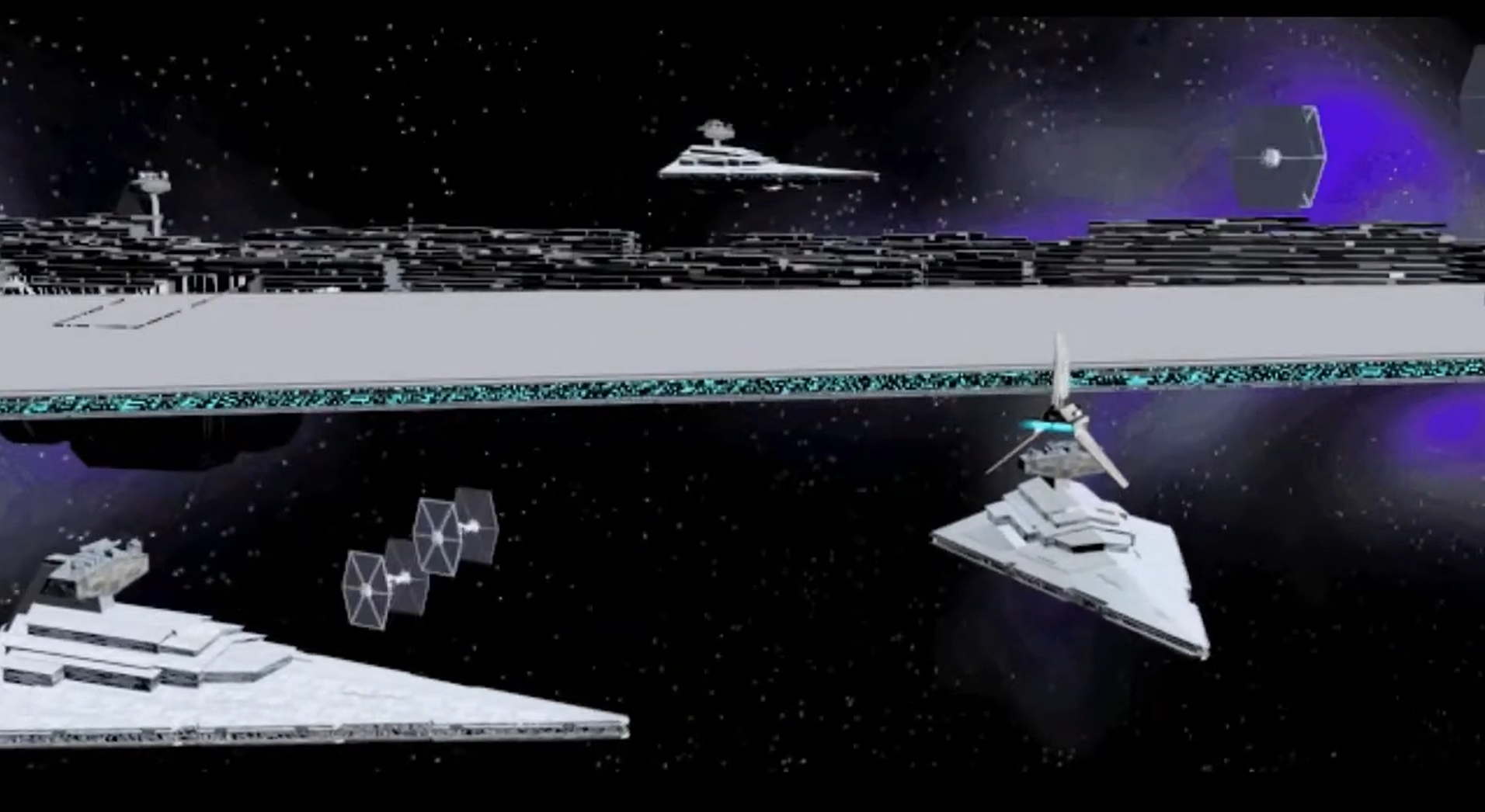
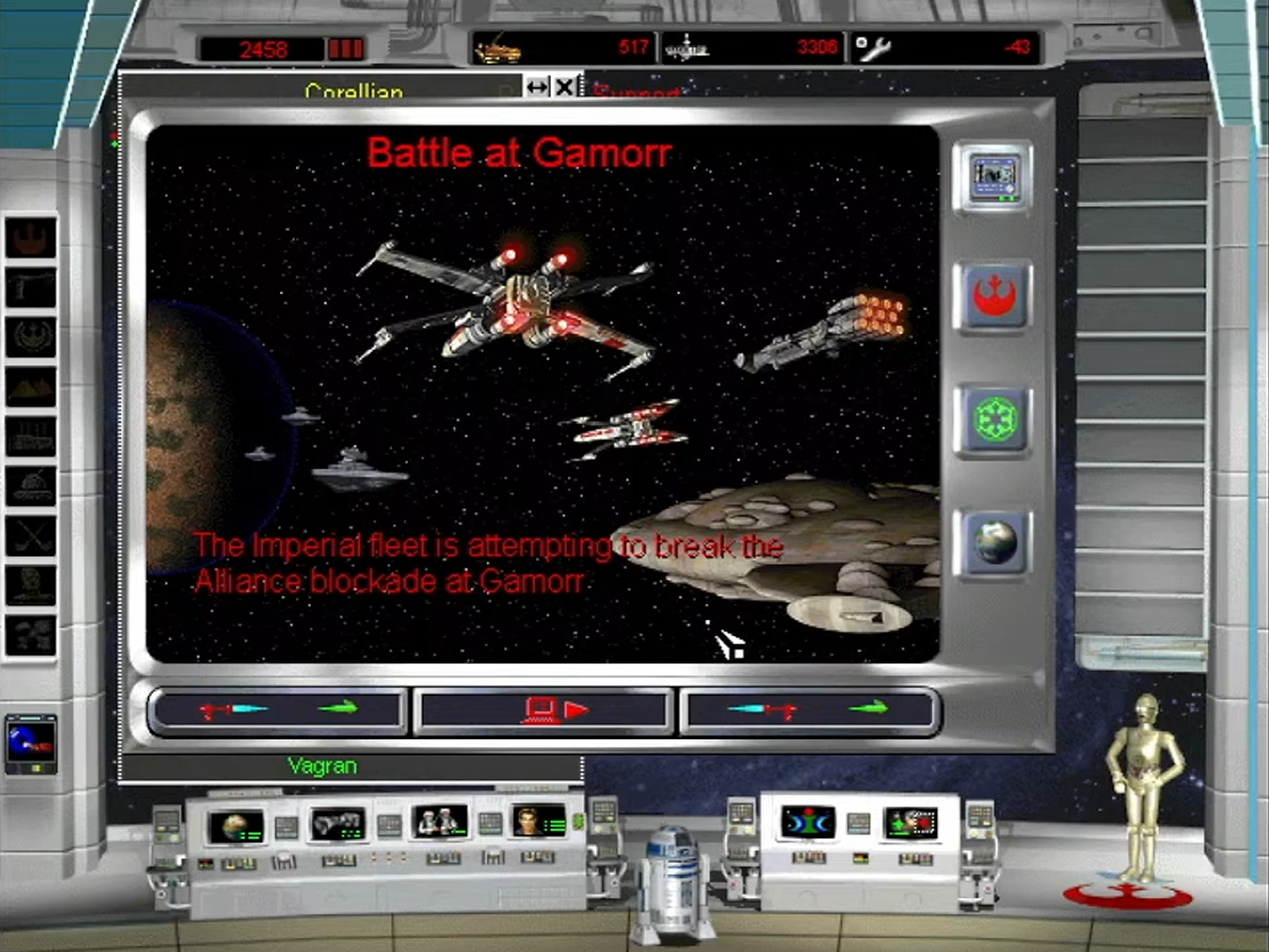
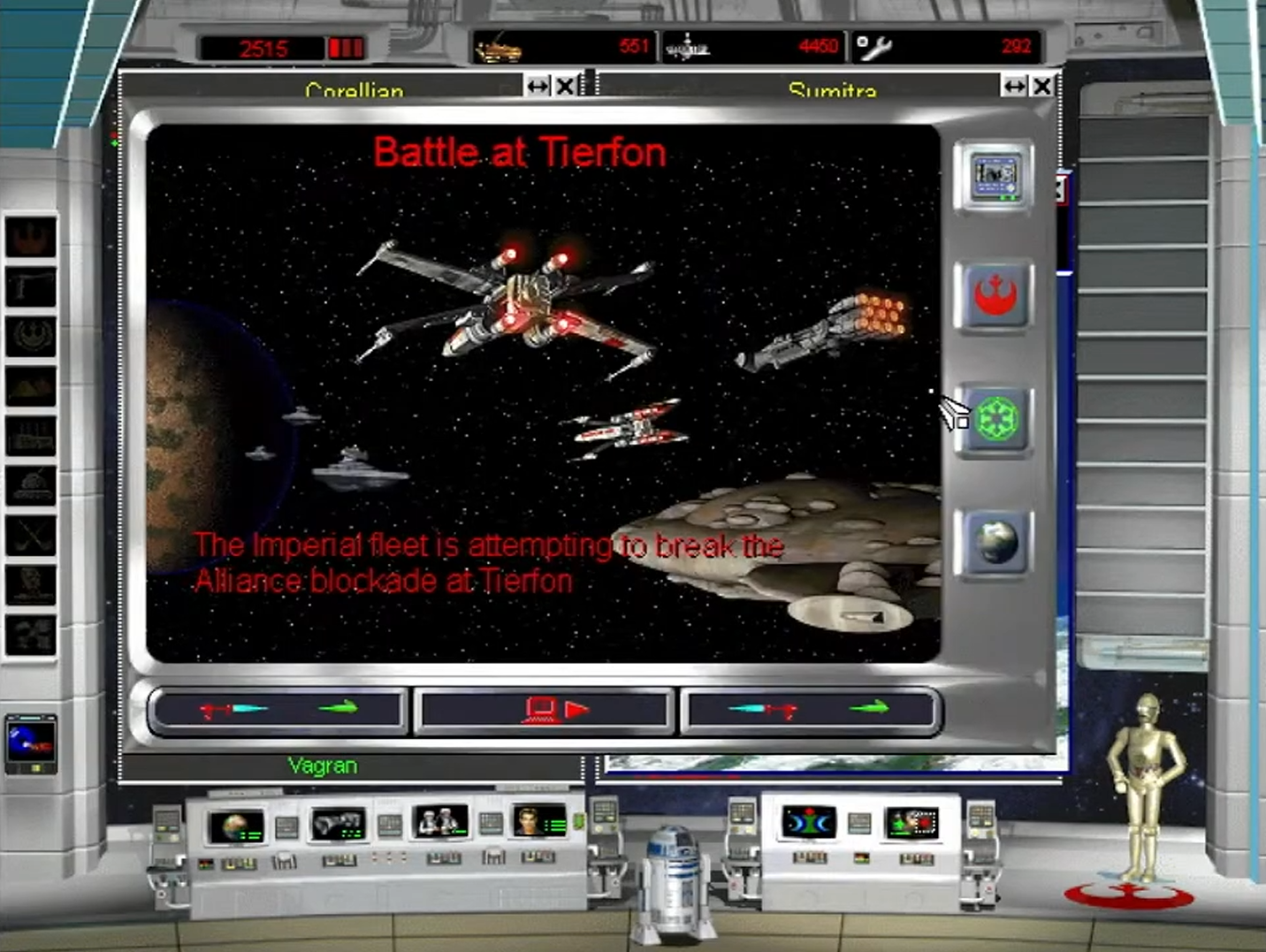
When opposing fleets meet above a system, the player can allow the computer to simulate the outcome or enter a tactical 3D battle.
Inside the tactical view, capital ships and fighter squadrons can be assigned targets, maneuvers, formations, and combat roles. The official manual describes the player as the admiral, directly ordering ships within a three-dimensional battlefield.
This sounded spectacular in 1998.
It was also where the design struggled most visibly.
The ships are recognizable, the scale is appealing, and watching Star Destroyers exchange fire with Mon Calamari cruisers delivers the correct Star Wars fantasy. But the controls are awkward, formations are difficult to use effectively, and battles frequently feel determined by fleet composition before the first order is given.
GameSpot’s contemporary review argued that tactical commands had only limited influence and that the larger or more advanced fleet usually won regardless.
That criticism remains fair.
The tactical mode wants to be the exciting reward for all the strategic preparation.
Instead, it often confirms that the strategic preparation already decided everything.
Still, there is pleasure in seeing your fleet exist.
Those shipyards, research missions, refinery investments, and maintenance decisions finally become something visible.
A badly controlled Star Destroyer is still a Star Destroyer.
The Death Star Is a Weapon and a Political Catastrophe
The Empire can research and construct a new Death Star.
Doing so requires immense resources and a long production period. The finished battle station offers enormous carrying capacity and firepower, can strengthen Imperial control through fear, and can destroy an entire planetary system.
The manual also warns that planetary destruction causes a severe loss of Imperial support across the galaxy. A destroyed world cannot be conquered, taxed, mined, or persuaded to become more cooperative later.
This is perhaps the most Star Wars mechanic in the game.
The Death Star is overwhelmingly powerful.
Using it may still be strategically stupid.
It functions best as a threat, improving the effectiveness of Imperial garrisons simply through its presence. Actually firing the superlaser can turn neutral populations against the Empire and create political damage far beyond the destroyed target.
The Alliance has limited options against it. Fighters may attempt a Death Star run during tactical combat, while sabotage missions can destroy the station or disable its protective shield arrangement.
Constructing one is deeply satisfying.
Losing it to a handful of fighters after spending half the campaign building it is also deeply authentic.
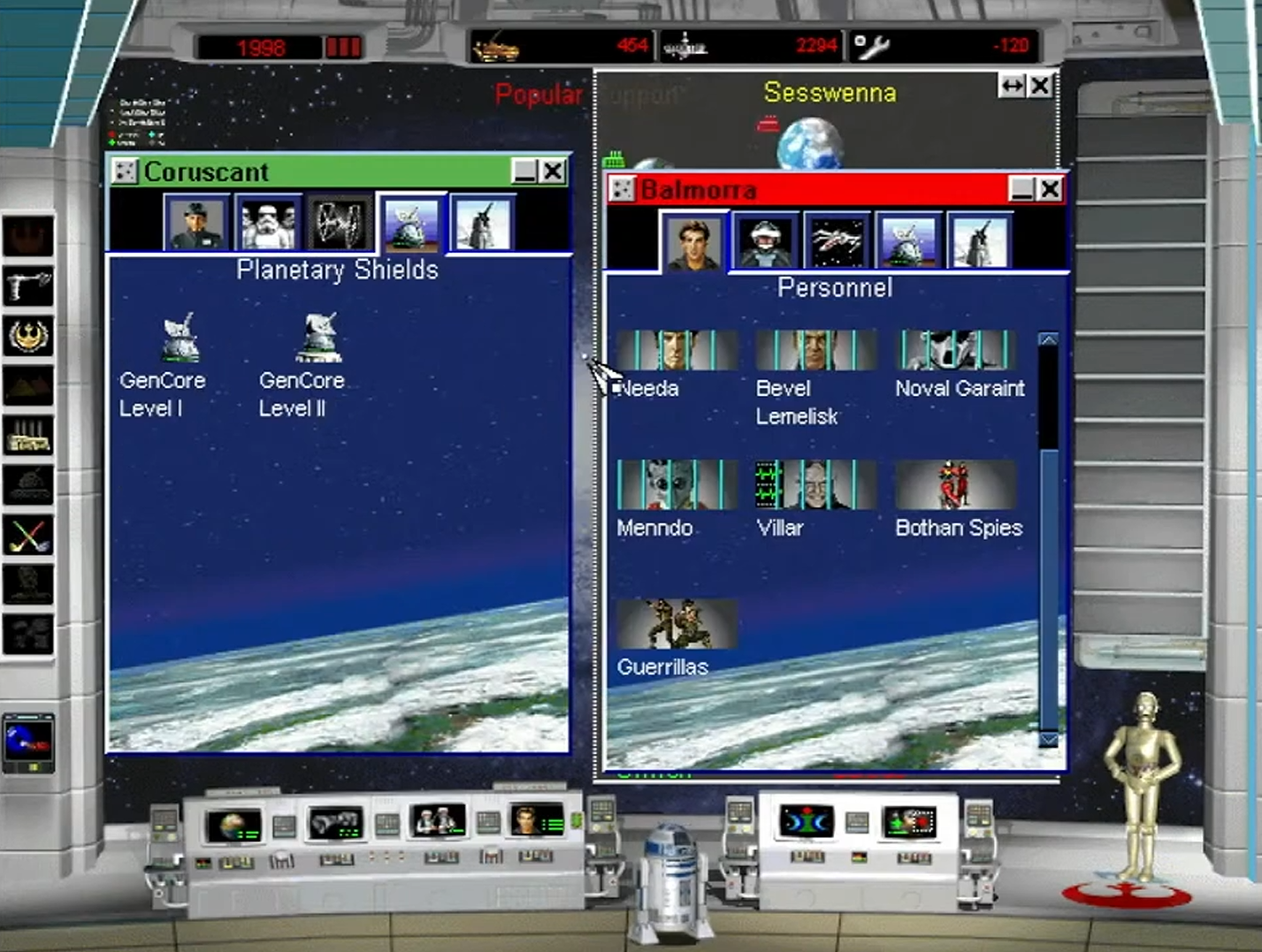
The Interface Became the Real Final Boss
Rebellion’s reputation is inseparable from its interface.
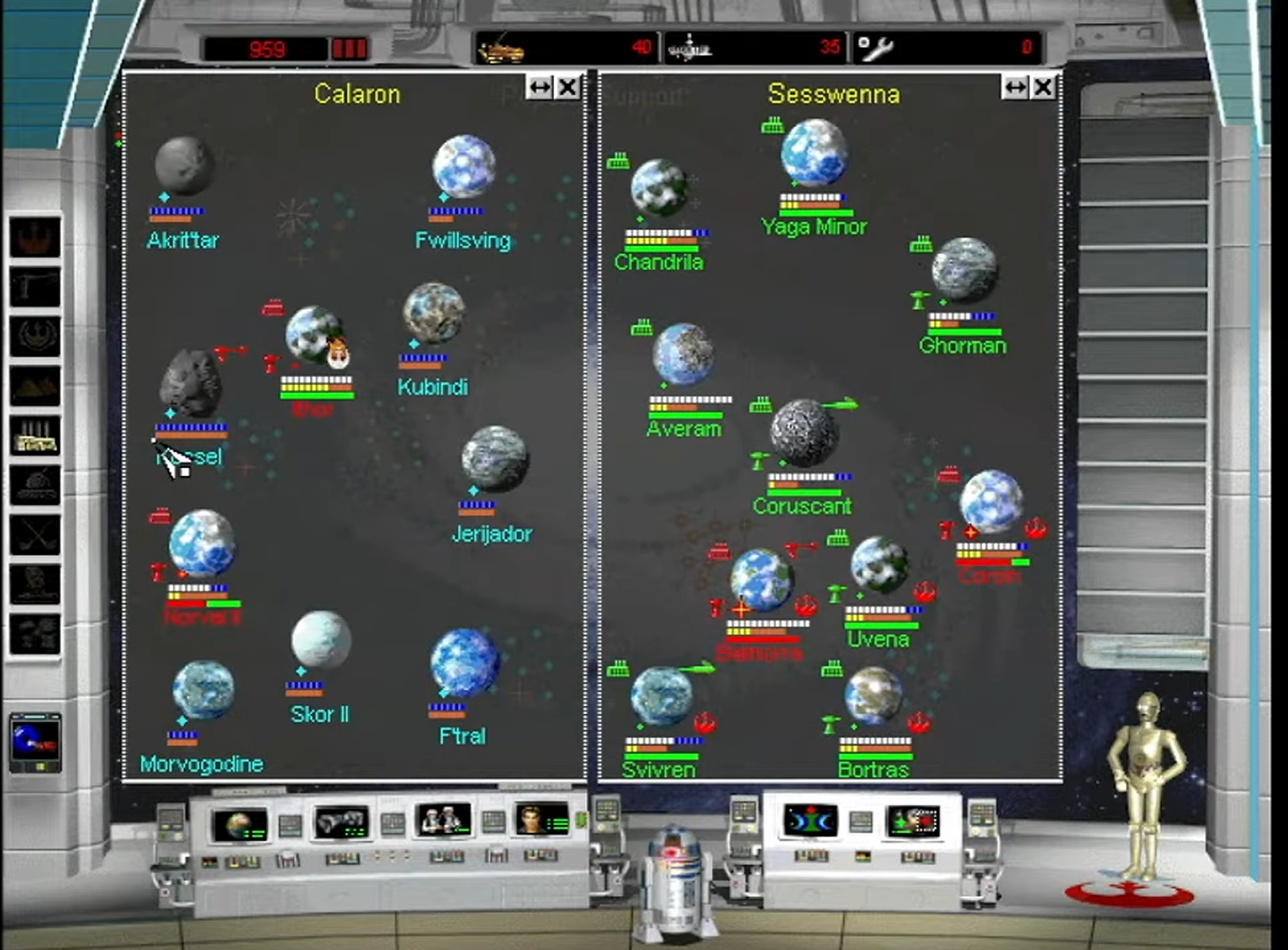
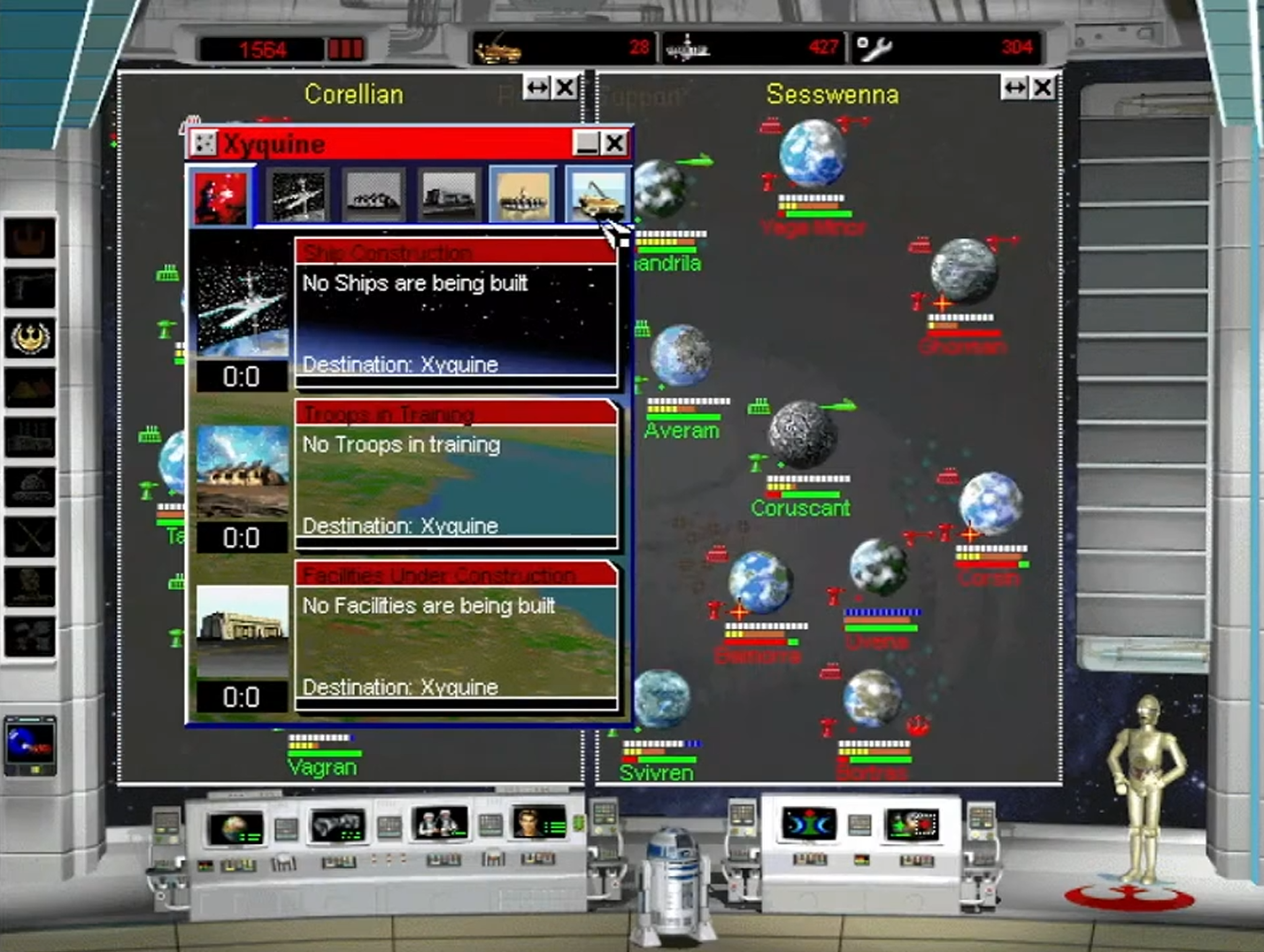
The game presents the galaxy through a Command Center filled with maps, buttons, message tabs, droid assistants, production windows, personnel screens, fleet panels, system-defense displays, minimized-window slots, and layers of information that frequently open more layers of information.
The Alliance receives reports through R2-D2 and advice from C-3PO. The Empire uses the droid IMP-22. Many routine tasks can be delegated to these assistants, including parts of production, garrison management, and battle simulation, although the manual warns that automated decisions may not match the player’s preferences.
The presentation is wonderfully committed.
It feels like operating a Star Wars command network.
It also feels like Windows 95 has been given control of the Galactic Civil War.
GameSpot famously described the game as dying “the death of a thousand clicks” and criticized its confusing interface, slow pace, and tedious repetition. The review scored it 4.5 out of 10.
That phrase stuck because it is accurate.
Moving a fleet may involve opening a sector, selecting a system, opening the relevant window, locating the correct units, issuing the order, confirming the destination, closing several panels, and then discovering that R2-D2 has 11 new messages.
Rebellion does not merely contain complexity.
It physically places that complexity between you and the galaxy.
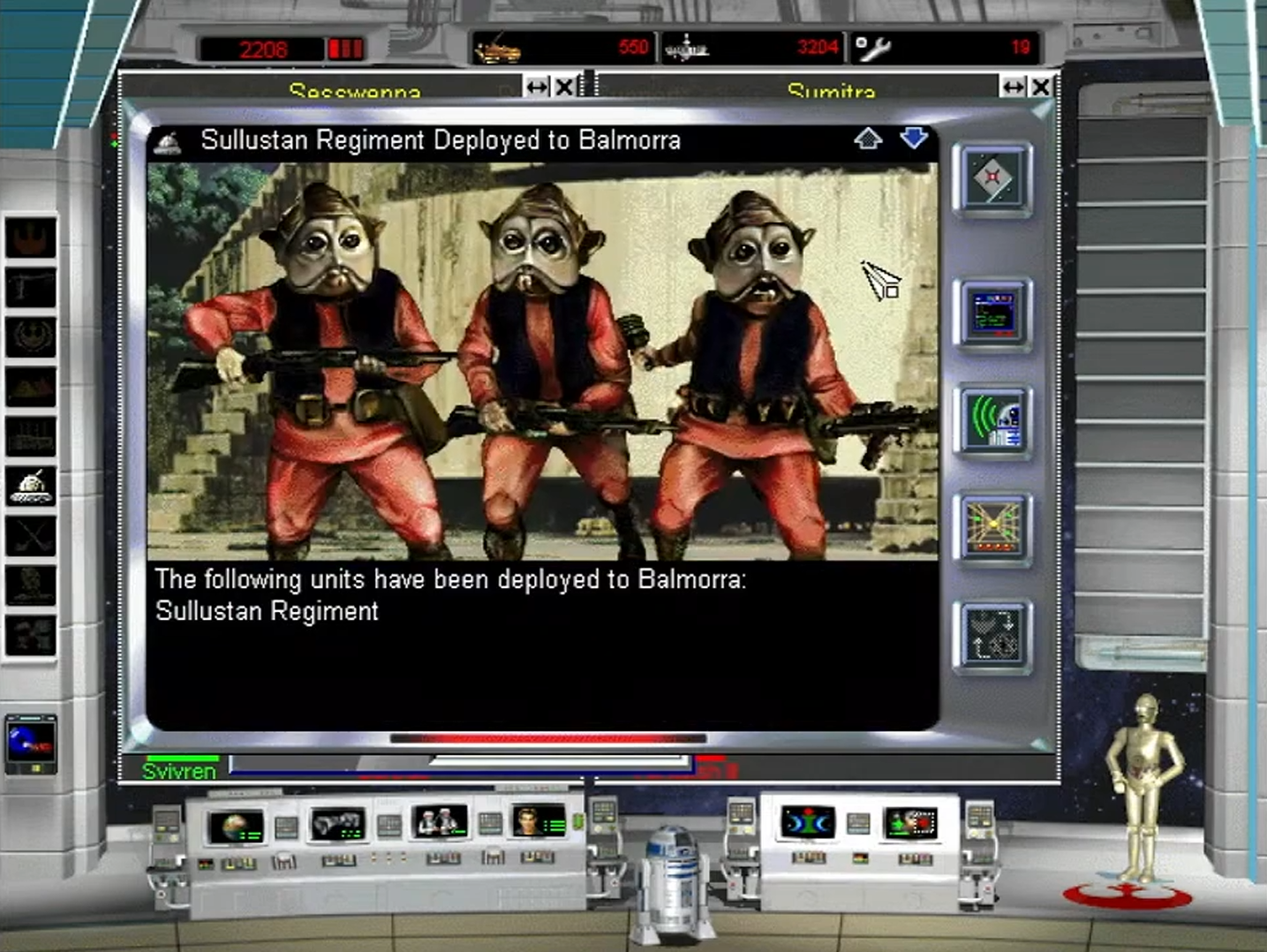
The Droid Briefings Are Helpful Until They Become a Threat
The advisor droids are one of the game’s most charming ideas.
They deliver spoken reports, notify the player about completed construction, failed missions, fleet movements, research breakthroughs, and political changes. The droids make the strategic information feel like part of the Star Wars universe rather than a sterile spreadsheet.
They also talk constantly.
During a large campaign, reports arrive from dozens of systems and operations. A player may receive updates about manufacturing, espionage, ship movements, diplomacy, captured characters, research, and uprisings within a short period.
Eventually, hearing the message alert can produce the same emotional response as receiving a work email marked “urgent.”
The droids do not care that you are currently reorganizing the fleet over Corellia.
The refinery on Chandrila has completed production.
This apparently cannot wait.
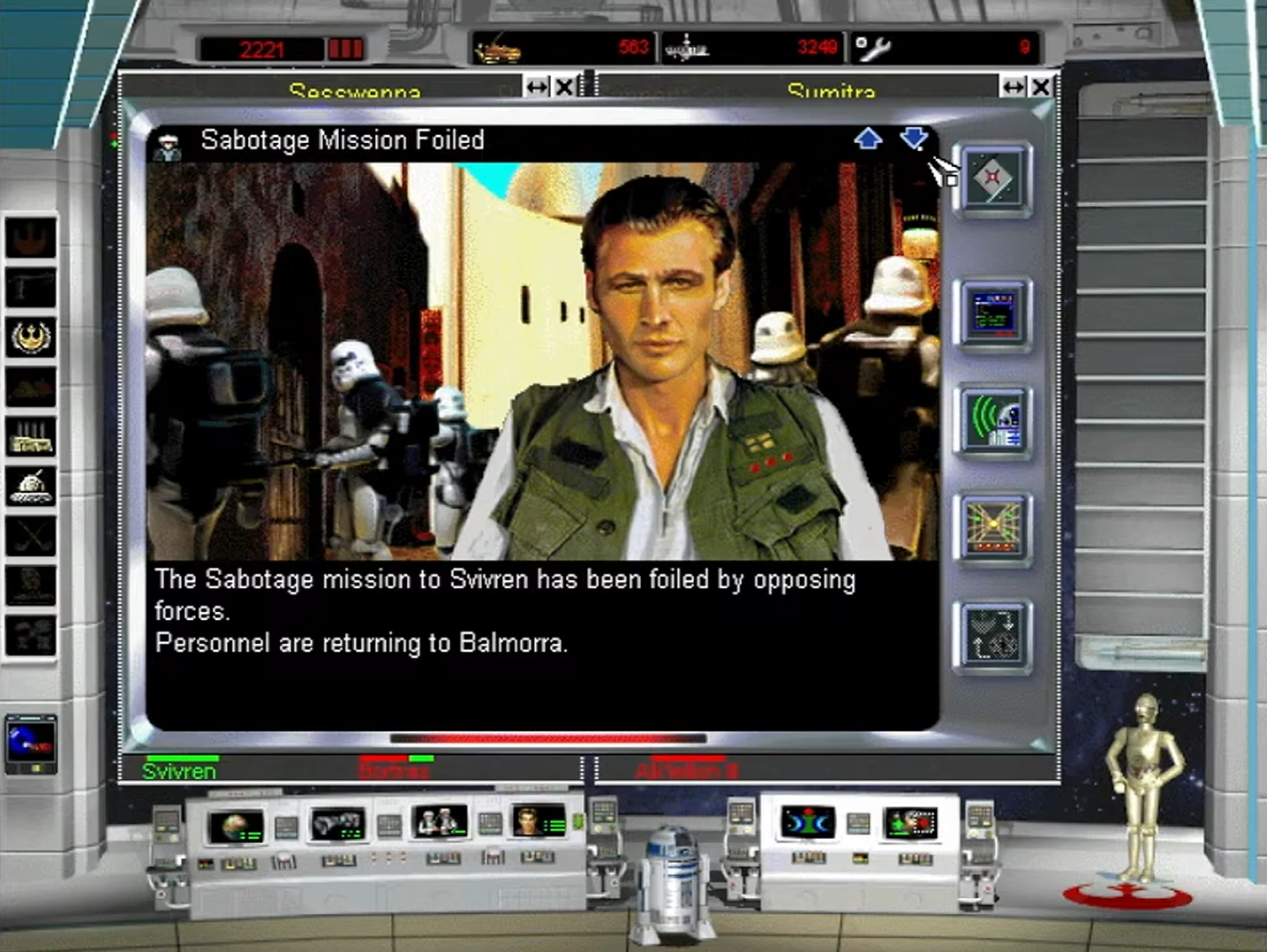
The Random Galaxy Turns Every Campaign Into Alternate History
The game’s randomization does not completely rebuild its rules, but it changes system resources, political alignments, character locations, and the distribution of strategic opportunities.
The Rebel headquarters appears in a different Rim location.
Secondary characters arrive in different orders.
Neutral systems begin with varying loyalties.
Resources and infrastructure shift.
Enemy missions succeed or fail unpredictably.
The result is not a scripted Star Wars narrative but a generator for alternate Galactic Civil Wars.
One campaign may revolve around a prolonged struggle for the Core.
Another may see the Alliance build power quietly along the Rim while the Empire searches in the wrong sectors.
Luke may become a Jedi early.
Leia may spend half the war in captivity.
Vader may uncover the Rebel headquarters and then fail to arrive before it relocates.
The Empire may construct several Death Stars because nobody at the budget meeting had the courage to say no.
This variability is the real reason players forgave so many rough edges.
The interface repeated itself.
The war did not.
Multiplayer Turned Administration Into Psychological Warfare
Rebellion supported two-player matches through local networks, internet connections, modems, and direct serial connections.
Both players managed their factions simultaneously, with the same hidden information, real-time movement, diplomacy, missions, and fleet warfare found in the single-player campaign. The game even included chat functionality, allowing opponents to exchange messages while quietly attempting to abduct each other’s senior leadership.
Multiplayer removed one of the biggest weaknesses of the single-player mode: the computer opponent.
A human player could misdirect, bluff, launch coordinated sabotage, relocate important characters, and recognize when a sudden wave of espionage missions suggested that the enemy had discovered something important.
It also made already lengthy campaigns even more demanding.
Finishing a large multiplayer galaxy required commitment, scheduling, and the continued survival of late-1990s networking technology.
The Galactic Civil War was easier to organize than getting both players online at the same time.
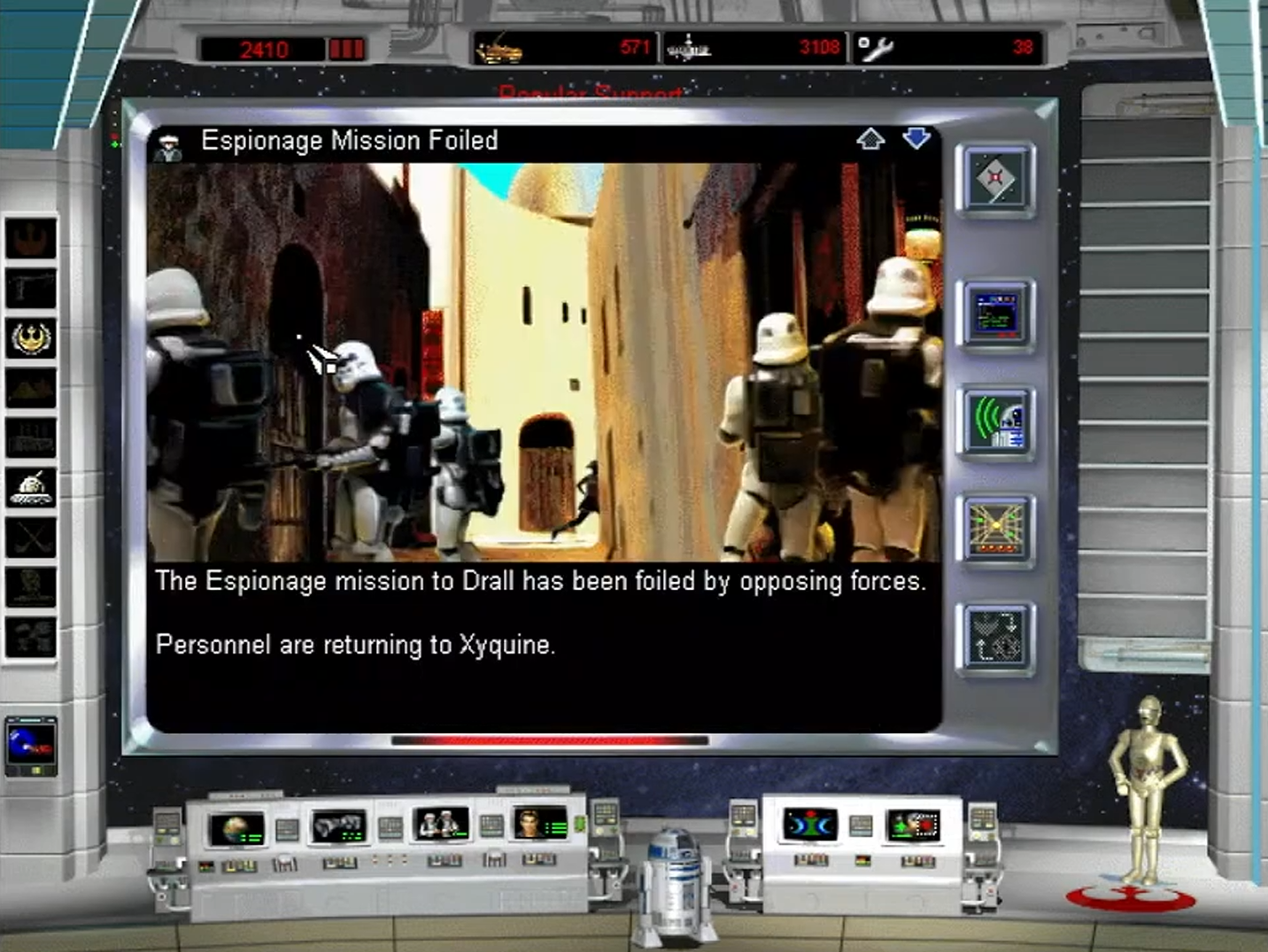
The Reviews Saw the Problems Immediately
Rebellion received a mixed and often hostile response.
Critics recognized the scale of the concept but attacked its interface, pacing, repetitive administration, weak tactical combat, and steep learning curve. GameSpot’s review praised the Star Wars atmosphere but argued that the underlying strategy became buried beneath tedious interaction and waiting.
The game arrived in a difficult position.
Strategy players expected the clarity and depth associated with established 4X series.
Star Wars fans expected drama, battles, and recognizable characters.
Rebellion attempted to satisfy both groups while introducing an interface unlike almost anything else LucasArts had published.
For many players, the tutorial and enormous manual were not optional support material.
They were the entrance examination.
The harsh reviews were not unfair.
Rebellion is difficult to learn, awkward to operate, visually uneven, and capable of becoming painfully slow.
But reviews focused on what happened moment to moment.
The cult reputation grew from what happened across entire campaigns.
The Cult Following Found the Game Hidden Under the Windows
Players who survived the opening hours discovered a strategy sandbox with unusual depth.
The character missions remained compelling.
The asymmetric factions created different strategic pressures.
Political support made conquest more complicated than painting planets a faction color.
The hidden Rebel headquarters produced real tension.
The Death Star connected military power to political consequences.
The random galaxy generated stories no scripted campaign could repeat exactly.
That is why the game’s later player reputation became much warmer than its original critical reception.
Its retired Steam listing records a strongly positive user-review percentage, reflecting the affection of players who returned to it long after 1998.
Rebellion is not secretly polished.
Its admirers do not love it because the criticism was wrong.
They love it because the game attempts something so specific that the flaws become part of the price of entry.
There still is not another Star Wars game exactly like it.
Rebellion Was Not Simply an Early Empire at War
The obvious comparison is Star Wars: Empire at War, released in 2006.
Both games allow players to command the Empire or Rebellion across a galactic map, construct fleets, control planets, and fight tactical space battles.
The similarities are real.
The experience is very different.
Empire at War is more immediate and readable. Its planetary and space battles are conventional real-time strategy encounters. Fleets move clearly. Units have understandable battlefield roles. The galactic layer exists to feed action into the tactical maps.
Rebellion places far more emphasis on characters, intelligence, political support, covert missions, hidden information, and administration. Planetary combat is largely abstracted, while the strategic layer is the main game rather than a menu connecting battles.
Empire at War asks how you want to fight over a planet.
Rebellion asks whether the planet supports you, who is spying on it, whether the shipyard has finished its order, which diplomat should be assigned there, and whether an uprising will begin before your garrison arrives.
One is a more successful videogame.
The other is a stranger simulation.
Star Wars strategy history needs both.
The Community Refused to Let It Die
Rebellion’s dedicated fan community has spent years creating tools, modifications, graphical replacements, databases, and compatibility solutions.
Modern community fixes improve performance and support on newer versions of Windows, while anniversary projects and editors allow players to modify characters, systems, units, maps, and other game data. Community resources still offer patches designed for Windows 11 and modern display wrappers.
That work matters because the original game was built around Windows 95-era technology and old DirectX requirements.
Installing a 1998 strategy game should not require its own research-and-development mission.
The community has made the process considerably less painful.
The Official Digital Version Has Disappeared
For several years, Rebellion was sold digitally on platforms including Steam and GOG, giving modern players an official route into the game.
That changed in April 2026.
The game was retired from the Steam store during a wider wave of Disney-related delistings. SteamDB now marks the application as retired and unavailable for purchase, while existing community pages and owner access remain. The removal occurred without a public explanation, and contemporary coverage noted that Rebellion’s official modern purchase route had effectively disappeared.
That makes preservation more urgent.
Rebellion is not merely an old game with clumsy menus.
It is a unique attempt to simulate the political, military, economic, and personal machinery of the Galactic Civil War.
Its disappearance from sale leaves physical discs, existing digital libraries, and fan-supported compatibility work carrying the burden.
The Empire had better archival planning.
Why Star Wars: Rebellion Belongs in the Archive
Rebellion belongs here because ambition matters.
The game tried to model an entire galaxy when most Star Wars titles were still concentrating on one pilot, one soldier, or one cinematic sequence.
It treated Luke, Leia, Han, Vader, Mon Mothma, and Palpatine as strategic assets without reducing them to ordinary combat units.
It made diplomacy important.
It made intelligence essential.
It made planetary loyalty separate from military occupation.
It allowed the Alliance to move its headquarters, the Empire to rebuild the Death Star, and minor characters to become heroes or traitors.
It understood that the Galactic Civil War was not simply a sequence of famous battles.
It was a contest of information, legitimacy, industry, leadership, fear, and time.
Then it placed all of that inside one of the most difficult interfaces LucasArts ever published.
The result is not elegant.
It is not welcoming.
It is not consistently enjoyable.
But it is unmistakably its own thing.
The Galaxy Was Too Big for the Interface, but Not for the Idea
Star Wars: Rebellion attempted to place the entire Galactic Civil War on a Windows desktop.
Not the highlights.
Not only the Death Star battles.
The whole machine.
The diplomats.
The spies.
The researchers.
The mines.
The refineries.
The hidden bases.
The prisoners.
The traitors.
The fleets waiting in hyperspace while a droid explains that production has finished on a planet you no longer remember owning.
The interface could not carry that ambition gracefully.
The tactical battles could not match the drama promised by the box.
The campaign could become slow, repetitive, and buried under messages.
Yet the central idea remains powerful.
A Star Wars war should not only be won by the person with the largest fleet.
It should be won by the side that understands the galaxy better.
Rebellion understood that in 1998.
It just needed several fewer windows to explain it.
Frequently Asked Questions
What is Star Wars: Rebellion?
Star Wars: Rebellion is a real-time grand-strategy and 4X game developed by Coolhand Interactive and published by LucasArts for Windows in 1998. Players command either the Rebel Alliance or Galactic Empire across a galaxy-wide campaign.
Is Star Wars: Supremacy a different game?
No. Star Wars: Supremacy is the title used for the same game in the United Kingdom and Ireland. The gameplay and campaigns are unchanged.
How large is the galaxy in Star Wars: Rebellion?
Depending on the selected size, the galaxy contains between 100 and 200 planetary systems divided into sectors of ten systems each.
What are the victory conditions?
The Alliance must capture Coruscant, Emperor Palpatine, and Darth Vader. The Empire must destroy the hidden Rebel headquarters and capture Mon Mothma and Luke Skywalker. A headquarters-only mode provides shorter campaigns.
Can the Rebel headquarters move?
Yes. The Alliance headquarters begins at a random Rim system and can be relocated to another friendly system when threatened. The Empire must first discover its location through intelligence or military activity.
Can the Empire build a Death Star?
Yes. The Empire can research and construct a new Death Star. It requires enormous resources, can destroy systems, and strengthens control through fear, but using it causes a major loss of galactic support.
Can Luke Skywalker become more powerful in the Force?
Yes. Luke can travel to Dagobah for training and later teach other Force-sensitive Alliance characters. Vader can discover and train potential Imperial Force users.
Does Star Wars: Rebellion have multiplayer?
Yes. The original game supported two-player matches through LAN, internet, modem, and direct serial connections.
How is Rebellion different from Empire at War?
Rebellion focuses more heavily on diplomacy, espionage, characters, planetary loyalty, hidden information, and grand strategy. Empire at War offers more accessible real-time ground and space battles with a simpler galactic layer.
Can you still buy Star Wars: Rebellion digitally?
As of July 2026, the game has been retired from the Steam store and is no longer officially available for purchase there. Community patches continue helping existing copies run on modern Windows systems.
Author

Related Posts

Club Penguin’s Star Wars Takeover Launched 13 Years Ago Today, and Yes, Darth Vader Was a Penguin
SWGOH Jaxxon Kit Guide: Best Team, Abilities, Omicron, and How He Works
Star Wars Zero Company Has Only One Jedi, and You Can Get Her Killed
Luke Training Leia as a Jedi Is Finally Getting a New Star Wars Novel

SWGOH The Ronin Kit Guide: Best Team, Abilities, Omicron, and How He Works
Star Wars: Zero Company Will Take 30–40 Hours to Beat, and That Might Be Exactly Right
The Mandalorian and Grogu Named One of the Year’s Best Fantasy Movies So Far
Star Wars: Detours Is Finally Being Shown Publicly, Because Nothing Stays Buried Forever