
Before Star Wars games became known for lightsabers, morality systems, squad tactics, and giant cinematic set pieces, there was Star Wars: Dark Forces — a fast, grimy, surprisingly ambitious first-person shooter that helped kick open a whole new side of the galaxy.
Released on February 15, 1995, by LucasArts, Dark Forces was the first Star Wars first-person shooter, and it did not just slap stormtroopers onto a generic corridor blaster. It introduced Kyle Katarn, sent players deep into Imperial installations, and built a campaign around sabotage, infiltration, mission objectives, and the Empire’s terrifying Dark Trooper project. Even now, that combination feels like a turning point. This was the moment Star Wars games proved they could do more than simply imitate the films. They could expand the universe in their own voice.
For the SWTORStrategies archive, Dark Forces is one of those foundational entries that makes the whole timeline stronger. It belongs naturally in the complete Star Wars games list and the Star Wars Games (1990–1999) hub, not just because it is a good game, but because it launched one of the most important character arcs in the franchise’s gaming history. Without Dark Forces, there is no Kyle Katarn as fans know him, and without Kyle Katarn, later games like Jedi Outcast and Jedi Academy lose a huge part of their legacy.
Introduction
What makes Dark Forces so interesting in hindsight is that it arrived during the era when people lazily labeled almost every first-person shooter a “Doom clone,” yet LucasArts was clearly trying to do more than that. The game had a stronger narrative frame than many of its contemporaries, more environmental interaction, more verticality, more mission-specific structure, and a much more deliberate attempt to make players feel like they were operating inside the machinery of the Galactic Empire rather than just running down hallways and collecting ammo. Nintendo’s modern description of the game calls out its movement, interactivity, large selection of items and power-ups, and engaging environments, which is a pretty fair summary of why it stood out in 1995.
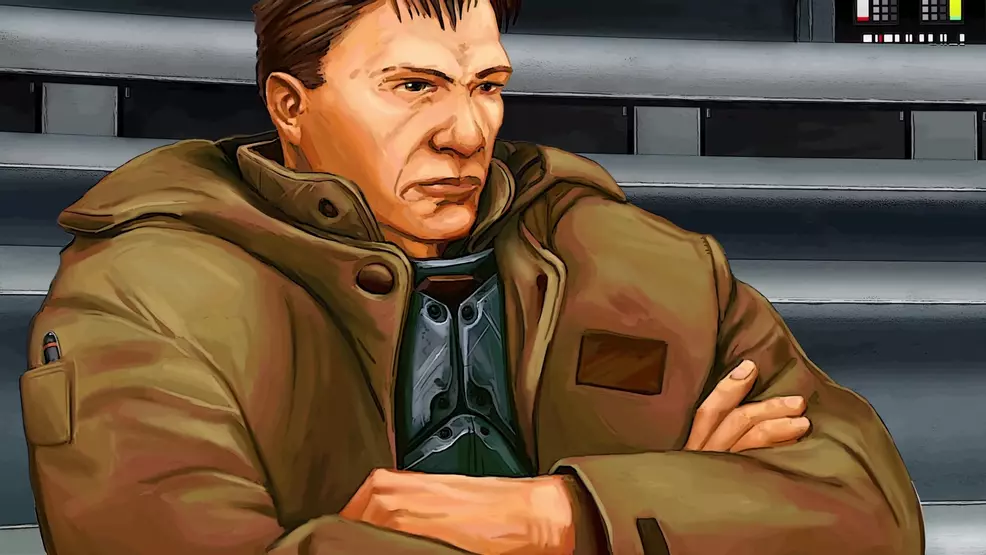
It also introduced a different kind of Star Wars protagonist. Kyle Katarn was not a Jedi, not a farm boy, not a movie hero, and not some disposable faceless soldier. He was a former Imperial turned mercenary working for the Rebel Alliance, and that alone gave Dark Forces a rougher, more boots-on-the-ground tone. In an era when the Expanded Universe was growing in confidence, Kyle immediately felt like the sort of character games could build around in a way films rarely did. The official StarWars.com retrospective on the remaster flat-out frames him as a hero modern players should get to meet, which says a lot about how enduring he became.
Game Information
Star Wars: Dark Forces was developed and published by LucasArts. It first launched for MS-DOS in 1995, with the Macintosh version following that same year and a PlayStation port arriving in 1996. The game is a single-player first-person shooter built around a 14-level campaign, and its story follows Kyle Katarn as he investigates the Empire’s secret Dark Trooper Project after stealing the Death Star plans for the Rebel Alliance. Steam lists the original release date as February 15, 1995, while MobyGames and official remaster descriptions confirm the basic structure of the original release and campaign.
Genre-wise, this is a first-person shooter, but that undersells how much it was trying to do. The game mixes blaster combat with switches, environmental hazards, platforming, mission objectives, puzzle-like layouts, and cinematic cutscenes between major beats. MobyGames notes that its levels are often complex and maze-like, with objectives that go beyond simply finding an exit, while Nintendo’s official description highlights its weapons, enemies, puzzles, and power-ups. In other words, this is not just a historical curio. It is a proper campaign-driven shooter with real ambition.
Gameplay Overview
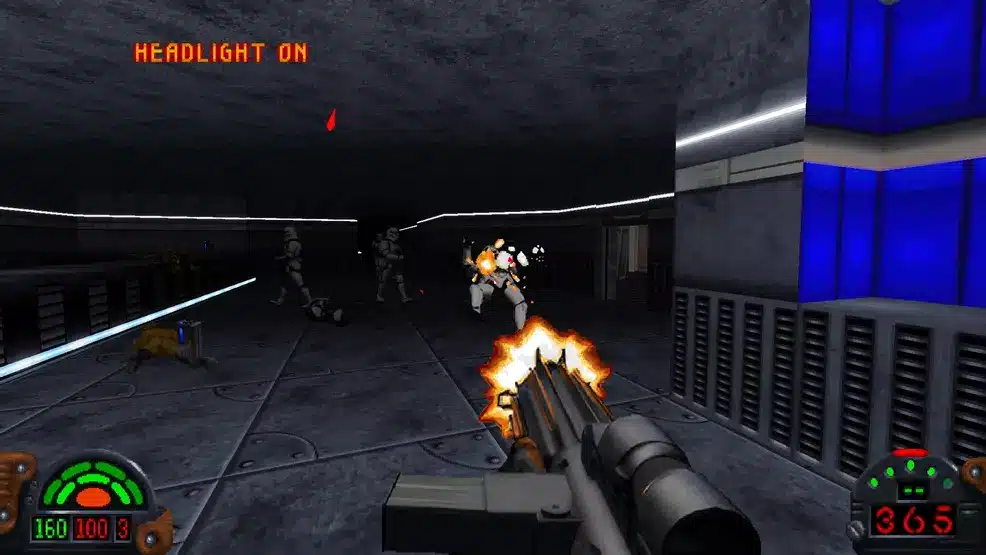
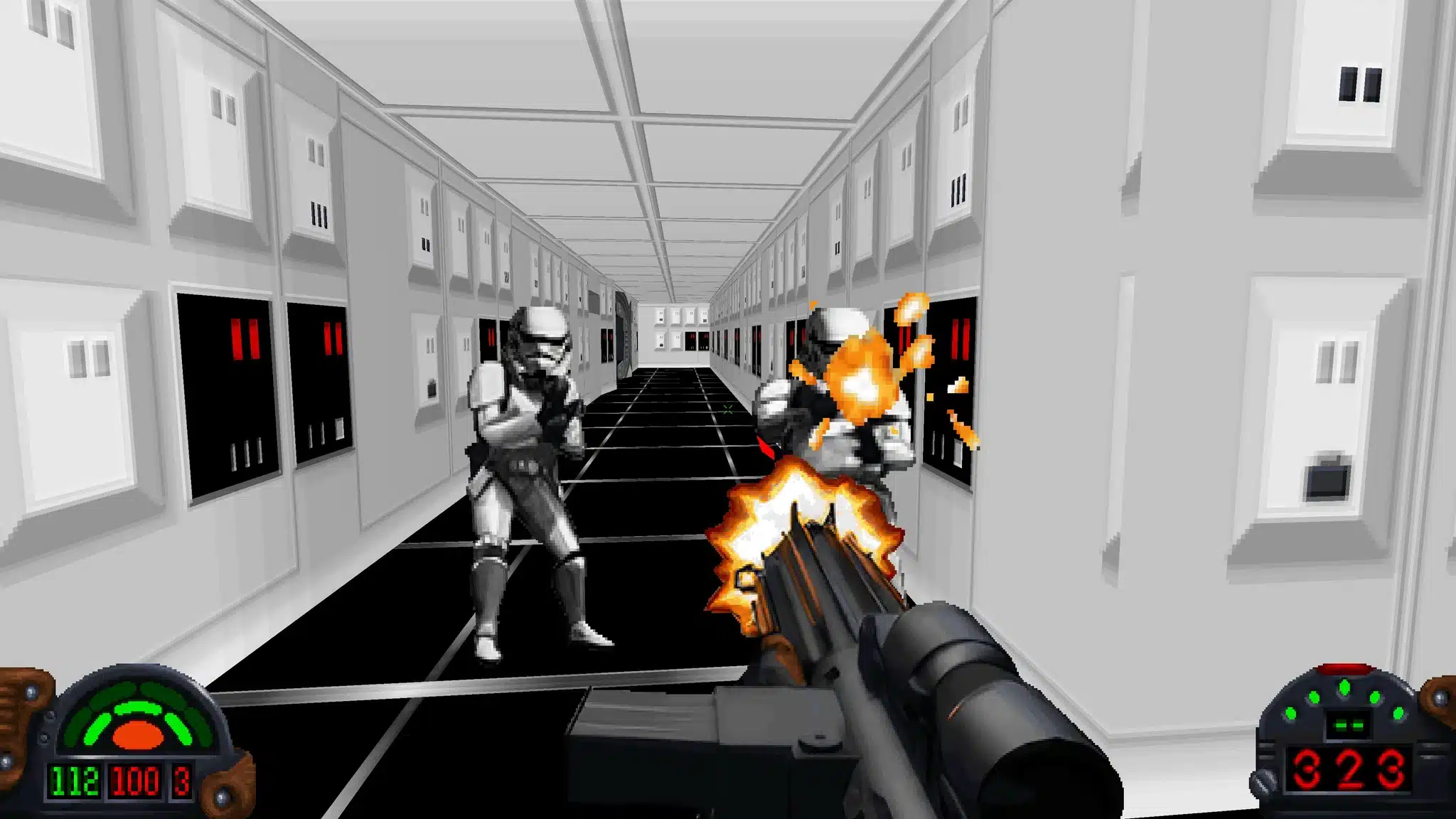
The core loop in Dark Forces is simple enough: infiltrate, survive, and sabotage. But the way it executes that loop is what made it stand out. Players blast through Imperial officers, stormtroopers, probe droids, and Dark Troopers using a growing arsenal of weapons, from pistols and rifles to thermal detonators and heavier hardware. Levels ask for more than just speed and reflexes. They require exploration, route-reading, switch hunting, environmental awareness, and the occasional leap of faith that 1990s level designers absolutely loved a little too much.
What really helped the game rise above the pack was movement and space. The original Dark Forces gave players the ability to look up and down, jump, crouch, move across catwalks, ride platforms, and navigate multi-layered environments in ways that were unusually advanced for the time. StarWars.com points out that the game had proper room-over-room environments and even occasional 3D models in special cases, while MobyGames notes the Jedi engine’s technical advantages over many comparable shooters. That may sound normal now, but in 1995 it helped make the game feel far more dynamic than a lot of its competition.
There is also a strong sense of place throughout the campaign. MobyGames highlights visits to locations tied to the broader saga, including Coruscant, a Star Destroyer, and Jabba’s orbiting territory, while the official game description emphasizes the idea of searching the galaxy for clues and striking enemy bases. That wider range of settings gave Dark Forces a real Star Wars identity. It was not just “corridor shooter with stormtroopers.” It felt like a galaxy-spanning covert war.
Historical Context
In the mid-1990s, Star Wars was in a strange but important place. The Special Editions had not hit theaters yet. The prequels were still years away. The brand was alive, but it was not yet the permanently roaring machine it would become. That gave games and books a lot of room to shape the Expanded Universe in bold ways, and Dark Forces arrived right in that sweet spot. It was one of the clearest examples of LucasArts using games not just as licensed merchandise, but as actual world-building tools.
Its biggest narrative legacy may be obvious now: before Rogue One, Dark Forces was the famous “steal the Death Star plans” story in old Star Wars continuity. StarWars.com and Space both reference that angle when discussing the game’s place in franchise history. Even though later canon moved in a different direction, the older version still matters because it shows how games once carried major story beats that today might be reserved for films or prestige streaming series. That is part of what makes Dark Forces feel so important. It was not just adapting Star Wars. It was adding to it.
It also marked LucasArts’ first real attempt to enter the FPS market with its own internal tech instead of simply leaning on someone else’s engine. MobyGames explicitly notes that LucasArts used the internally developed Jedi engine rather than licensing Doom technology, and that decision gave the game a more distinctive technical identity. That matters in archive terms, because Dark Forces was not merely trend-chasing. It was LucasArts making a statement that Star Wars shooters could have their own mechanical and technological character.

Development
One of the most impressive things about Dark Forces is how much engineering muscle LucasArts put into it. The official StarWars.com feature on the remaster quotes Nightdive’s Max Waine pointing out some of the original game’s technical feats, including room-over-room spaces and occasional 3D models before those features were common in the genre. MobyGames similarly credits the Jedi engine for enabling advanced movement and spatial design that helped the game stand apart from many other shooters of its day.
The game also used LucasArts’ iMUSE system to dynamically shift music during action scenes. MobyGames describes the score as drawing on John Williams-inspired cues while using adaptive audio to respond to gameplay. That sort of musical reactivity was another area where LucasArts often punched above its weight. It helped Dark Forces feel more cinematic and more alive, even when the visuals were still very much products of the pixel-heavy mid-90s.
And then there is the character design side. Kyle Katarn did not arrive as a throwaway protagonist. He arrived as the anchor for a whole sub-branch of Star Wars gaming. That became obvious later, of course, but the seed was planted here. Space notes that Kyle became one of the biggest heroes of the old Legends continuity, and that is not some retroactive exaggeration. He absolutely did. Dark Forces laid that foundation.
Reception
Reception to the original PC and Mac versions of Dark Forces was strong, especially compared with the much less celebrated PlayStation port. Wikipedia’s reception summary, which compiles contemporary reviews, notes that the PC and Macintosh versions were well received and often praised for improving on Doom-style conventions with stronger mission objectives, puzzle elements, graphics, and sound. It also notes that criticism tended to focus on the lack of multiplayer and on the game being relatively short by some standards.
That split makes sense when you play or study the game today. The strengths are still easy to spot: atmosphere, level variety, a strong use of Star Wars world-building, and the feeling that LucasArts genuinely wanted to do more than clone another hit. The weaknesses are also very 1995: some awkward platforming, maze-like level design that can turn into disorientation, and a save structure that feels less generous than modern players expect. But as a whole, Dark Forces clearly landed as more than just a curiosity. It was respected enough to endure.
Legacy
If you are looking at the long arc of Star Wars games, Dark Forces matters for three huge reasons. First, it helped establish the FPS side of the franchise. Second, it introduced Kyle Katarn. Third, it became the foundation for the broader Dark Forces/Jedi Knight lineage that eventually led to Jedi Outcast and Jedi Academy. MobyGames directly identifies it as the start of that series, and both StarWars.com and Space treat Kyle’s debut as a major piece of Star Wars gaming history.
Its influence is broader than just sequels, too. The Dark Troopers themselves eventually crossed over into later Star Wars storytelling, and the game’s reputation was strong enough that it earned a 2024 remaster designed to bring Kyle’s first adventure to modern players. StarWars.com frames that remaster as a chance for a new generation to meet him, which is a pretty good summary of the game’s staying power. Titles do not get that kind of revival unless they still matter.
For archive purposes, Dark Forces is not just a key 1995 game. It is one of the major bridge pieces in the entire Star Wars timeline — connecting 1990s shooter design, Expanded Universe storytelling, and one of the franchise’s most beloved game-exclusive heroes. It is exactly the kind of title that gives weight to the Star Wars Games (1990–1999) hub and the broader complete Star Wars games list.
Trivia and Interesting Facts
One of the most famous pieces of Dark Forces trivia is that, in the old Legends timeline, Kyle Katarn was the man who stole the Death Star plans for the Rebel Alliance. That role later changed in canon, but for a long stretch of Star Wars gaming history, this was one of the game’s biggest narrative calling cards.
The game featured 14 levels and no multiplayer, which makes it feel a bit unusual compared with how many shooters were later remembered. LucasArts instead put more emphasis on campaign structure, level objectives, and atmosphere. That design choice helped the game age as a story-driven single-player piece rather than just a competitive relic.
It also earned long-term recognition. MobyGames lists later accolades including a PC Gamer readers’ all-time Top 50 placement, which speaks to how fondly the game was remembered years after launch.
FAQ
What is Star Wars: Dark Forces?
It is a 1995 first-person shooter from LucasArts starring Kyle Katarn, a former Imperial turned mercenary working for the Rebel Alliance. The game centers on stopping the Empire’s Dark Trooper Project.
Why is Dark Forces important in Star Wars game history?
Because it was the first Star Wars FPS, introduced Kyle Katarn, and laid the groundwork for the later Dark Forces/Jedi Knight series.
Was Dark Forces just a Doom clone?
Not really. It was influenced by the era’s FPS design, but it offered more movement options, more mission-based structure, more environmental interaction, and more ambitious level design than many contemporaries.
How was Dark Forces reviewed?
The original PC and Mac versions were generally well received, while the PlayStation port was reviewed less favorably, especially for technical issues like frame rate and presentation.
Where does this game fit in the SWTORStrategies archive?
It belongs in both the complete Star Wars games list and the Star Wars Games (1990–1999) hub, and it also connects naturally to later Kyle Katarn articles like Jedi Outcast and Jedi Academy.
Internal Links
This article should naturally include links to:
- Star Wars Games: Complete List
- Star Wars Games (1990–1999)
- Star Wars Jedi Knight II: Jedi Outcast (2002)
- Star Wars Jedi Academy (2003)
- Star Wars: Rogue Squadron (1998)
Stay connected with the galaxy’s latest updates!
Follow us on X, Facebook, Instagram, bsky or Pinterest for exclusive content, mod guides, Star Wars gaming news, and more. Your support helps keep the Holonet alive—one click at a time.
Author

Related Posts

The High Republic Returns to Comics With a Brand-New Mystery
BB-8 Puppeteer Says Sequel Backlash Is Repeating Prequel History
Disney’s Star Wars AI Video Plan Dies With Sora Shutdown-
Elevating Your Visual Content Through Image to Image




-
Star Wars Galaxies Private Servers Are Suddenly Busy Again 
Star Wars: Zero Company Breaks Its Silence With New Artwork Ahead of Hands-On Coverage
Star Wars: Shadows of the Empire (1996): The N64 Epic That Turned Star Wars Into a Multimedia Event-
Star Wars: Galactic Racer’s Internal Codename Appears to Have Been Project Griffin