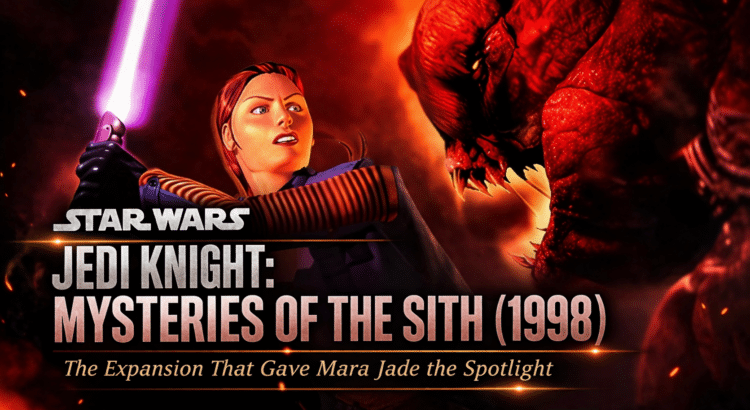
Some Star Wars games feel big because they reinvent the wheel. Others matter because they take an already strong foundation and push the universe into a more interesting direction. Star Wars Jedi Knight: Mysteries of the Sith belongs firmly in that second category.
Released in 1998 as an expansion to Star Wars Jedi Knight: Dark Forces II, Mysteries of the Sith did not arrive with quite the same “everything is changing” impact as its predecessor. It was not the game that first gave Kyle Katarn a lightsaber or introduced full-on Force powers to the series. That had already happened. What Mysteries of the Sith did instead was something arguably just as important for the long-term identity of Star Wars games: it expanded the Jedi Knight formula, leaned harder into ancient Force lore, and gave Mara Jade a central playable role in a major Star Wars game.
That alone makes it a fascinating entry in the larger archive. For SWTORStrategies’ complete Star Wars games list, this is exactly the kind of title that helps connect the dots between bigger headline releases. And for the Star Wars Games (1990–1999) hub, Mysteries of the Sith is a natural follow-up to Star Wars: Dark Forces (1995) and Star Wars Jedi Knight: Dark Forces II (1997). It is the next step in the Kyle Katarn line, but it is also something more than that. It is one of the clearest examples of late-90s LucasArts using games to deepen the Expanded Universe rather than simply revisiting film beats.
And yes, it is also gloriously late-90s in the best way. Ancient Sith temples, dark side corruption, Mara Jade with a lightsaber, and expansion-pack energy that somehow still felt important. That is a strong recipe.
Game Information
Star Wars Jedi Knight: Mysteries of the Sith was released in 1998 for Windows as an expansion pack to Star Wars Jedi Knight: Dark Forces II. In its original form, it required the base game to play, which immediately places it in a slightly different category than a full standalone sequel. But that should not make it sound minor. In practice, it functioned as a major continuation of the Jedi Knight story, adding a new single-player campaign, multiplayer content, new locations, new enemies, and a deeper look at both Kyle Katarn and Mara Jade.
The story is set several years after Dark Forces II. Kyle Katarn has become more established as a Jedi, while Mara Jade enters the picture as his student. When Kyle is drawn toward a dark side presence tied to ancient Sith ruins, Mara becomes increasingly central to the story. That narrative shift is one of the expansion’s biggest strengths. Instead of simply repeating Kyle’s arc, Mysteries of the Sith broadens the Jedi Knight universe and allows another major Legends-era character to carry real weight.
From an archive standpoint, this game belongs squarely in both the master Star Wars games hub and the 1990–1999 Star Wars games hub. It is also inseparable from the two articles that should frame it internally: Dark Forces (1995) and Jedi Knight: Dark Forces II (1997).
Gameplay Overview
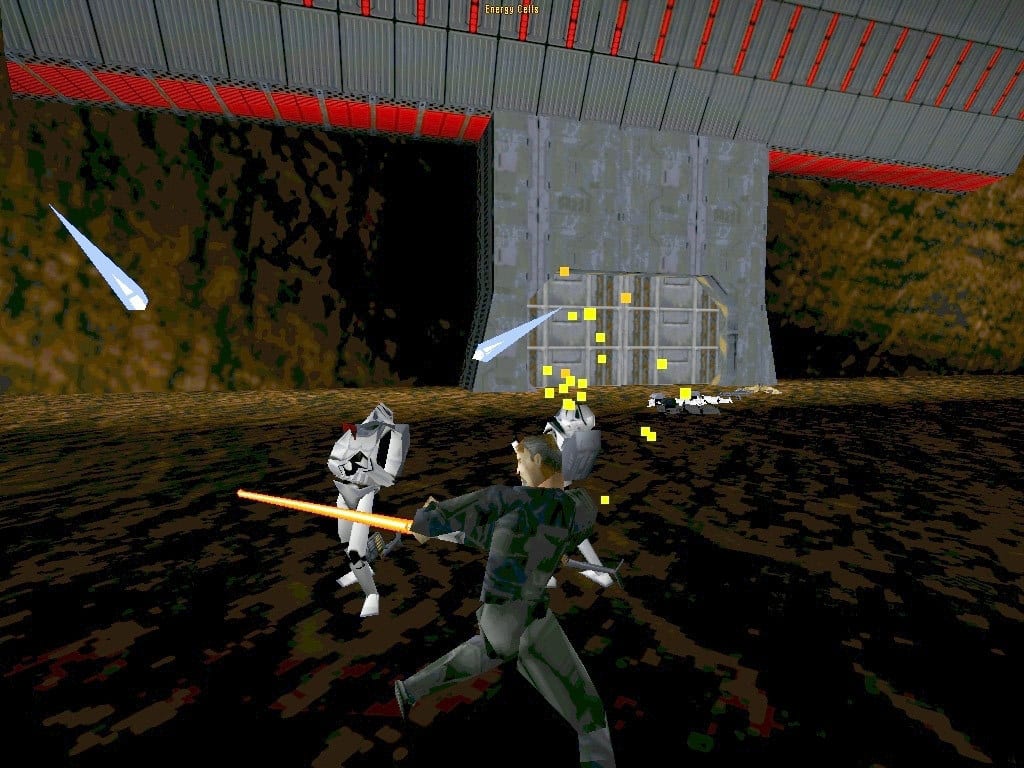
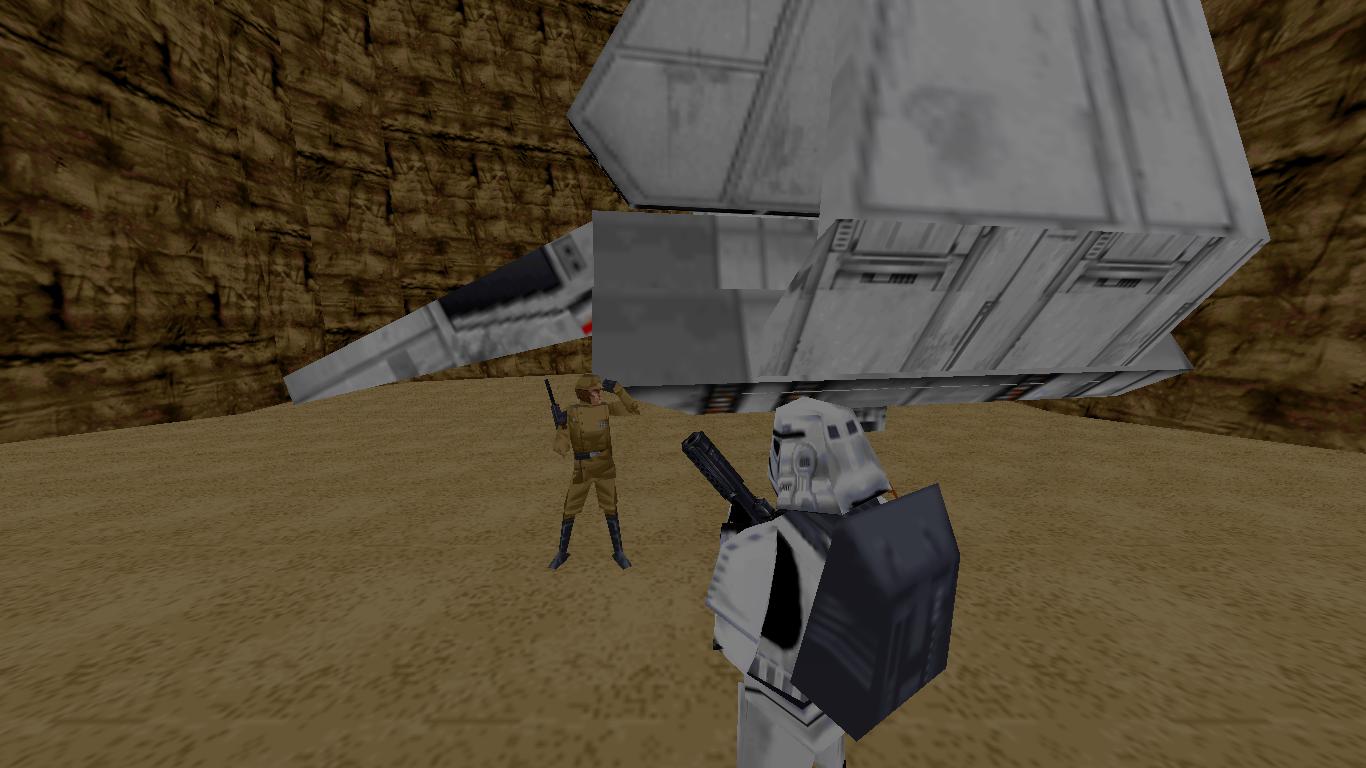
Mechanically, Mysteries of the Sith builds directly on the systems introduced in Dark Forces II. That means players once again move through large 3D environments using blasters, explosives, Force powers, and lightsaber combat, with the option to play in first-person or third-person depending on preference. If Dark Forces II was the leap forward, Mysteries of the Sith is the confident extension of that leap.
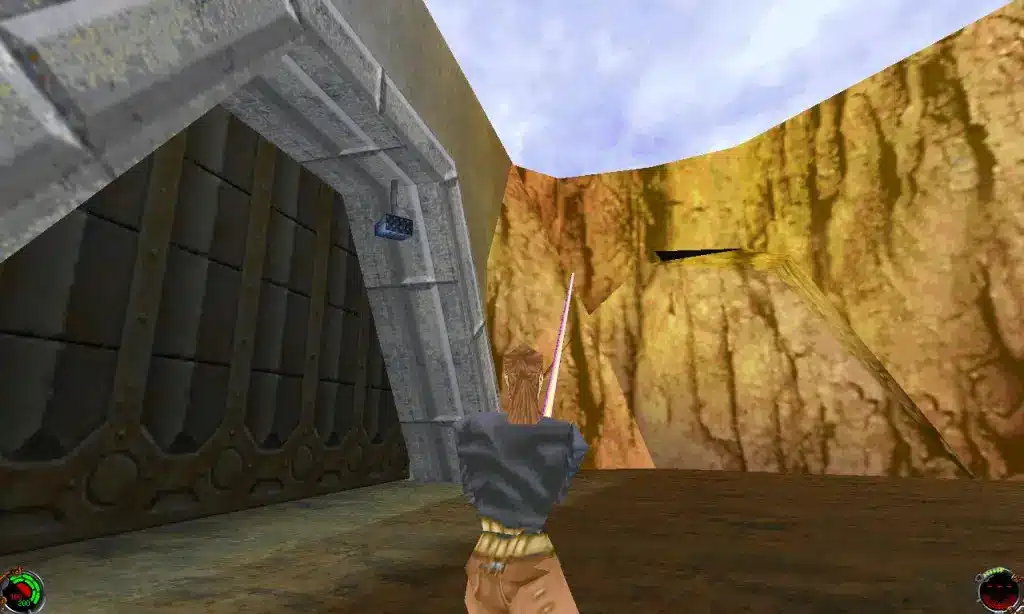
The immediate difference is in tone and emphasis. This expansion feels slightly more mystical, slightly darker, and a bit more focused on Force lore than straightforward mercenary action. There is still plenty of combat and plenty of that classic LucasArts level design, but the atmosphere leans more toward discovery, corruption, and ancient evil than toward military mission structure. The title is not subtle about this. “Mysteries of the Sith” is exactly the kind of phrase a late-90s Star Wars expansion would put on the box when it wanted you to know things were getting weird and mystical.
That works in its favor. The levels often feel more exploratory and more rooted in hidden knowledge than in overt warfare. Players deal with traps, creatures, enemy Force users, and environments that push the game closer to dark fantasy than pure shooter design. It is still very much a product of its engine and its era, which means some traversal can feel clunky and some level layouts can get maze-like, but there is a distinct flavor to this campaign that helps it stand out from the base game.
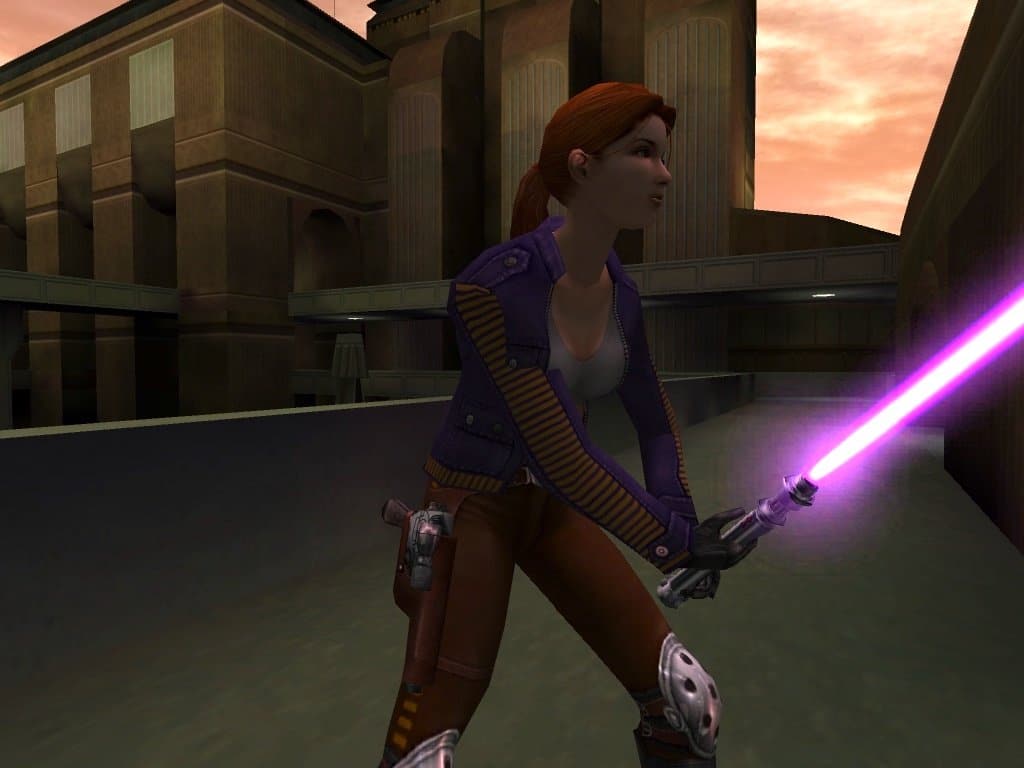
Mara Jade’s role is also crucial here. Once she steps into the spotlight, the expansion gains a different energy. Kyle was already a great lead because he bridged blaster-heavy action and Jedi heroism. Mara adds something else: a more focused, more guarded presence that fits the expansion’s darker atmosphere. In gameplay terms, she is not a radical departure from Kyle, but in narrative terms she makes the experience feel less like “more of the same” and more like a meaningful continuation of the Jedi Knight mythos.
Historical Context
To understand why Mysteries of the Sith matters, it helps to remember the specific moment LucasArts was operating in. This was the late 1990s, when Star Wars was rebuilding theatrical momentum through the Special Editions and the Expanded Universe was thriving in books, comics, and games. The prequels had not yet arrived, which meant there was still plenty of room for games to invent, expand, and experiment without every major corner of the timeline being tightly boxed in by current film projects.
That freedom mattered. It let LucasArts treat Star Wars games as places where important characters could evolve and where major lore ideas could be explored. Dark Forces II had already turned Kyle Katarn into something much bigger than a shooter protagonist. Mysteries of the Sith then widened that lane by pulling Mara Jade into a starring role and by diving deeper into ancient Sith imagery and Force mystery.
In hindsight, there is something especially interesting about that last part. This expansion touched on Sith temples, lost dark side power, and places like Dromund Kaas years before later Star Wars games and Old Republic stories would make those ideas more familiar to broader audiences. It feels like a small but real bridge between the 90s Expanded Universe and the richer Sith-focused game storytelling that would come later.
That makes Mysteries of the Sith more than just a side chapter. In the larger flow of the archive, it is a connective tissue game. It links the grounded shooter origins of Dark Forces to the more refined Jedi action of later titles like Jedi Outcast and Jedi Academy. Without it, the line from Kyle Katarn’s early missions to the full Jedi Knight legacy feels a little less complete.
Development
As an expansion, Mysteries of the Sith did not need to reinvent LucasArts technology from the ground up. Instead, it used the established Jedi Knight framework and pushed it toward a darker, more story-driven extension. That let the developers focus on content, mood, and narrative expansion rather than on building a whole new technical foundation.
That sounds modest on paper, but it was actually a smart move. The base game had already built the core identity: first-person and third-person action, Force powers, lightsaber combat, CD-ROM-era cinematic ambition, and the now-iconic Kyle Katarn setup. The expansion could then spend its time doing what good expansion packs used to do best: deepen the world, add memorable locations, and give players a reason to step back into a game they already liked.
And that is where Mysteries of the Sith succeeds. It has a strong sense of purpose. It is not just extra missions stapled onto a hit. It feels like LucasArts understood there was still real storytelling value in this series and wanted to keep building it before moving on.
The biggest development decision, of course, was putting Mara Jade into such a meaningful role. That gave the expansion more narrative identity immediately. She was already an important figure in the Expanded Universe through Timothy Zahn’s work, but games had the chance to do something books could not: let players directly inhabit that role. That was a big deal, even if it did not always get framed that way at the time.
Reception
Reception to Mysteries of the Sith was generally positive, though it was never treated as a seismic event on the same level as Dark Forces II. That is not really surprising. Expansions almost always live in the shadow of the game that made them possible, and this one was no exception.
What players and critics appreciated was the fact that LucasArts did not just phone it in. There was real effort here to extend the Jedi Knight formula with worthwhile new content and a stronger push into Force-driven storytelling. The expansion’s atmosphere, Mara Jade focus, and continued Kyle Katarn arc all helped it feel more substantial than a routine add-on.
The criticism largely tracked what you might expect from a late-90s expansion built on an existing engine. Some players found it more of an incremental step than a major leap. Others still ran into the same kinds of issues that affected the base game, from occasional level-design frustration to the usual era-specific roughness in movement and navigation. But that did not stop the expansion from carving out a strong reputation among people who cared about the Jedi Knight series specifically.
And that is really the key point. Mysteries of the Sith may not have been the universally discussed headline title of its year, but inside the Kyle Katarn/Jedi Knight fandom, it mattered. A lot.
Legacy
The legacy of Mysteries of the Sith is easy to underestimate if you only look at it as “the expansion after Dark Forces II.” That description is technically true, but it misses why the game is still worth talking about.
First, it helped solidify the Jedi Knight series as more than a one-off experiment. Dark Forces II could have remained the flashy sequel where Kyle got a lightsaber and fought Dark Jedi. Mysteries of the Sith proved there was enough life in the formula and enough appetite for the setting to keep going deeper.
Second, it gave Mara Jade one of her most prominent roles in Star Wars gaming history. That alone makes it stand out. She was not a background reference or a supporting cameo. She mattered. For a franchise that often centered the same handful of heroic archetypes, that was significant.
Third, it planted some imagery and lore ideas that would resonate strongly in later years. Ancient Sith sites, deeper dark side mystery, and the broader feeling that games could explore corners of Star Wars too strange or specific for the films — that all became part of the DNA of the franchise’s gaming side.
And finally, Mysteries of the Sith matters because it helps the full archive make sense. When readers move through the complete Star Wars games list, they should not just see isolated landmarks. They should see lineages. This expansion is one of the clearest examples of that. It connects Dark Forces, Dark Forces II, and the later Jedi Knight titles into something that feels like a real series arc rather than a pile of disconnected classics.
Trivia and Interesting Facts
One of the most notable things about Mysteries of the Sith is that it gave Mara Jade a major playable role in a Star Wars game at a time when that still felt unusual. That alone gives it a special place in the archive.
The expansion is also remembered for its darker tone. Even by Jedi Knight standards, this one leans harder into ominous Force energy, old Sith power, and the risk of corruption. It is less “heroic adventure across the galaxy” and more “something is deeply wrong in these ruins.”
It is also one of the earlier Star Wars games to give Dromund Kaas a notable role. For longtime players who later spent time with Sith-heavy Old Republic material, that is a fun bit of connective tissue in hindsight.
And like many late-90s PC expansions, it was part of an era when “expansion pack” still meant something substantial. This was not cosmetic DLC. It was a real continuation of the story.
FAQ
What is Star Wars Jedi Knight: Mysteries of the Sith?
It is a 1998 expansion pack for Star Wars Jedi Knight: Dark Forces II, continuing the story of Kyle Katarn and giving Mara Jade a major playable role.
Is Mysteries of the Sith a standalone game?
Originally, no. It was released as an expansion and required Dark Forces II.
Why is Mysteries of the Sith important?
Because it expanded the Jedi Knight series, gave Mara Jade a significant starring role, and pushed the games further into Sith lore and Force-focused storytelling.
Where does it fit in the Star Wars timeline of games?
It belongs in the Star Wars Games (1990–1999) era and connects directly to Dark Forces and Dark Forces II.
Does it connect to later Jedi Knight games?
Yes. It is an important bridge between the early Dark Forces titles and later games like Jedi Outcast and Jedi Academy.
Why do people still remember it?
Mostly because of Mara Jade, the darker Sith-heavy tone, and the fact that it felt like a meaningful extension of one of LucasArts’ most beloved Star Wars game series.
Stay connected with the galaxy’s latest updates!
Follow us on X, Facebook, Instagram, bsky or Pinterest for exclusive content, mod guides, Star Wars gaming news, and more. Your support helps keep the Holonet alive—one click at a time
Author

Related Posts

Star Wars Zero Company Director Thinks Old-School PC Genres Are Back Because Consoles Couldn’t Carry Them Properly
William Shakespeare’s Ahsoka’s Tale Gets a September Release Date
Jeremy Allen White Says Finding Rotta the Hutt’s Voice Was Freer Than Playing Bruce Springsteen-
Dave Filoni Says Maul: Shadow Lord Will Finally Bring Some of George Lucas’ Maul Plans to Life




LEGO Star Wars: The Video Game Released 21 Years Ago Today — and It Changed More Than You Remember-
Maul: Shadow Lord Is Not Making Maul a Hero — and That Is Exactly the Point -
A Screen-Used C-3PO Head Just Sold for Over $1 Million 
D23 2026 Could Be a Big Night for Ahsoka Season 2 and Star Wars: Starfighter