
There is a point where the prequel era in Star Wars games stopped feeling like a collection of side attractions and started feeling like an actual era.
Not just podracing. Not just one cool bounty hunter with a jetpack and several anger-management issues. Not just sleek starfighters gliding through Naboo skies.
An actual war.
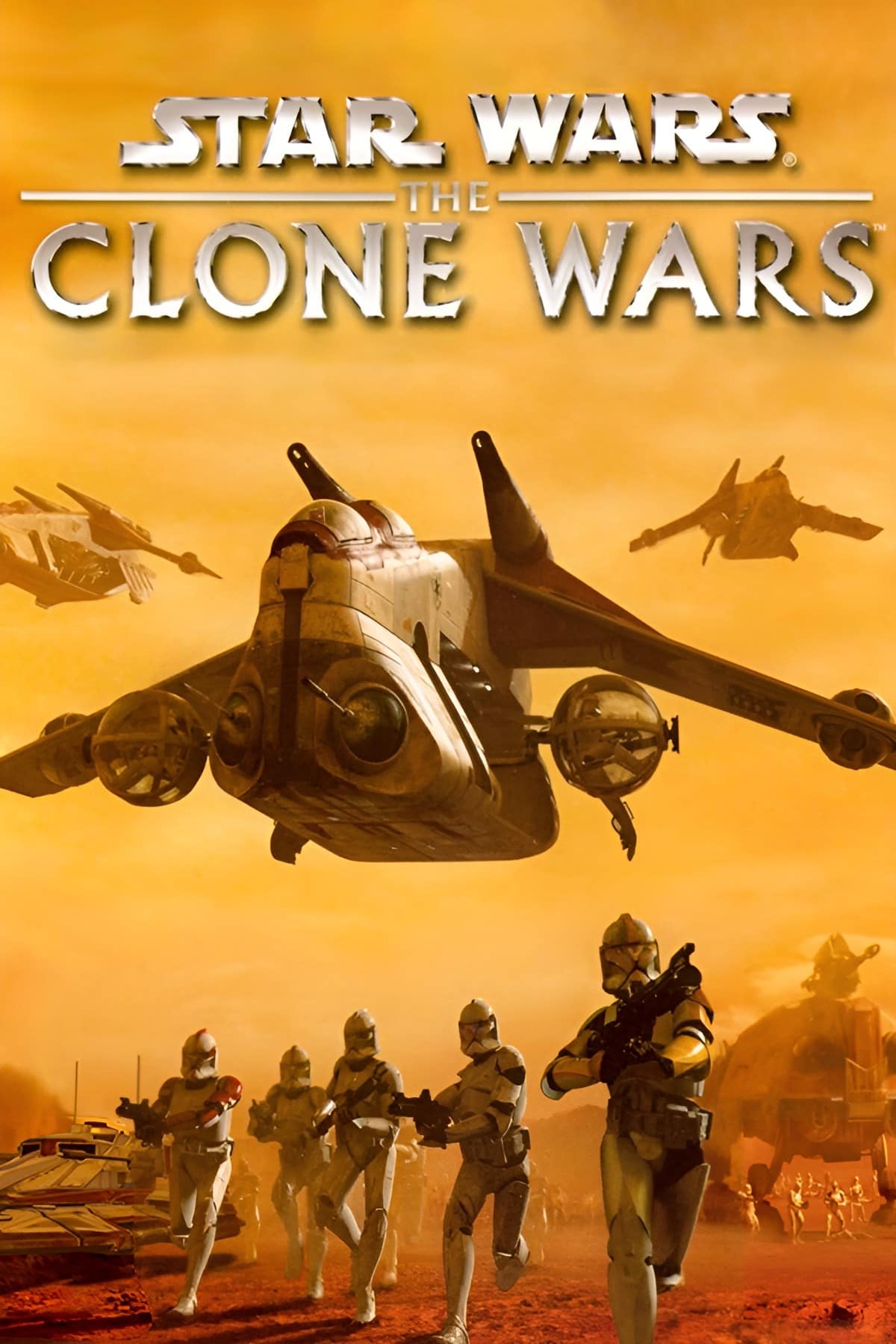
That is where Star Wars: The Clone Wars (2002) comes in.
If Star Wars: Starfighter (2001) gave the prequels proper wings, and Star Wars: Jedi Starfighter (2002) made them a little cooler, and Star Wars: Bounty Hunter (2002) dragged the same era into the underworld and let Jango Fett behave like a licensed public menace, then The Clone Wars did something bigger.
It widened the lens.
It took the prequel era out of the cockpit, out of the alleyways, and out onto the battlefield.
That makes it a natural stop in both our Complete List of All Star Wars Games Ever Made (1979–Present) and the Star Wars Games (2000–2005) hub, because this is one of those games that quietly helped define what Star Wars could look like on consoles in the early 2000s. It is not the most famous title from the era, and it is definitely not the most polished. But it is one of the clearest examples of LucasArts realizing that the prequels were not just films with tie-in potential. They were a whole military sandbox waiting to happen.
And yes, it also let you drive a Republic gunship into absolute nonsense, which never hurts.
Before “The Clone Wars” became a whole empire
One of the funny things about this game now is the title.
Star Wars: The Clone Wars sounds enormous in hindsight. Today, those words bring a whole mountain of associations with them: animated series, characters, arcs, canon debates, tragic Jedi, and enough fan discourse to fuel a small city. But in 2002, this game arrived before that phrase had become its own cultural universe. It was one of the earliest big swings at treating the Clone Wars as more than a line of dialogue and a cool-looking backdrop.
That alone gives it historical weight.
This was a game coming out in the immediate aftermath of Attack of the Clones, at a time when the war itself still felt mysterious and full of open space. Episode II had shown us the beginning. Episode III was still ahead. In between? Huge room to play around. Huge room for LucasArts to invent military scenarios, enemy commanders, planetary conflicts, and vehicle-heavy action without tripping over too much established baggage.
That freedom is all over the game.
Instead of just retelling movie beats, The Clone Wars builds its own campaign around the escalating conflict between the Republic and the Separatists, with Anakin Skywalker, Obi-Wan Kenobi, and Mace Windu all pulled into battles involving a nasty new superweapon and one of the more forgotten prequel-era villains, Sev’rance Tann.
Which, honestly, is part of the game’s charm. This is Star Wars from a very specific moment when the franchise still had room for extra villains, weird detours, and side stories that did not immediately need seven seasons and a hardcover reference guide.
This was Pandemic warming up before Battlefront
A big part of why The Clone Wars is interesting now has less to do with a single mission and more to do with who made it.
This was developed by Pandemic Studios, which would later become much more famous in Star Wars circles for Star Wars: Battlefront and Battlefront II. Looking back, The Clone Wars feels a bit like an early sketchbook for ideas Pandemic would later sharpen into something far more iconic.
You can feel the DNA.
The game loves vehicles. It loves large spaces. It loves the fantasy of being dropped into a battle and handed some combination of speed, armor, and firepower. It is less interested in fine precision than in controlled chaos. You are often not just “moving through a level” in the traditional action-game sense. You are navigating a warzone, usually in something that hovers, blasts, rolls, or all three.
That gives the game a very different texture from the stuff we had just been covering. Jedi Starfighter is sleek and cockpit-focused. Bounty Hunter is dirty and character-driven. The Clone Wars is broader and more mechanical. It wants scale. It wants battlefields. It wants you to feel like the war has gone public and the toys just got much bigger.
That is why it still matters in the archive. It is not just another prequel tie-in. It is one of the stepping stones toward Star Wars becoming very good at large-scale console warfare.
Vehicles first, elegance later
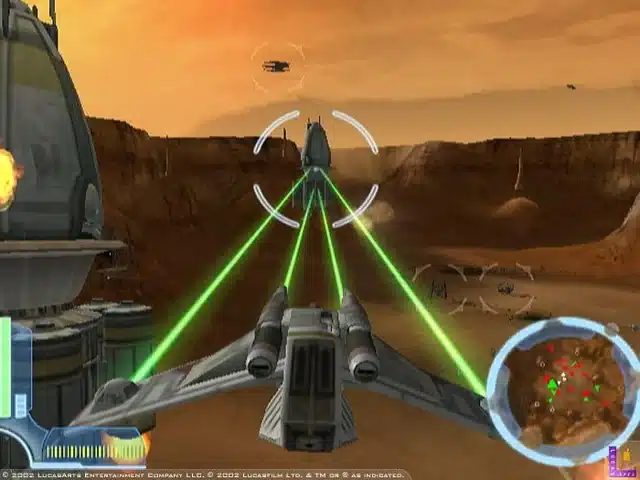
The core identity of The Clone Wars is wonderfully blunt: this is a vehicle combat game with a few Jedi detours, not the other way around.
And honestly, that is the right way to approach it.
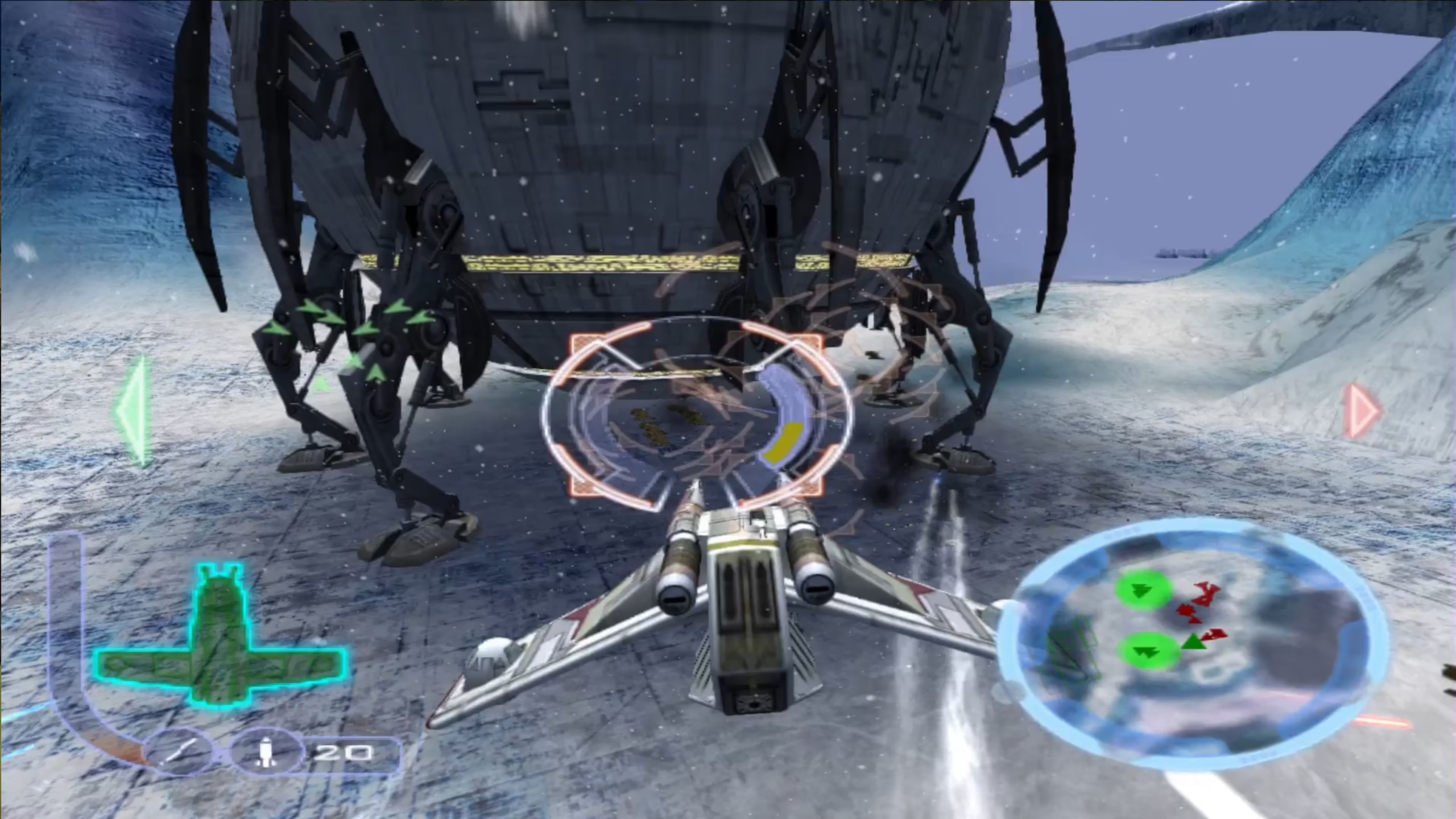
The game hands players control of a bunch of Republic hardware, including tanks, walkers, speeders, starfighters, and gunships, then throws them into missions that often feel somewhere between arcade combat and battlefield puzzle-solving. Sometimes you are escorting. Sometimes you are blowing up heavy targets. Sometimes you are trying to survive a battlefield that seems to believe in quantity over mercy. And a lot of the fun comes from the sheer variety of how the game lets you do that.
This is one of the areas where the game still deserves some respect. It is not just “one vehicle, many maps.” It is built around changing tools and changing contexts. A Republic gunship feels different from a tank. A speeder mission carries a different rhythm from a heavier assault sequence. The game keeps shifting the shape of the war under you, which helps it avoid becoming one long beige blur of prequel hardware and laser fire.
Mostly.
Because let us be fair: this is still an early-2000s console game, and sometimes early-2000s console games did not know when to stop pushing objectives into your face like an overcaffeinated mission designer with a clipboard. But when The Clone Wars is in the zone, it has this great chunky momentum to it. It feels less like a finely tuned sim and more like Star Wars smashing toy vehicles together at a very high production value.
That is not an insult. That is basically a genre description.
The war finally had some weight to it
One of the smartest things the game does is make the Clone Wars feel larger than the movies had time to show.
That matters because Attack of the Clones gives you the start of the conflict, but not much time to live in it. The film is still busy doing romance, politics, mystery plotting, and the occasional highly questionable decision with sand dialogue. The actual war is more of a promise than a fully developed environment.
The Clone Wars gets to cash in on that promise.
By focusing on military campaigns, battlefield movement, and a larger strategic threat, it helps sell the idea that this is no longer just a crisis on Naboo or a one-off planetary mess. This is a widening galactic war with technology, commanders, and front lines. Even if the storytelling is not incredibly deep, the atmosphere does useful work. You are no longer in “movie tie-in mode.” You are in “this conflict has spread” mode.
That is a big difference.
And it is one reason the game sits nicely after Starfighter and Jedi Starfighter. Those games gave the era mobility and style. The Clone Wars gives it weight. Suddenly there are fronts to defend, weapons to stop, and a broader war machine grinding into motion.
You can feel Star Wars getting a little more militarized, a little less romantic, and a little more comfortable with the idea that this era is about conflict on scale.
Sev’rance Tann is exactly the kind of villain this era produced
There is also something delightfully specific about Sev’rance Tann.
She is not one of those villain names that dominates Star Wars nostalgia. She is not Darth Maul-level iconic. She is not one of the franchise’s sacred cows. But she is a very useful reminder of how games in this era expanded Star Wars through side characters who had just enough menace and just enough design flair to carry a campaign.
That is part of the early-2000s LucasArts magic.
The studio was very comfortable building around characters who lived in the margins of the films. Sometimes those characters stuck harder than expected. Sometimes they became cult favorites. Sometimes they just helped give a game its own identity for a while. Sev’rance Tann belongs to that category. She gives The Clone Wars its own villain rather than forcing everything to lean too heavily on Dooku or film repetition, and that helps the game feel like it has its own business to attend to.
It also gives the story a more serial-adventure feel. Not every Star Wars conflict has to involve the top four most marketable names in the galaxy. Sometimes the war gets handed off to people further down the chain, and the galaxy still burns just fine.
Then the Jedi showed up on foot
This is probably where opinions on the game start to split.
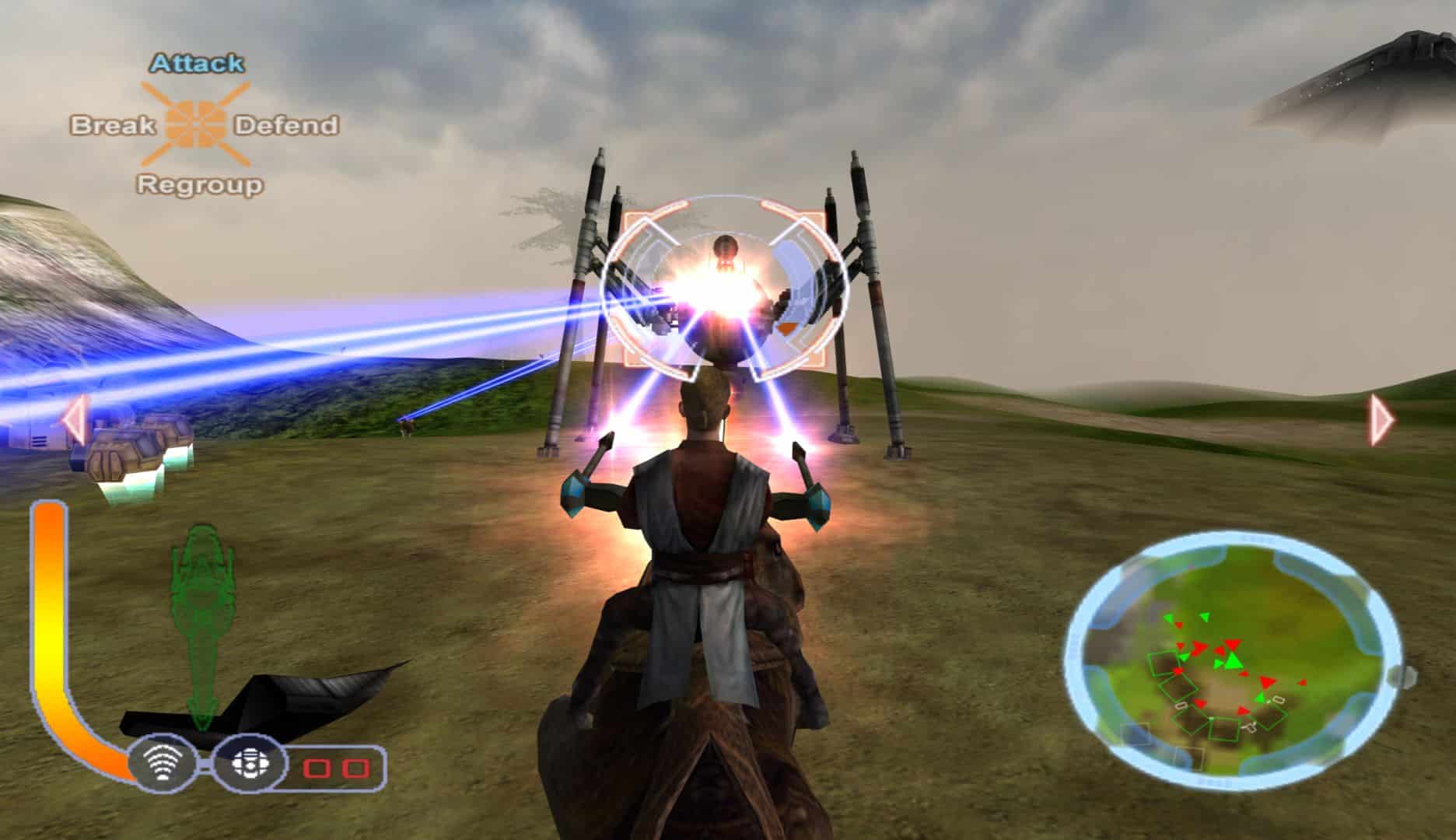
Because for all its vehicle-combat strengths, The Clone Wars also includes on-foot Jedi sections, and these are… well, let us say they are very 2002.
Not always bad. Not always great. Definitely 2002.
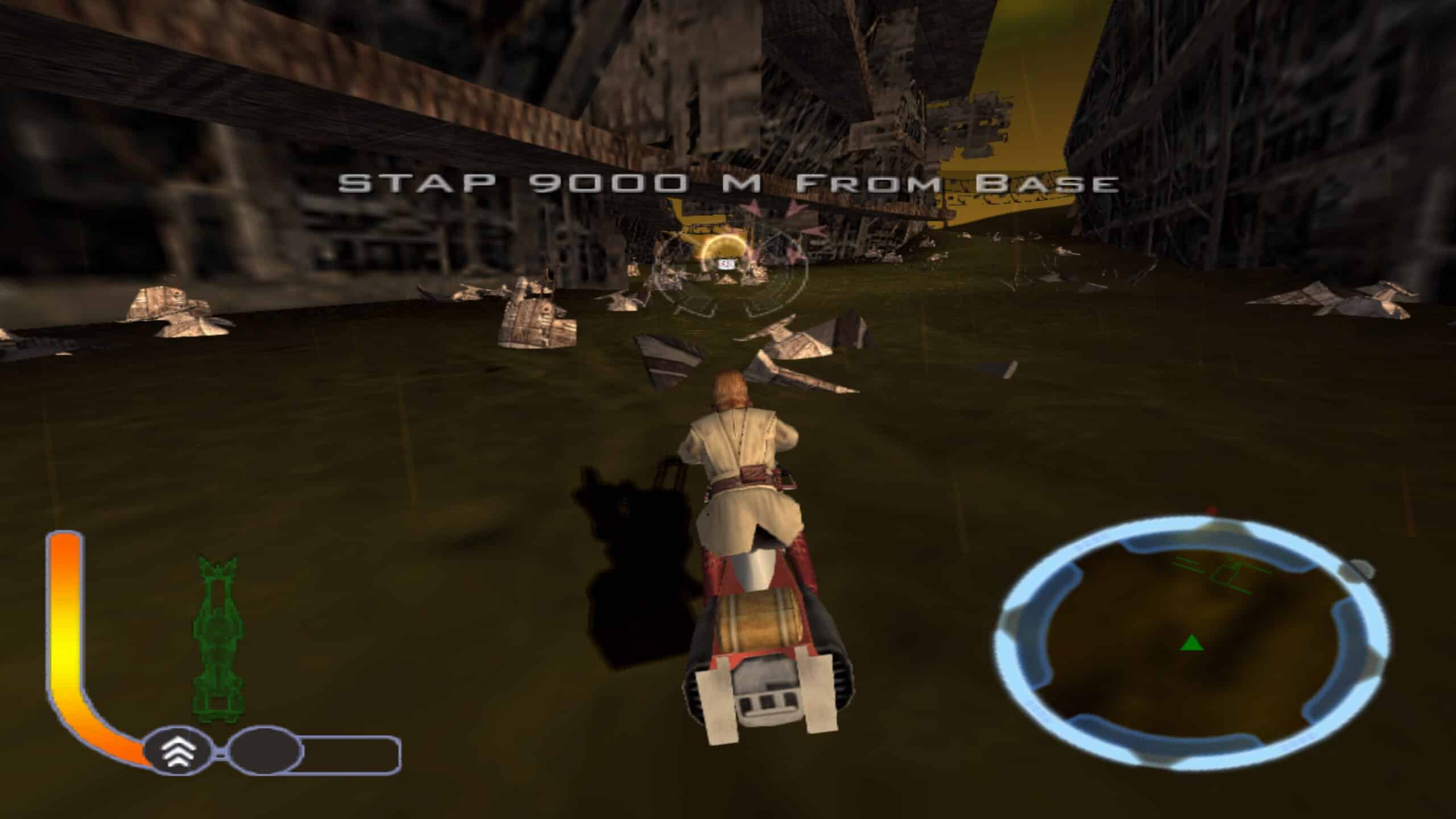
On paper, the idea makes sense. You cannot put Anakin, Obi-Wan, and Mace Windu in a game and never let them swing lightsabers directly. That would be asking for trouble. So the game tries to break up the vehicular action with more direct character-control sequences.
Sometimes these are a nice change of pace.
Sometimes they feel like the game is politely reminding you that it is much more comfortable when everyone is inside something with cannons on it.
That does not ruin the experience, but it is part of why The Clone Wars has always felt a little uneven. The vehicle missions are the real meat. The Jedi sections are more like a side dish the kitchen thought you might want, even though the grill was clearly the star of the restaurant.
Still, I would rather have the game try something extra than just repeat the same tank mission twelve times and hope nobody notices.
The reception was decent, but nobody mistook it for perfection
At the time, The Clone Wars landed in that familiar Star Wars-game middle zone where people generally thought it was entertaining, but not exactly a revelation.
And honestly, that is fair.
The praise usually went to the scale, the visuals, the sound design, the vehicle variety, and the way the game captured the broad feel of Republic-versus-Separatist combat. That part worked. You could feel the appeal. If you were a Star Wars fan in 2002 and you wanted to blow up droids in increasingly dramatic hardware, the game was not exactly withholding.
The criticism, meanwhile, was also pretty predictable. Some reviewers found parts of the gameplay repetitive. Some thought the controls could be clunky depending on the vehicle. Some did not love the on-foot Jedi sections. And some felt the whole package stopped just short of greatness because the ambition was clear, but the refinement was not always there.
That sounds right to me.
The Clone Wars is not one of those miracle games where every idea lands and every system sings. It is a little rough. A little inconsistent. Occasionally a little too happy to let chaos stand in for design precision. But it also has personality, scale, and the kind of console-era Star Wars energy that still makes it easy to like.
Which, to be fair, has described a lot of beloved Star Wars media over the years.
It also helped the prequel era stop feeling shiny all the time
Another thing the game gets right is tone.
A lot of the earlier prequel-era games still carried that slick, polished Naboo glow. Even when they were action-heavy, they often felt sleek. The Clone Wars roughs things up a bit. It puts the era in the dirt. In the smoke. In the machinery of war. It makes the prequels feel less like a showroom and more like a campaign.
That matters historically, because one of the long-term strengths of Clone Wars storytelling is that it adds scars to the prequel era. It takes a world that can sometimes seem too polished and shows the wear underneath. The 2002 game is not doing that with the sophistication of later television or novels, obviously, but you can see the instinct forming.
This is Star Wars getting a little muddier.
And Star Wars usually benefits from that.
Where it belongs in the bigger picture
This is the part where The Clone Wars earns its place.
It is not as iconic as the games that came after it. It is not as easy to romanticize as the classics from the ’90s. It does not have the mythic glow of Knights of the Old Republic, and it does not dominate conversation the way Pandemic’s later Battlefront would.
But that does not make it minor.
If anything, it makes it important in a different way. This is one of the games where you can feel Star Wars learning how to do Clone Wars-scale conflict on consoles. It is part experiment, part proof of concept, part solid action game, and part historical bridge between Episode II-era branding and the much broader war storytelling that would come later.
That is a meaningful job.
And in archive terms, that is exactly the kind of title that deserves attention. Not just the loudest hits. Not just the obvious masterpieces. Also the games that helped the road get built.
The view from the battlefield
There are cleaner Star Wars games.
Smarter ones. Bigger ones. More polished ones.
But Star Wars: The Clone Wars (2002) still has value because it captured a moment when the prequel era stopped being a collection of cool images and became a conflict you could actually play through. It traded in speed and swagger for scale and hardware. It let Pandemic start flexing muscles that would matter later. It expanded the war before “The Clone Wars” became a whole brand unto itself.
And perhaps most importantly, it understood that sometimes Star Wars is not at its best when one hero walks into the room with destiny hanging over his head.
Sometimes it is at its best when you hand a player a Republic gunship and tell them the situation has gotten completely out of hand.
That is not elegance.
But it is a very good start.
FAQ
What is Star Wars: The Clone Wars (2002)?
It is a 2002 Star Wars action game focused largely on vehicle combat during the early Clone Wars, featuring characters like Anakin Skywalker, Obi-Wan Kenobi, and Mace Windu.
Who developed Star Wars: The Clone Wars?
The game was developed by Pandemic Studios and published by LucasArts.
What kind of gameplay does The Clone Wars have?
It is mostly a vehicle-based action game, with players controlling Republic tanks, speeders, gunships, and other hardware across large battle-oriented missions, plus some on-foot Jedi sections.
How does it connect to the Star Wars films?
The game is set in the period around Attack of the Clones and helps expand the early Clone Wars era beyond what the movie itself had time to show.
Is Star Wars: The Clone Wars connected to the later animated series?
Not directly. It came years before the 2008 animated series, though both draw from the same general era of conflict.
Why is Star Wars: The Clone Wars worth revisiting?
Because it is an important early attempt to turn the prequel-era war into a playable battlefield and a fascinating stepping stone toward later large-scale Star Wars games.