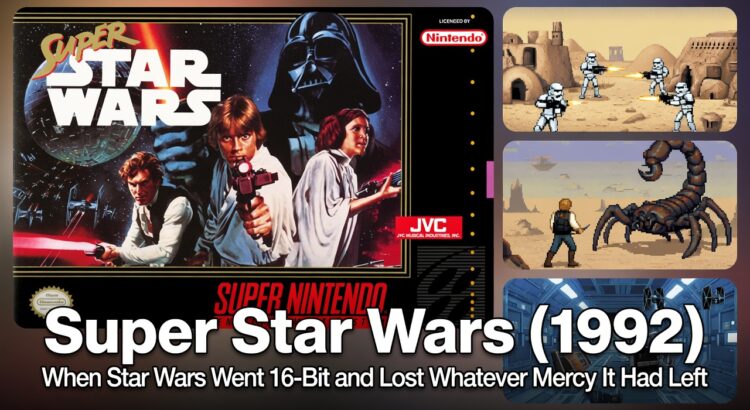
If Star Wars (1991) on NES felt like A New Hope had been turned into a weird, hard platformer, then Super Star Wars felt like somebody gave that idea more horsepower, more color, more explosions, and absolutely no intention of making your life easier. Released for the Super Nintendo in 1992, the game was developed by Sculptured Software with Lucasfilm Games / LucasArts involvement and published by JVC Musical Industries. It adapted the original 1977 film into a 16-bit action game full of side-scrolling blaster fights, platforming, landspeeder stretches, and the inevitable Death Star trench run.
As part of our Complete List of All Star Wars Games Ever Made (1979–Present), this is one of those games that really feels like a line in the sand. It also belongs naturally in the Star Wars Games (1990–1999) hub, because this is where Star Wars on home consoles stopped looking merely ambitious and started looking iconic. The series had already tried film adaptations on NES and Game Boy. Super Star Wars is where that whole idea suddenly got louder, sharper, and much more memorable.
This is where the old console formula finally found the right hardware
That is probably the most important thing about Super Star Wars. It did not come out of nowhere. It came right after the earlier Star Wars (1991) and just before The Empire Strikes Back (1992) style of console adaptation had fully run out of road. But the move to the SNES changed the feel immediately. The game could be bigger, faster, more detailed, and far more dramatic. Where the NES titles often felt like they were forcing Star Wars through a stiff cartridge-era filter, Super Star Wars feels like the same basic instinct finally landing on hardware that could make the fantasy sing.
And yes, by “sing,” I also mean “throw enemies at you with the enthusiasm of a game that is deeply suspicious of your free time.”
A New Hope, but now it has muscles
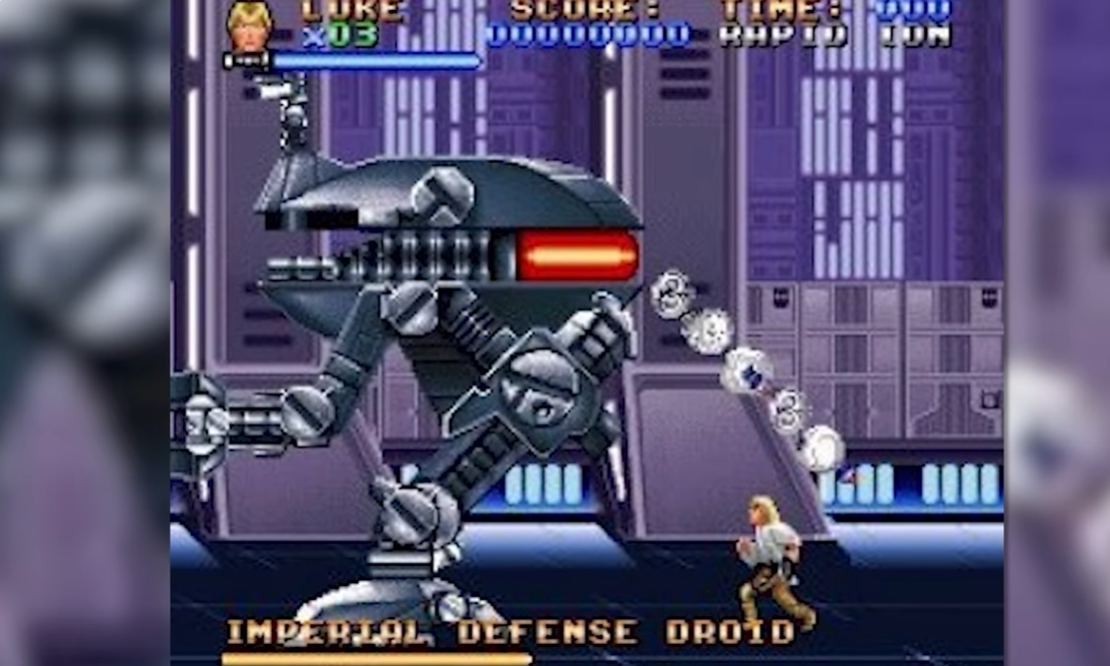
Like the earlier NES adaptation, Super Star Wars retells the broad events of A New Hope. You start on Tatooine, work through key locations and action beats, and eventually reach the Death Star and the final trench run. But the game is not trying to be a calm digital retelling of the film. It is trying to be an action showcase. That means extra enemies, expanded stages, exaggerated boss encounters, and a general sense that every movie scene has been put on a protein-heavy 16-bit diet.
That sounds silly, but it is also why people remember it. The game does not politely reenact Star Wars. It weaponizes it. Tusken Raider trouble becomes a full action stage. Mos Eisley becomes a hazard-filled gauntlet. The Death Star is not just a place you visit. It is another excuse to see how much spectacle and punishment the cartridge can squeeze out of the license.
Luke, Han, and Chewie all get to be proper action heroes
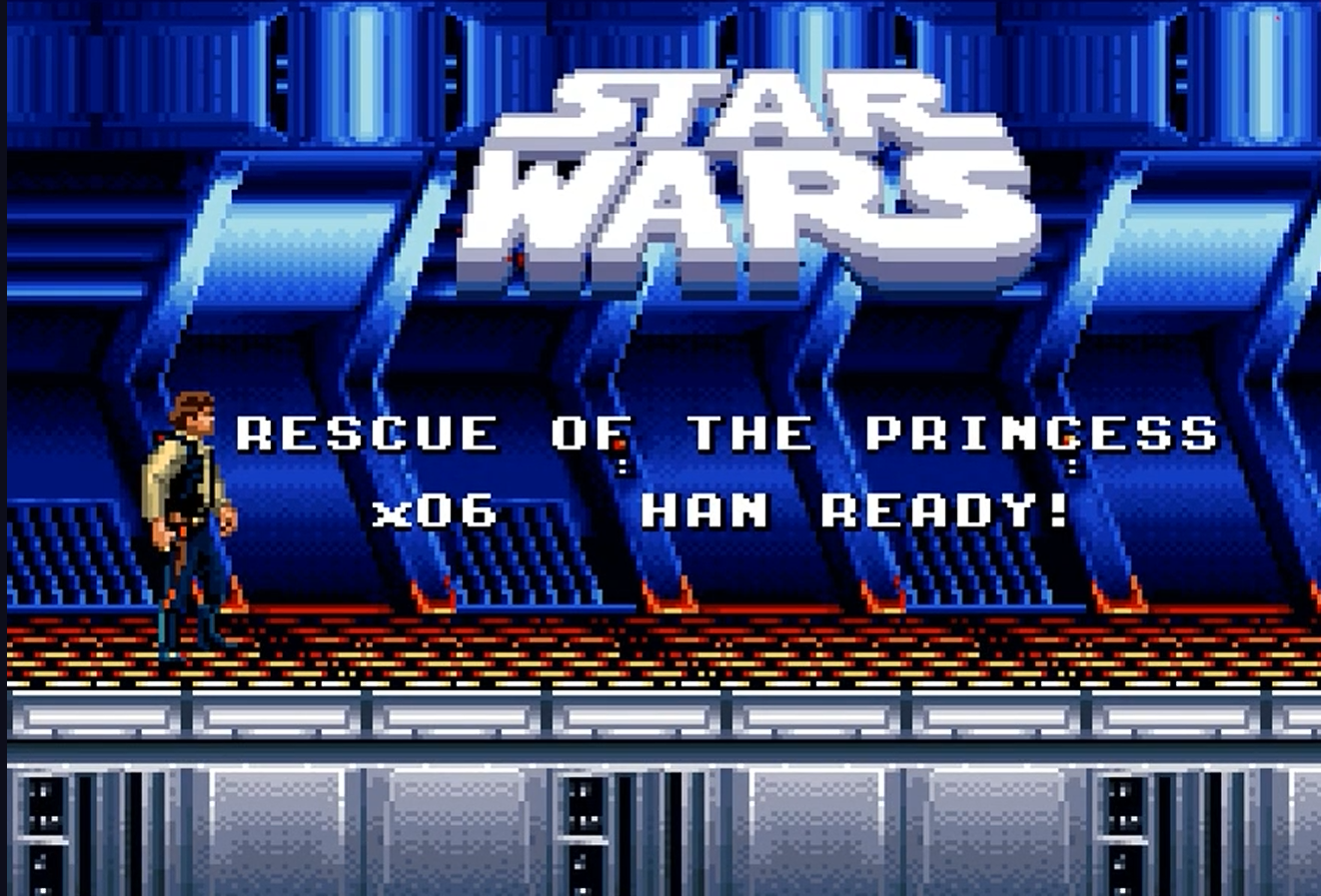
One of the smartest choices the game makes is spreading the spotlight around. You do not just play as Luke Skywalker. The game also lets you control Han Solo and Chewbacca, each with different weapons and feel. That does a lot for pacing, but it also makes the adaptation feel bigger. This is not just “Luke’s platforming journey.” It is a more chaotic ensemble version of Star Wars where different heroes take turns solving problems with blasters, brute force, or slightly alarming amounts of vertical jumping.
That variety matters because Super Star Wars is not short on intensity. Changing character abilities helps keep the game from becoming one long wall of the same movement and attack rhythm. It is still difficult, still occasionally rude, but it gives the player more tools and more flavors of Star Wars heroics than the older console titles managed.
This game absolutely loves being a video game first
That is not a complaint. It is the whole point.
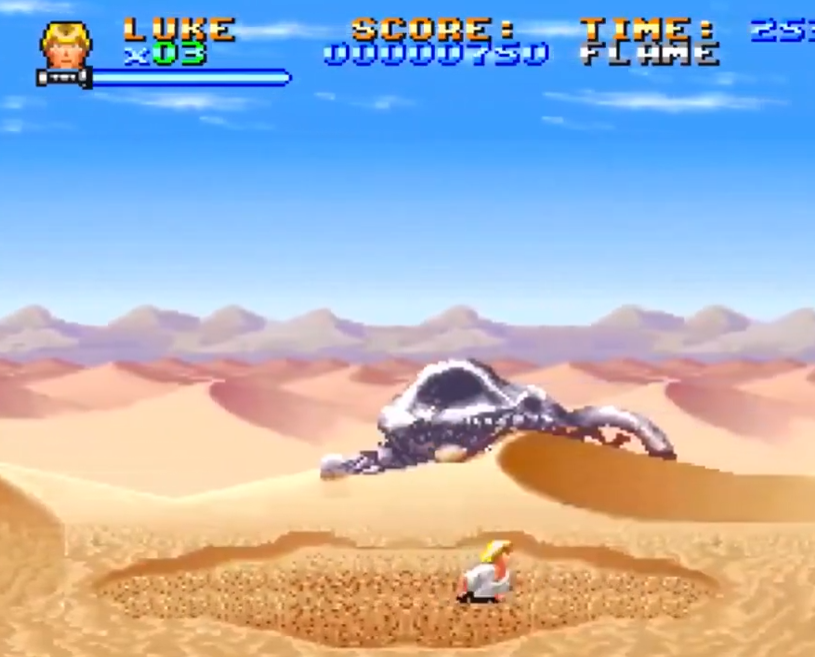
Like the NES adaptation before it, Super Star Wars is not particularly interested in strict realism to the film. If something needs to be bigger, louder, or stranger to work as a level, the game does it. If a movie moment can be turned into a boss fight, a chase sequence, or a more aggressive set piece, it goes there. The result is a version of A New Hope that often feels more like a fever dream of the movie than the movie itself. But it is a very entertaining fever dream.
That is also why the game became so beloved in retro circles. It is not elegant adaptation. It is maximalist adaptation. It understands that part of the fun of a 16-bit Star Wars game is not simply “remember this scene.” It is “remember this scene, now survive it while a game screams at you through enemy placement and lava pits.”
The 16-bit leap made a huge difference
This is where the game really earns its place historically. The SNES let LucasArts and Sculptured Software make Star Wars feel rich in a way the earlier home releases often could not. The sprite work was stronger, the animation had more life, the environments had more mood, and the music could do a much better job of carrying John Williams’ shadow without collapsing into chirps and compromise. Even people who find the difficulty excessive usually admit the presentation is a huge part of the game’s staying power.
You can feel the confidence too. This is not a timid licensed product trying not to embarrass itself. It wants to impress you. It wants to show off what 16-bit Star Wars can look and sound like. And in 1992, that was a pretty strong selling point.
The difficulty is real, and very much part of the reputation
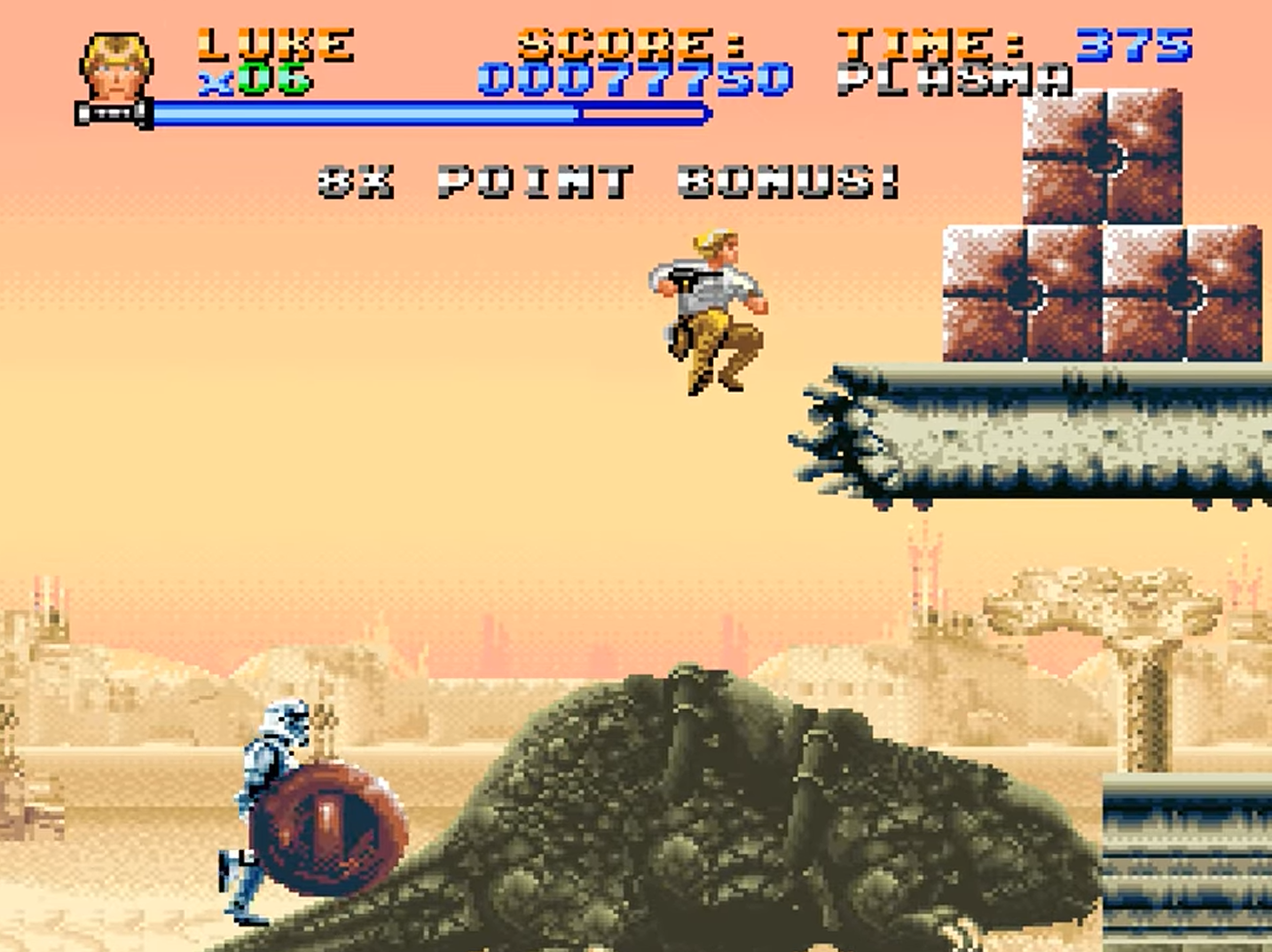
Let us not pretend otherwise. Super Star Wars has a reputation for being hard, and that reputation did not appear by magic. The game can be brutal. Stages are busy. Bosses can be rough. Platforming can be punishing. It often feels like it was built by people who thought “fun” and “light suffering” were natural roommates.
But unlike some hard games that just feel stiff or joyless, Super Star Wars usually gets away with it because the spectacle is so strong. When the game knocks you over the head, it at least does so while looking and sounding fantastic. That bought it a lot of goodwill then, and it still buys it goodwill now.
Critics liked it, and history has been kind to it
This is not one of those retro games that survives only on nostalgia fumes. Contemporary and later reputation both treated Super Star Wars pretty well. MobyGames shows a critics average around 80%, and Wikipedia’s summary notes that it won Electronic Gaming Monthly’s Best Action/Adventure Game of 1992 and Best Movie-to-Game. Later retrospectives also ranked it highly among SNES titles, with outlets such as IGN and Official Nintendo Magazine giving it serious long-tail respect.
That matters because it shows the game was not just loud and memorable. It landed. The industry noticed. Players noticed. And even after later Star Wars classics arrived, Super Star Wars kept a distinct identity as one of the signature 16-bit movie adaptations.
It also kicked off one of Star Wars gaming’s best-known mini-trilogies
Another reason this game matters is what came after it. Super Star Wars was the first entry in the Super Star Wars trilogy, followed by Super Star Wars: The Empire Strikes Back (1993) and Super Star Wars: Return of the Jedi (1994). That trilogy became one of the most recognizable Star Wars game branches of the 1990s, and this first game set the tone: beautiful 16-bit presentation, film adaptation turned up to eleven, and enough challenge to make people talk about it decades later.
So even if you only looked at it as a series foundation, it would still deserve a lot of respect.
Why it matters in the archive
This is the point where Star Wars game history starts to feel less like experiment and more like momentum. After the older home-console oddities and the rough early-90s NES/Game Boy adaptations, Super Star Wars is where the franchise finds a form that still feels distinctly alive now. It is not yet the LucasArts golden age in the way people usually mean that phrase, but you can see the road leading there.
That is why it fits so neatly after Star Wars (1991) and The Empire Strikes Back (1992). Those games are the rough draft. Super Star Wars is the moment the handwriting suddenly gets bolder and a lot more expensive-looking.
The view from Tatooine, with more explosions than strictly necessary
There are Star Wars games that are smarter than Super Star Wars. There are smoother ones too. There are definitely more forgiving ones.
But Super Star Wars still matters because it took the whole old idea of “make the movie into a game” and pushed it into a louder, more iconic, more 16-bit form. It is difficult, ridiculous in places, sometimes deeply unfair, and also exactly the kind of game that leaves a mark.
That is not grace.
That is legacy.
FAQ
What is Super Star Wars?
It is a 1992 SNES action game based on the original 1977 Star Wars film, developed by Sculptured Software with Lucasfilm Games / LucasArts involvement and published by JVC Musical Industries.
What platform was Super Star Wars released on originally?
Originally, it released on the Super Nintendo Entertainment System in 1992. It was later re-released on other platforms years afterward.
Who can you play as in Super Star Wars?
The game features Luke Skywalker, Han Solo, and Chewbacca as playable characters.
Was Super Star Wars well received?
Yes. It was well reviewed, with around 80% critic scores on MobyGames, and it won Electronic Gaming Monthly’s Best Action/Adventure Game of 1992 and Best Movie-to-Game.
Why do people remember Super Star Wars so strongly?
Because it combined strong 16-bit presentation, a very recognizable Star Wars atmosphere, and a famously punishing difficulty level into one of the standout SNES movie adaptations of its era.
Why is Super Star Wars worth revisiting today?
Because it marks the point where Star Wars film adaptations on home consoles stopped feeling merely experimental and started feeling iconic.