There are many ways to fail a diplomatic mission.
You can insult the other side.
You can misunderstand the negotiations.
You can discover that the conference room is filling with poisonous gas while an army of battle droids waits outside.
Or, in Star Wars: Episode I – The Phantom Menace, you can accidentally swing a lightsaber at the wrong person and turn the entire Trade Federation ship into a workplace dispute.
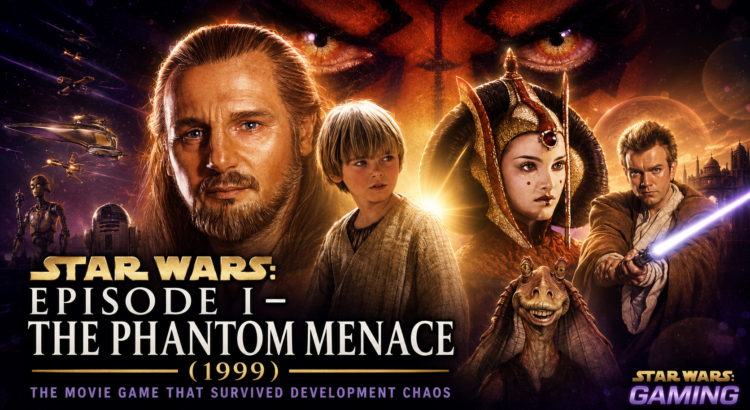
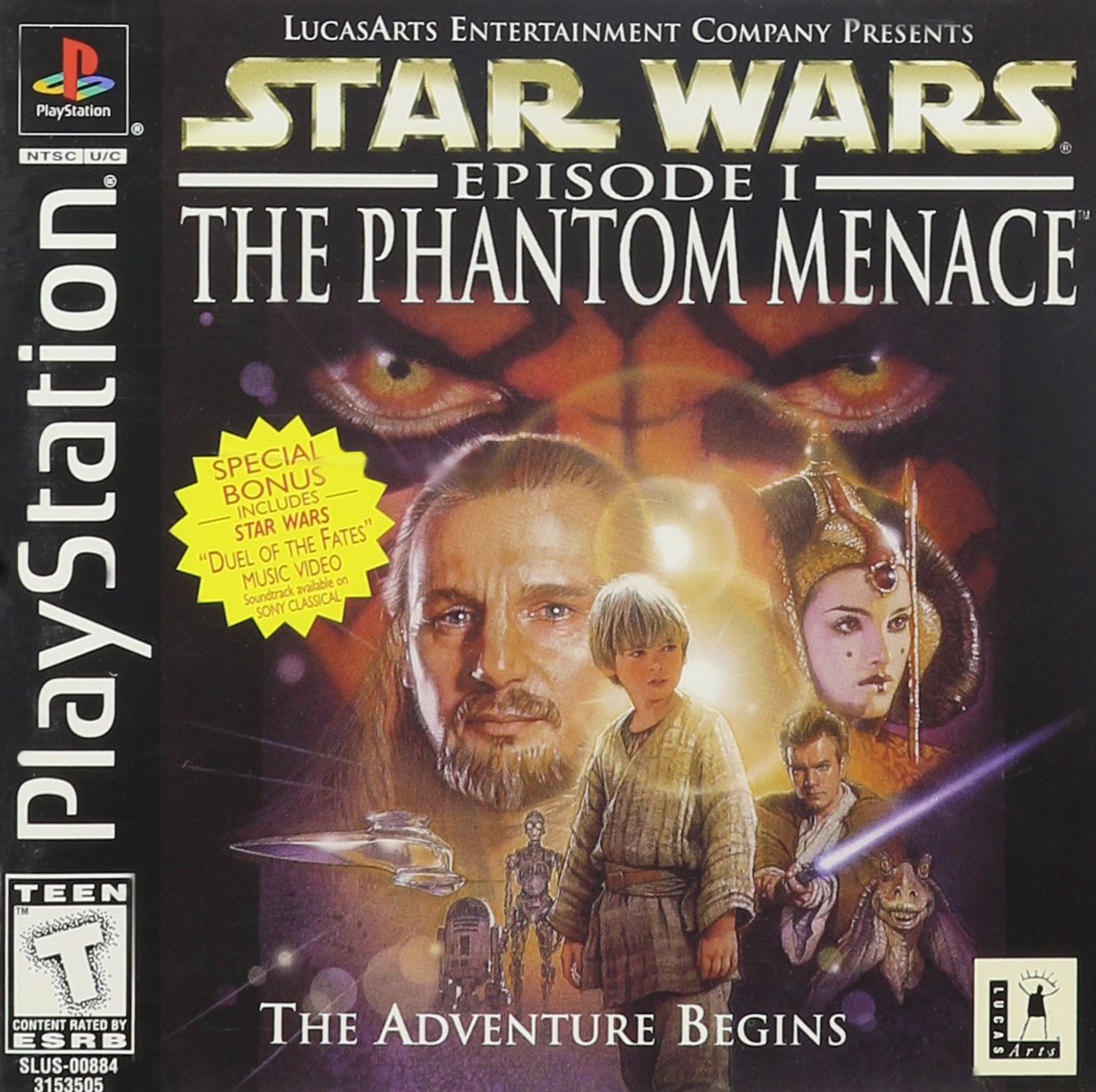
Released for Windows and PlayStation in 1999, The Phantom Menace was Big Ape Productions’ attempt to squeeze George Lucas’ first prequel into a third-person action-adventure. Players moved between Obi-Wan Kenobi, Qui-Gon Jinn, Queen Amidala, and Captain Panaka across an expanded retelling of the film, mixing lightsaber combat, blaster fights, puzzles, exploration, conversations, trading, and side objectives.
It was ambitious.
It was awkward.
It had a camera that occasionally behaved like it had also been hit with a Force push.
And behind the scenes, the developers were building it with incomplete movie references, restricted tools, shifting hardware targets, and firm instructions not to compete too directly with other Star Wars games.
The result was never going to be elegant.
It was, however, much more interesting than the usual disposable film adaptation.
As part of our complete archive of every Star Wars game ever released, The Phantom Menace belongs in the Star Wars games of 1990–1999 archive, directly after Sega’s spectacular Star Wars Trilogy Arcade.
That arcade machine compressed the original trilogy into a flawless sequence of things exploding.
The Phantom Menace gave you conversations, fetch quests, questionable Jedi ethics, and the freedom to make life in Mos Espa considerably worse for everyone.
Progress.
The Prequel Hype Machine Needed More Than One Game
It is difficult to explain just how enormous The Phantom Menace felt before its release.
The film arrived on May 19, 1999, as the first new Star Wars theatrical chapter since Return of the Jedi in 1983. The anticipation was extreme, secrecy surrounded the production, and Lucasfilm was preparing an entire wave of tie-in products around the return of the Jedi Order, young Anakin Skywalker, and the political crisis that would eventually destroy the Republic.
LucasArts did not bet everything on one adaptation.
The company split Episode I into several different game projects. The Phantom Menace handled the broad adventure and story. Episode I: Racer took the Boonta Eve podrace and turned it into a full racing game. Other titles would explore education, puzzles, arcade combat, and later the Battle of Naboo.
That strategy makes sense now.
It was also one of the reasons Big Ape’s game became so strange.
The developers were adapting a film built around wildly different types of spectacle, but some of the most obvious gameplay material had already been claimed by other teams. The podrace was unavailable because LucasArts had assigned it to Episode I: Racer, while the developers were also told not to make a first-person action game that might overlap with a Jedi Knight project.
So the game based on The Phantom Menace could not really focus on the podrace.
It could not become another Jedi Knight.
It still needed to launch near the film.
No pressure.
Four Heroes, Eleven Levels, and No Podracing
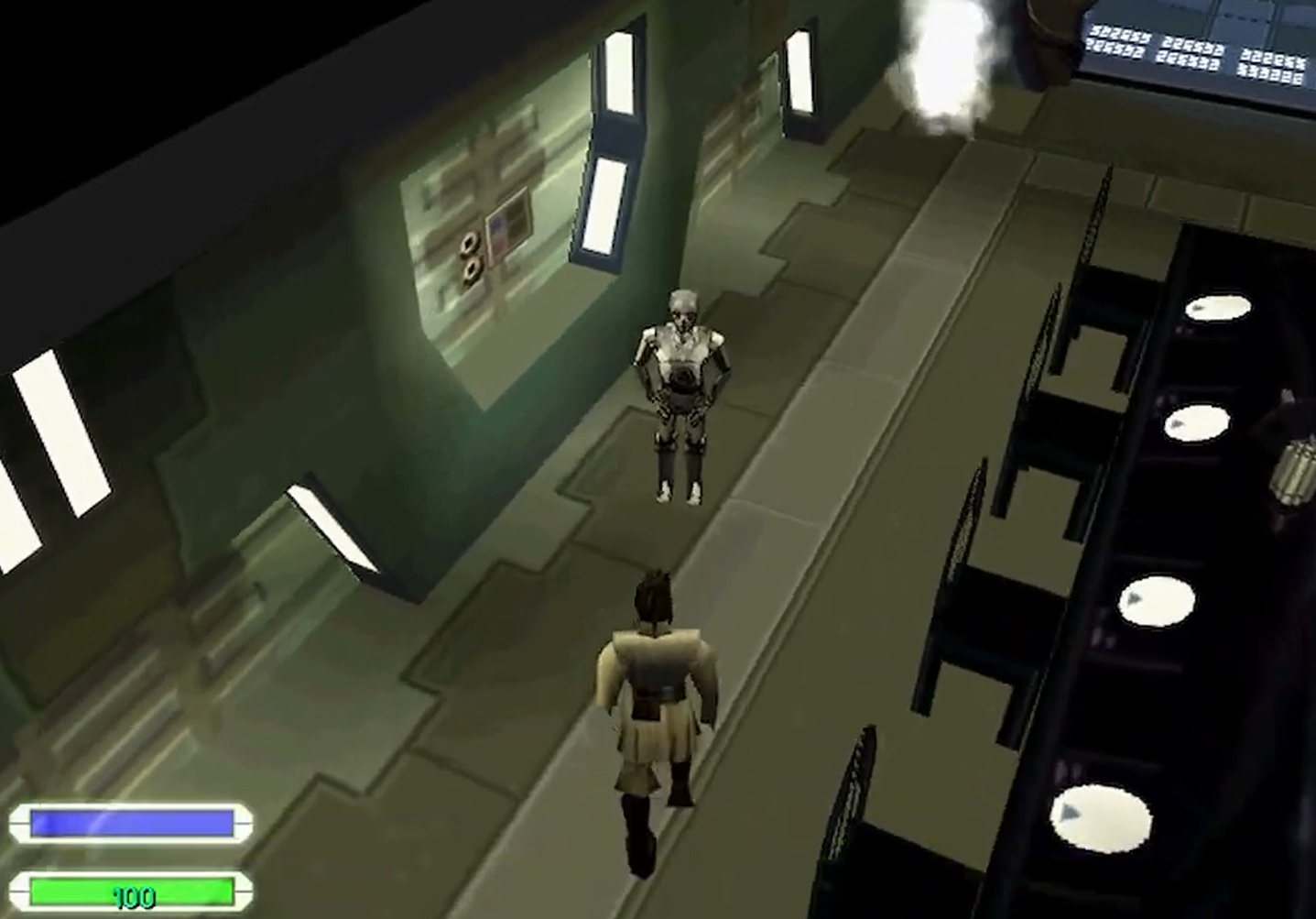
The campaign follows the broad shape of the movie across eleven levels.
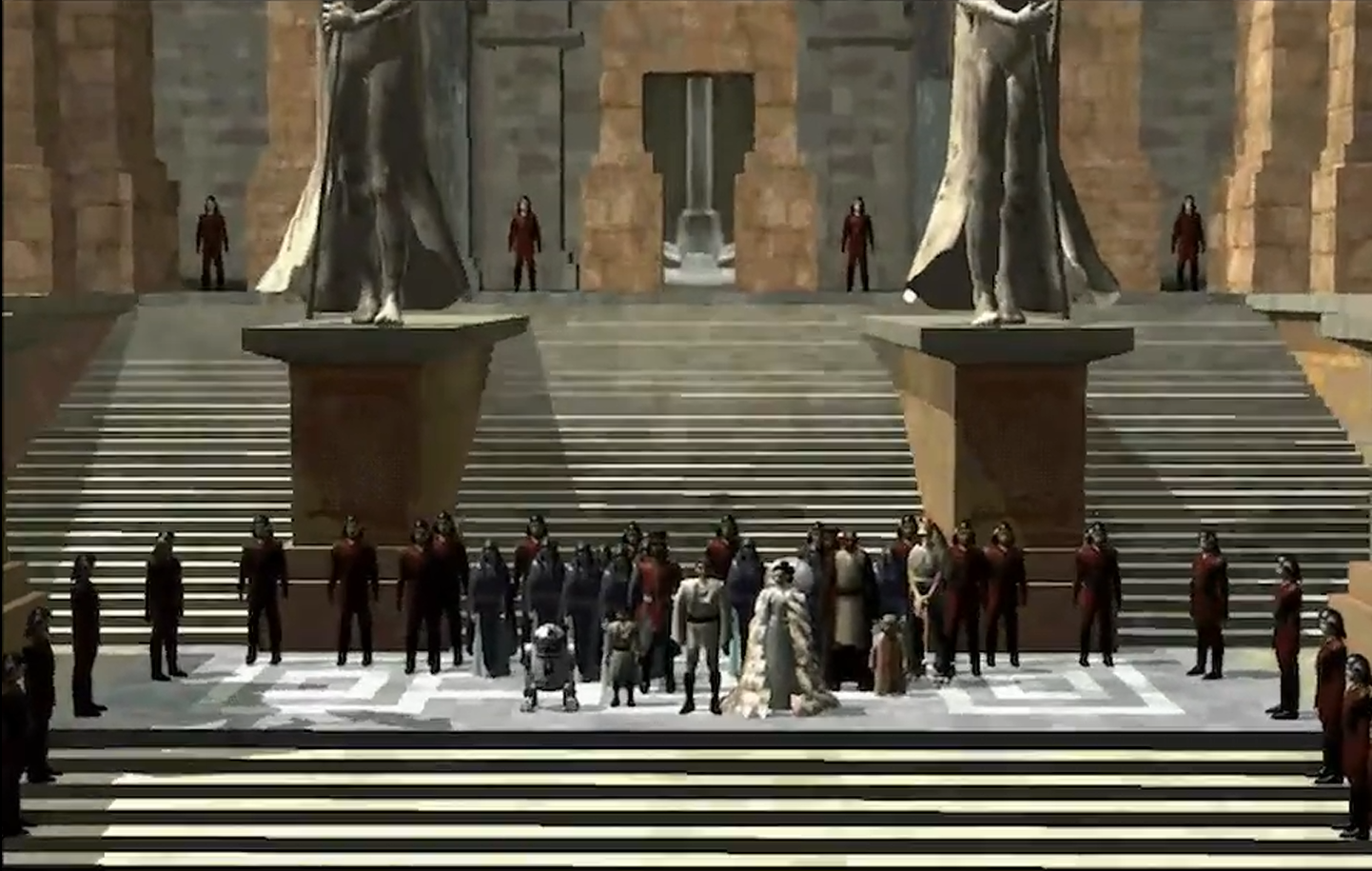
It begins aboard the Trade Federation battleship, moves through the swamps and underwater city of Naboo, reaches the gardens and occupied streets of Theed, travels to Mos Espa and its arena, shifts briefly to Coruscant, and finally returns to Naboo for the assault on the palace and the duel with Darth Maul.
The game changes playable characters depending on the chapter.
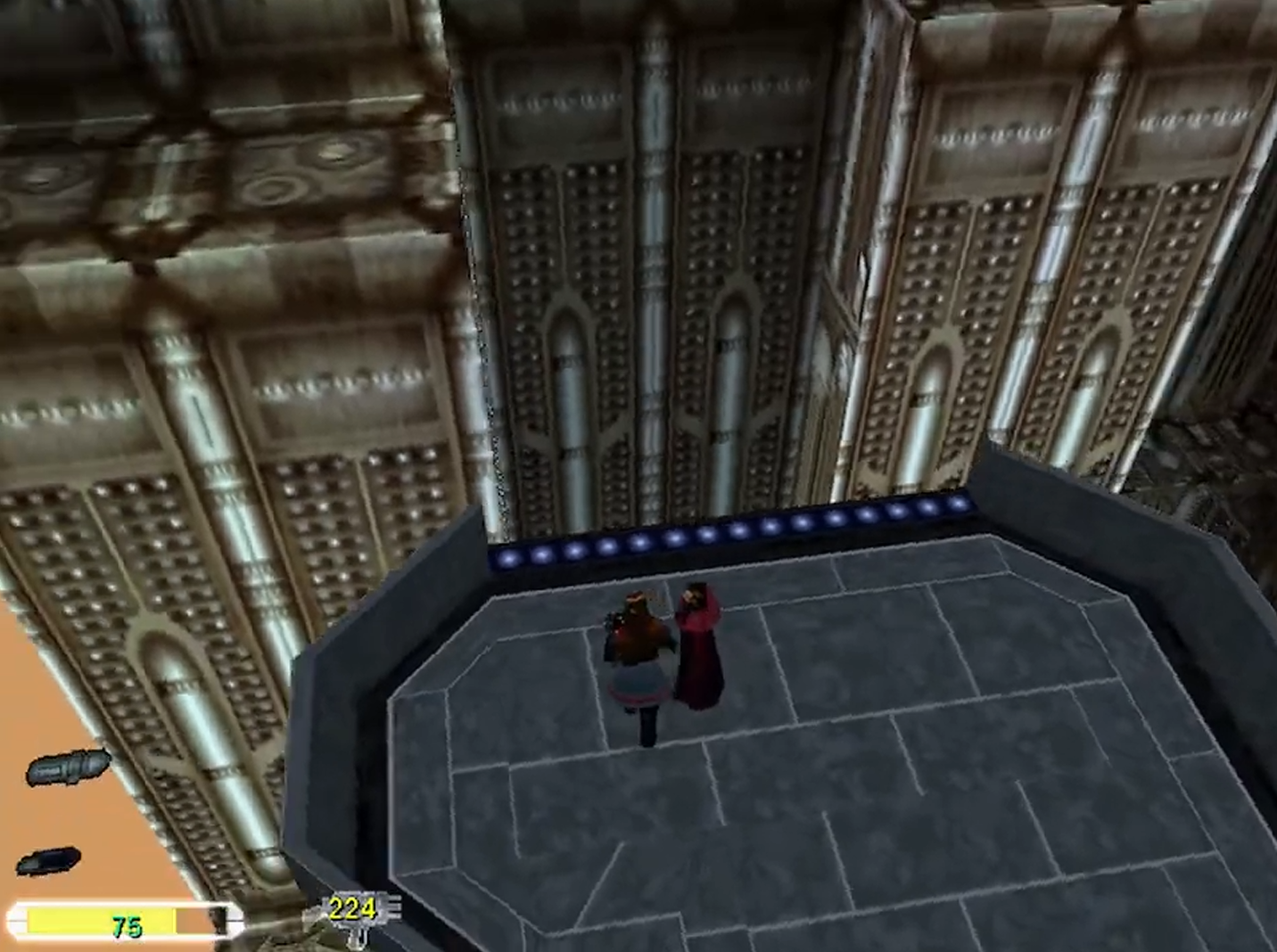
Obi-Wan handles the opening escape from the Trade Federation and much of the early Naboo action. Qui-Gon becomes the central character on Tatooine. Captain Panaka takes over during the expanded Coruscant sequence, while Queen Amidala becomes playable during the final liberation of Theed.
That structure gives the adaptation more variety than a straightforward Obi-Wan action game would have offered.
It also produces a noticeable drop in spiritual power whenever the game takes your lightsaber away and hands you Captain Panaka’s blaster.
The Jedi characters can swing their lightsabers, reflect enemy fire, use Force push, perform evasive movements, and pick up additional weapons. Panaka and Amidala rely more heavily on blasters, explosives, and conventional weaponry.
In theory, the character changes provide different approaches.
In practice, everyone spends a lot of time running into walls while the camera considers its options.
This Was More Adventure Game Than People Remember
The Phantom Menace is often remembered as a clumsy action game.
That description is fair, but incomplete.
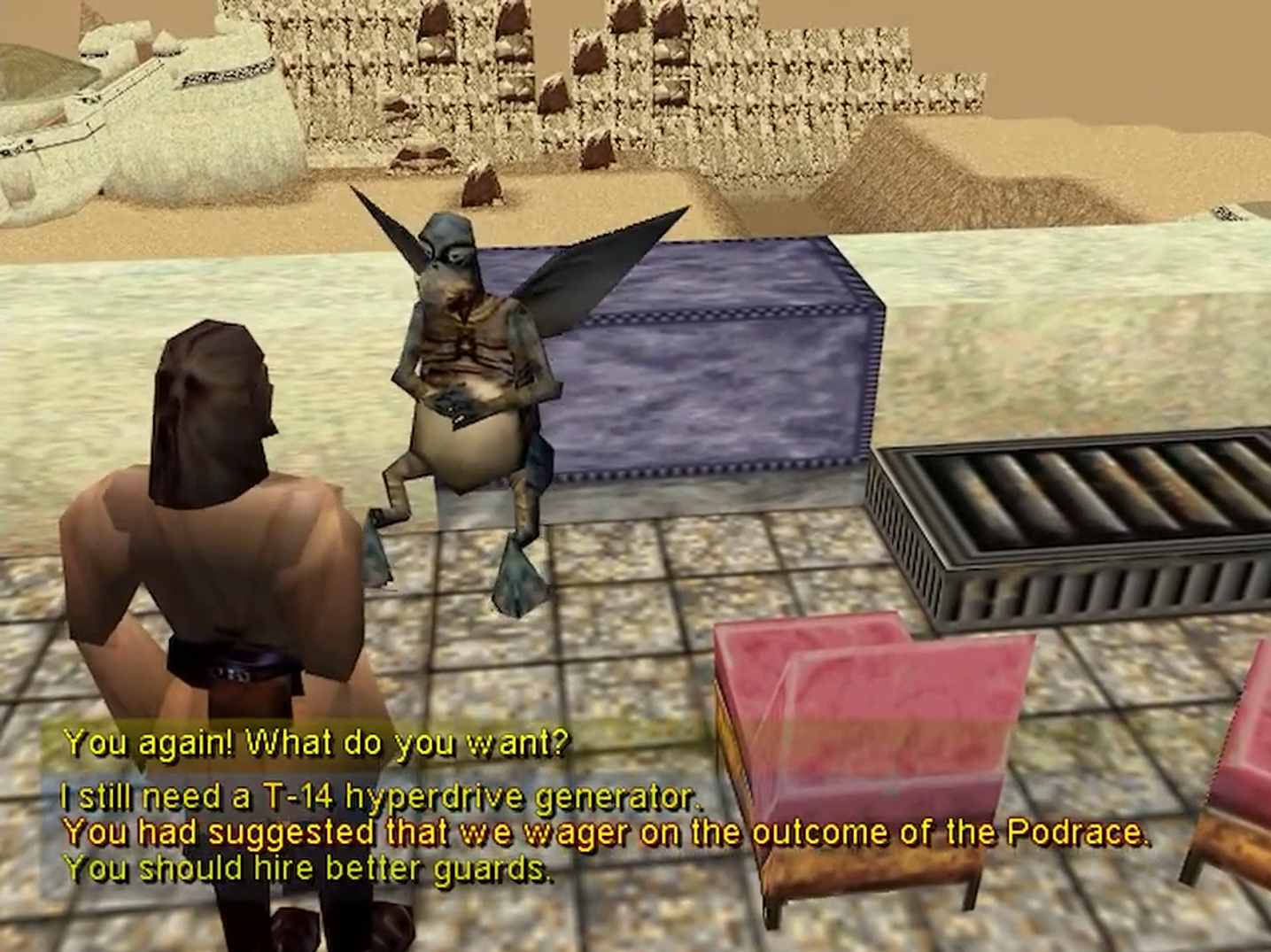
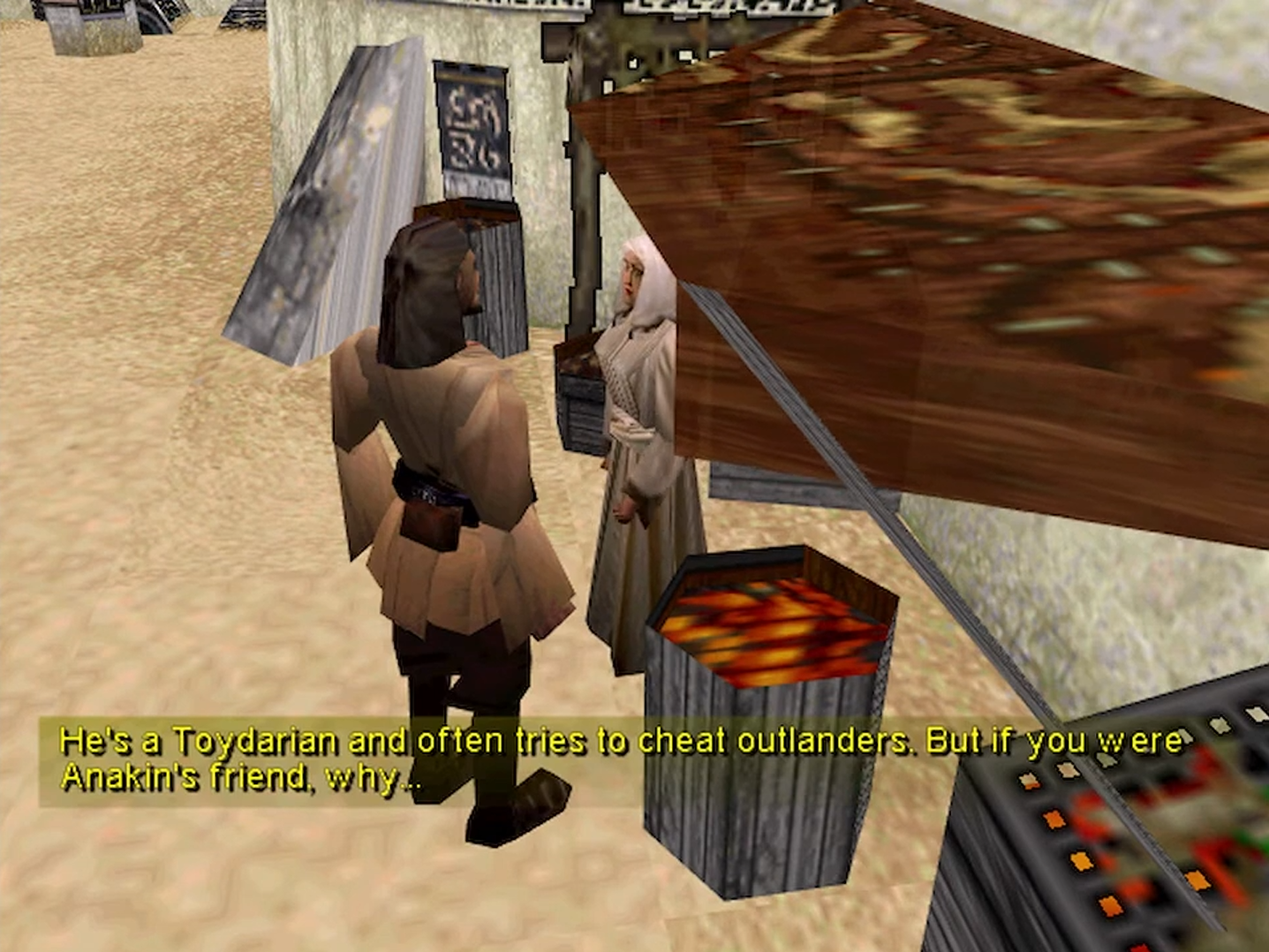
A surprising amount of the experience revolves around talking to characters, gathering information, exchanging objects, solving environmental puzzles, helping civilians, negotiating access, and deciding how politely your Jedi should respond to someone standing between him and the next podracer component.
The official modern PlayStation description highlights interaction with hundreds of creatures and characters, puzzle-solving, exploration, and visits to Naboo, Mos Espa, and Coruscant. The original game frequently uses dialogue and side tasks to open routes that brute force cannot solve cleanly.
That makes it feel closer to a simplified action RPG than a conventional movie tie-in.
Not because it has skill trees, character builds, or meaningful long-term progression.
It does not.
But because the world often reacts to how you speak and behave.
NPCs may provide directions, offer trades, request help, unlock areas, or become hostile. Some situations can be resolved in several ways. The player can behave like a calm Jedi negotiator, a rude wandering swordsman, or someone who believes “aggressive negotiations” means clearing Mos Espa street by street.
The design is messy, but it is not timid.
Mos Espa Is Where the Game Accidentally Becomes Brilliant
The Mos Espa chapter is the part people remember.
Qui-Gon enters the city looking for Anakin, Watto, and the parts required to repair Queen Amidala’s ship. The film resolves this through conversations, a wager, and the podrace.
The game cannot let you participate in that podrace.
Instead, it turns Qui-Gon into the galaxy’s most heavily armed procurement specialist.
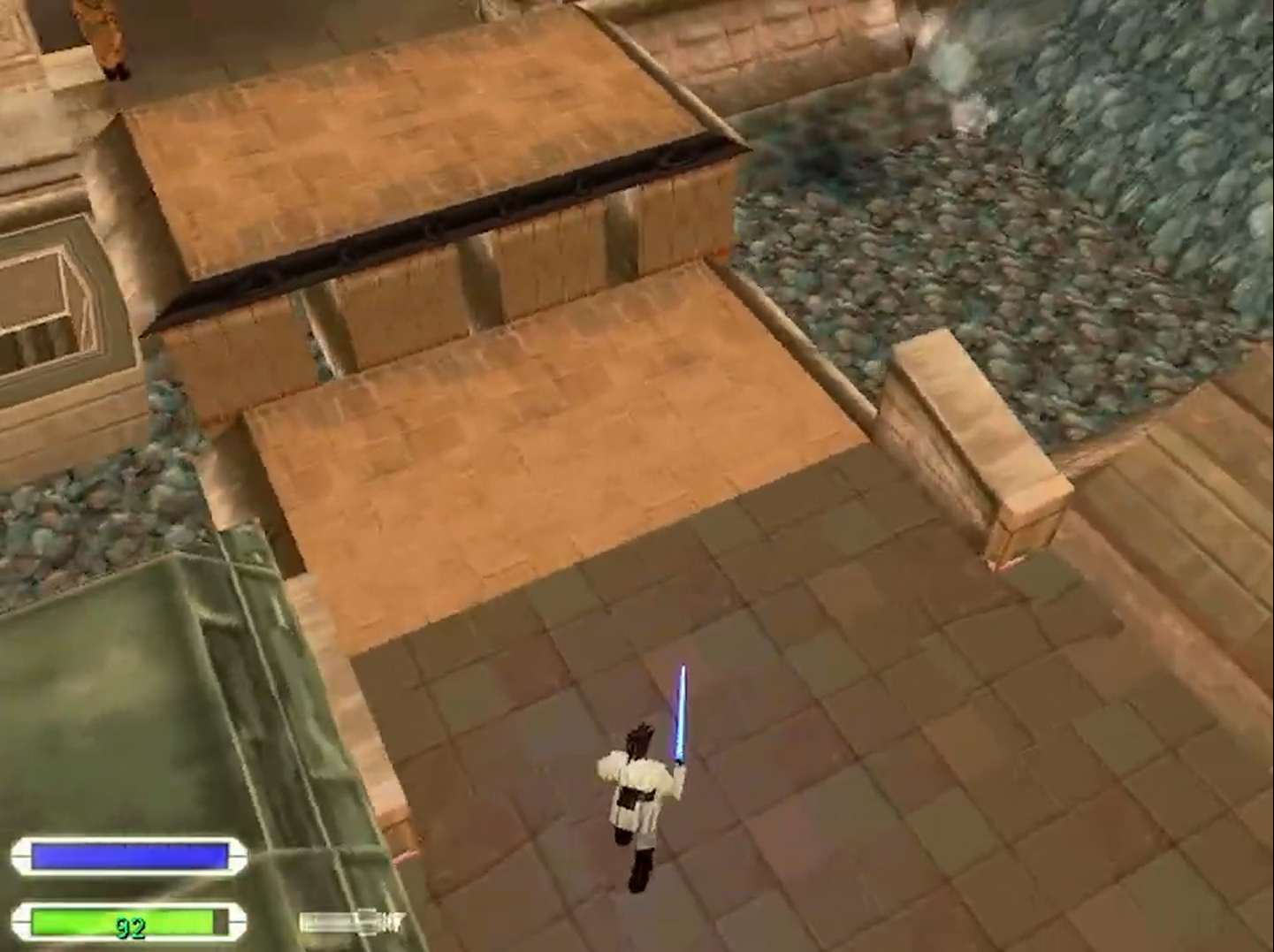
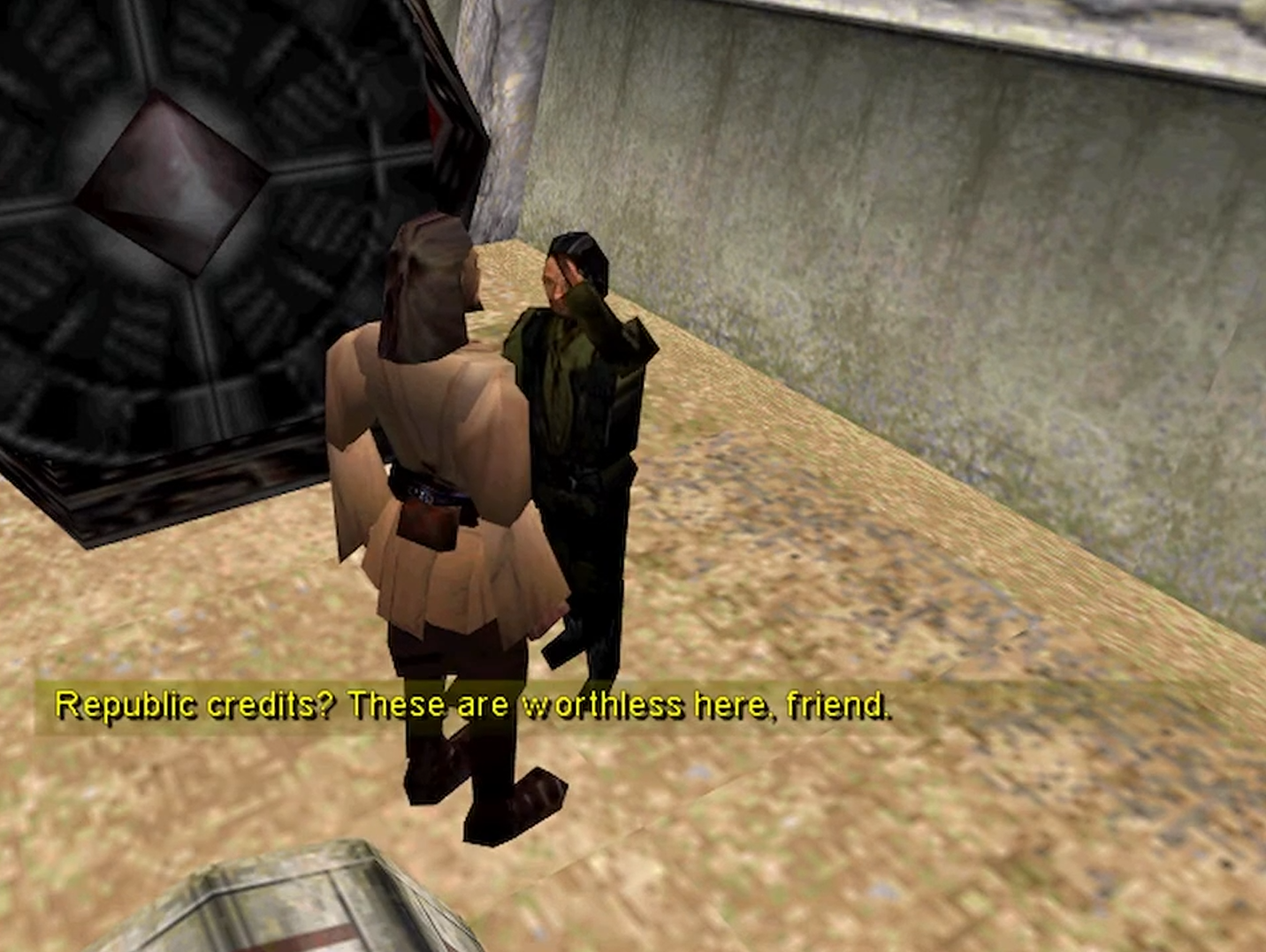
You explore the city, speak with merchants, track down Anakin and Jar Jar, acquire components, collect money, trade objects, investigate side problems, and deal with various criminals who have somehow failed to notice the glowing green sword attached to your belt.
The entire level feels like a small open-world prototype built several years before licensed games became obsessed with open-world design.
Mos Espa is not enormous.
It does not need to be.
It is dense enough to create stories.
One player may carefully complete the intended trading chain. Another may discover that certain items can be taken from characters who are no longer alive. The game even recognizes some of this behaviour: a contemporary walkthrough notes that Anakin may refuse to accept parts acquired through murder.
That tiny reaction is more memorable than many of the game’s scripted battles.
It means the developers considered what might happen when players ignored Qui-Gon’s personality and treated the Jedi Code as optional guidance.
Mos Espa becomes a social experiment.
Unfortunately, the lightsaber is one of the available research tools.
The Dark Side Was Mostly a Player Choice
The Phantom Menace allows a surprising degree of violence toward neutral characters.
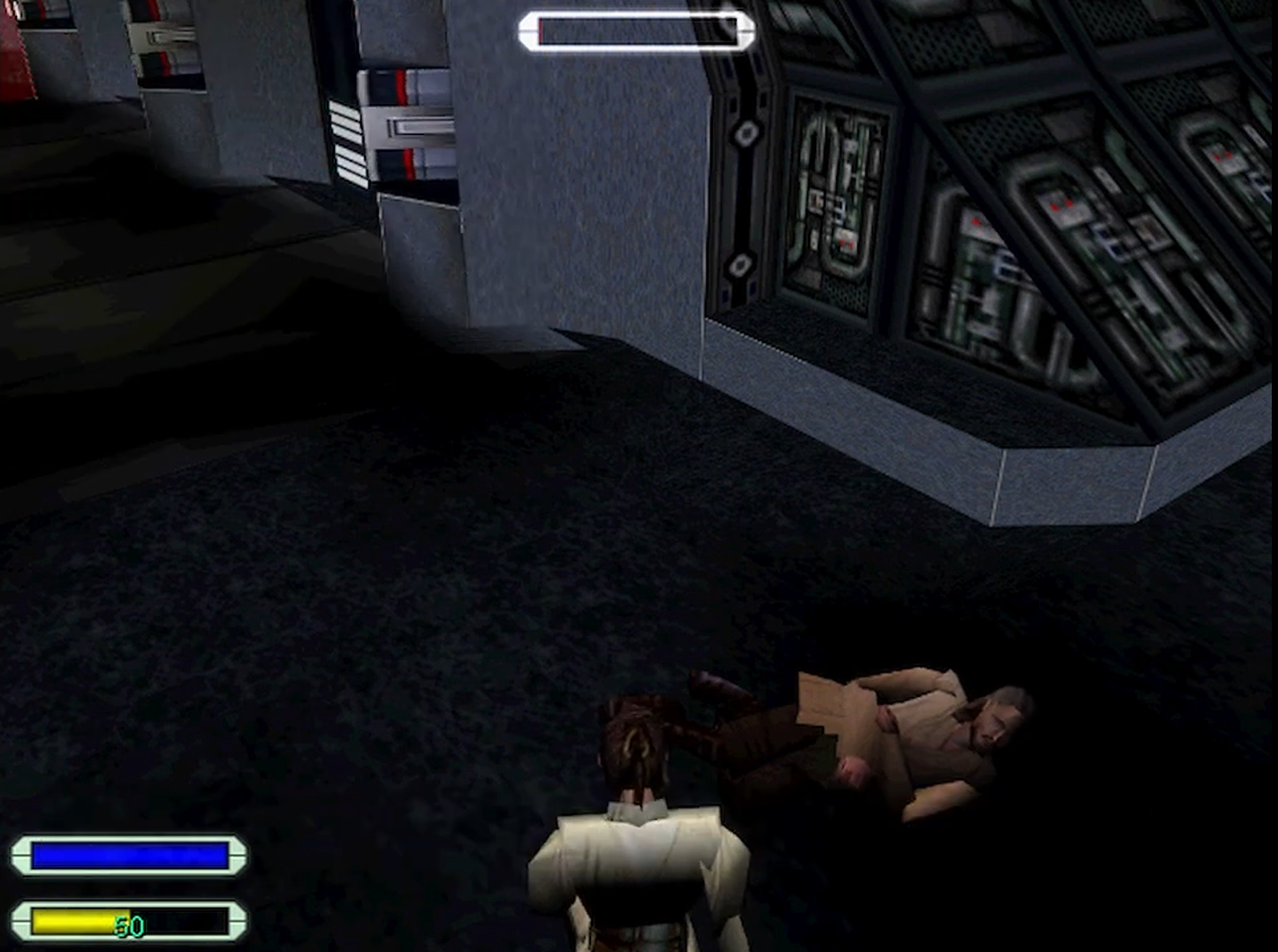
You can attack civilians, merchants, Gungans, allies, and various harmless droids. The consequences are inconsistent, but NPCs may flee, condemn the player, refuse to cooperate, or become hostile. Some essential characters are protected because even 1999 game design understood that letting Qui-Gon murder Anakin Skywalker would create problems for the remaining five films.
This freedom has become one of the game’s defining features.
Not because indiscriminate violence was the intended way to play.
Because the possibility clashes so violently with the character.
Qui-Gon Jinn is supposed to be a patient, unconventional Jedi Master.
In the player’s hands, he can become a man wandering through Tatooine asking strangers for podracer parts while holding a lightsaber and displaying increasingly limited tolerance for administrative delays.
The game does not have a morality meter.
There is no dark-side ending.
Darth Sidious does not call to congratulate you on an unusually efficient afternoon.
The world simply becomes more hostile and less cooperative as your decisions make everything worse.
It is primitive systemic storytelling, but it works.
Otoh Gunga Is a Maze Built from Bubbles and Regret
Before reaching Tatooine, players must survive Naboo.
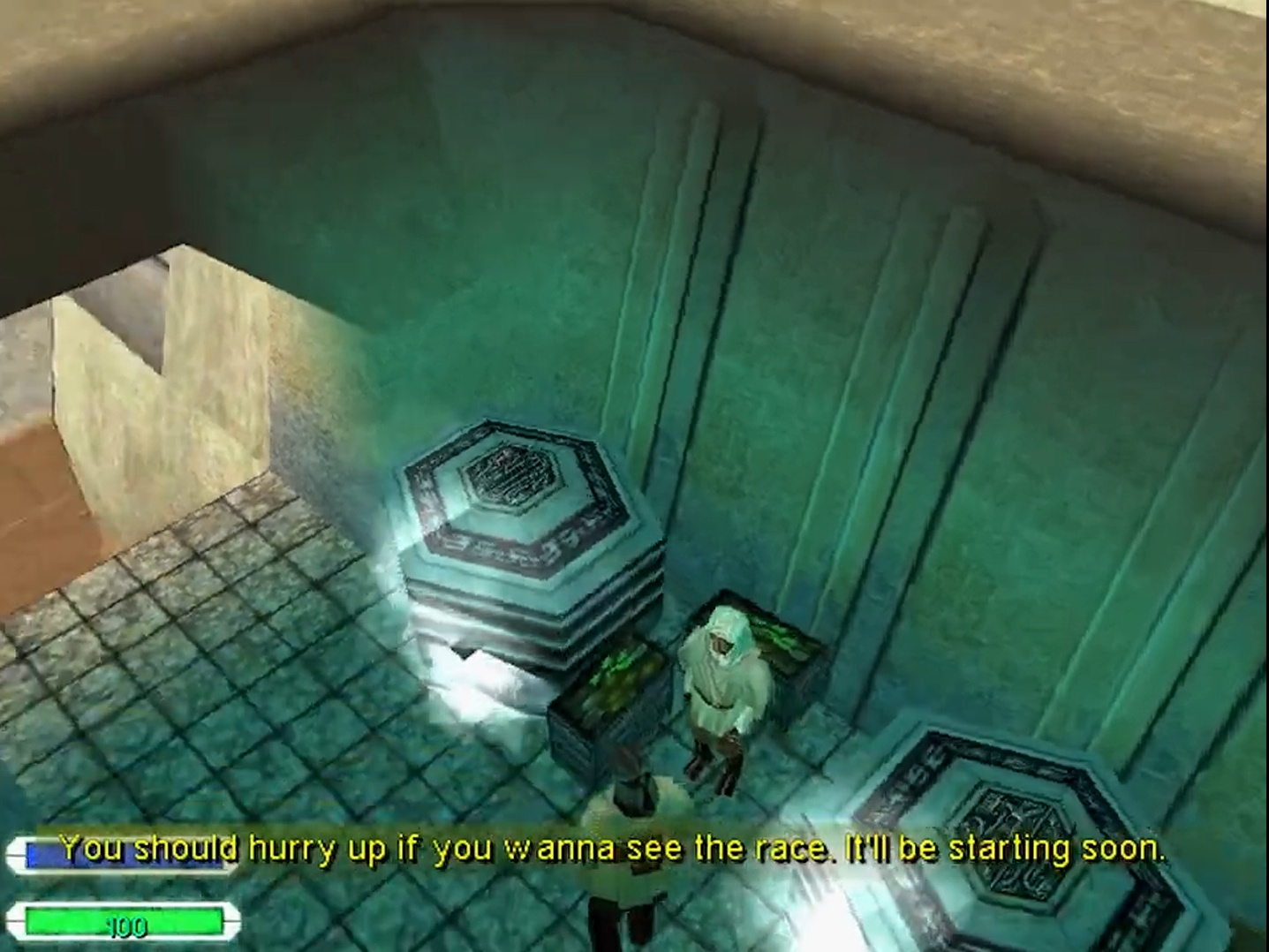
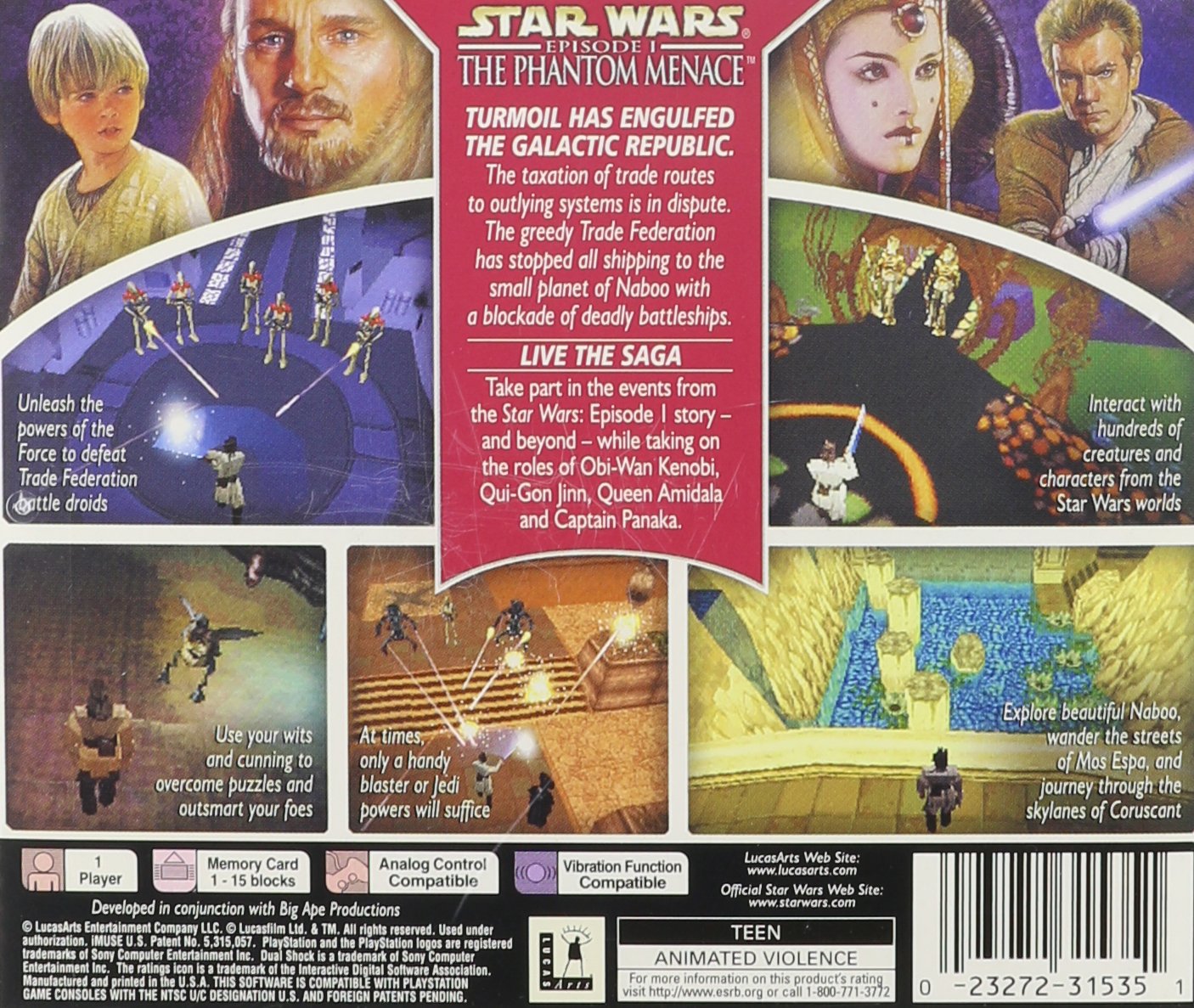
The opening Trade Federation level is a fairly direct mixture of combat, switches, locked doors, and droid encounters. The swamps introduce exploration and platforming. Then the game enters Otoh Gunga, the underwater Gungan city.
This is where many childhood playthroughs ended.
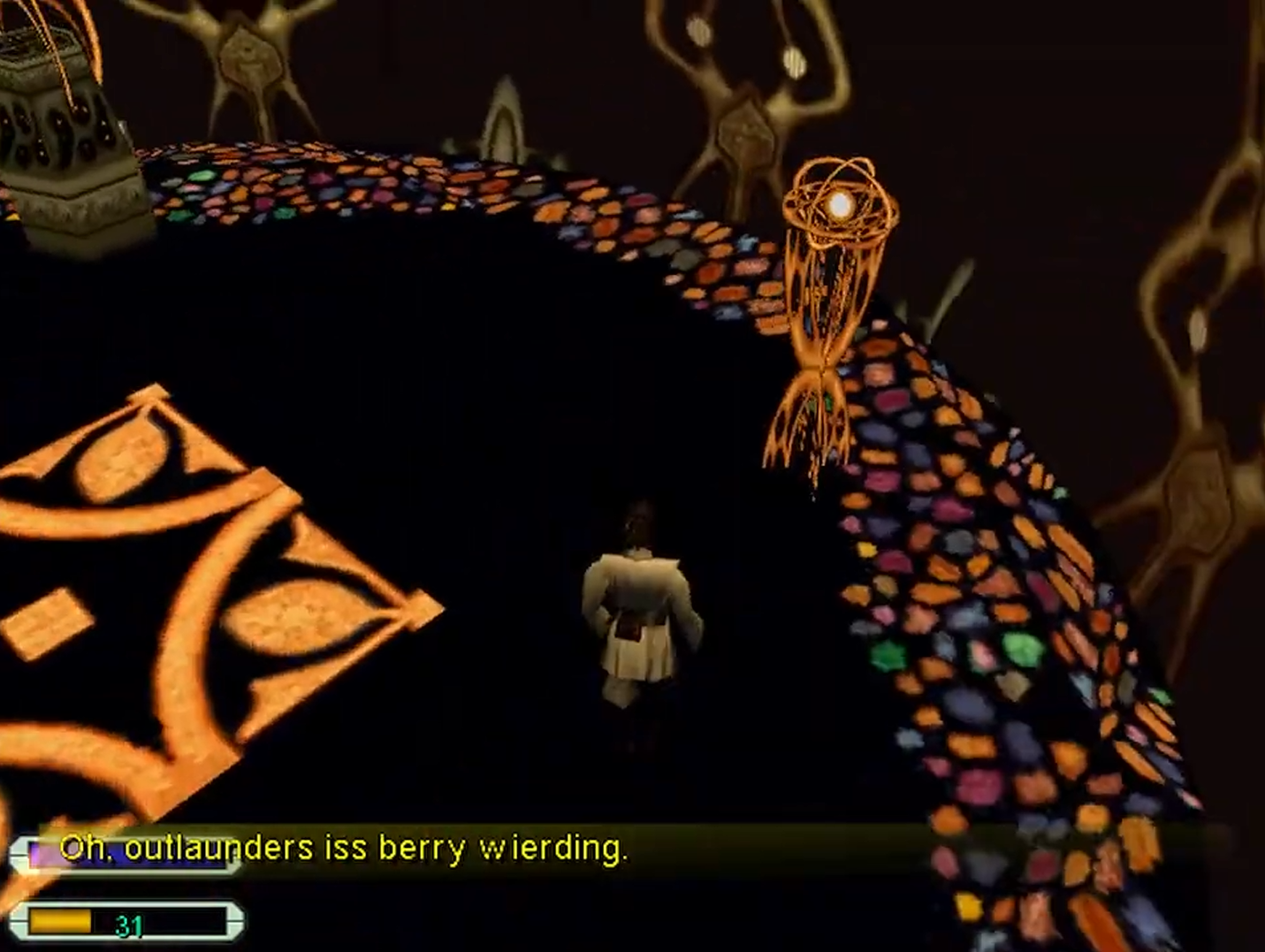
The city is composed of similar-looking chambers, narrow passages, glowing architecture, and Gungans who seem convinced that giving Obi-Wan clear directions would violate an ancient cultural law.
Jar Jar has been imprisoned, so Obi-Wan must navigate the city, interact with its inhabitants, solve puzzles, and arrange his release before the story can continue.
On paper, it is a welcome break from combat.
In reality, the camera, repeated visual design, uncertain objectives, and maze-like layout can make the level feel like an underwater shopping centre designed by someone who hates signage.
The level does, however, demonstrate what Big Ape was trying to achieve.
This was not merely a corridor shooter.
The developers wanted locations to feel inhabited. Gungans talk, react, argue, and stand between the player and progress. The city attempts to function as a place rather than a background for combat.
The execution is rough.
The ambition is visible.
The Camera Was Not a Jedi’s Ally
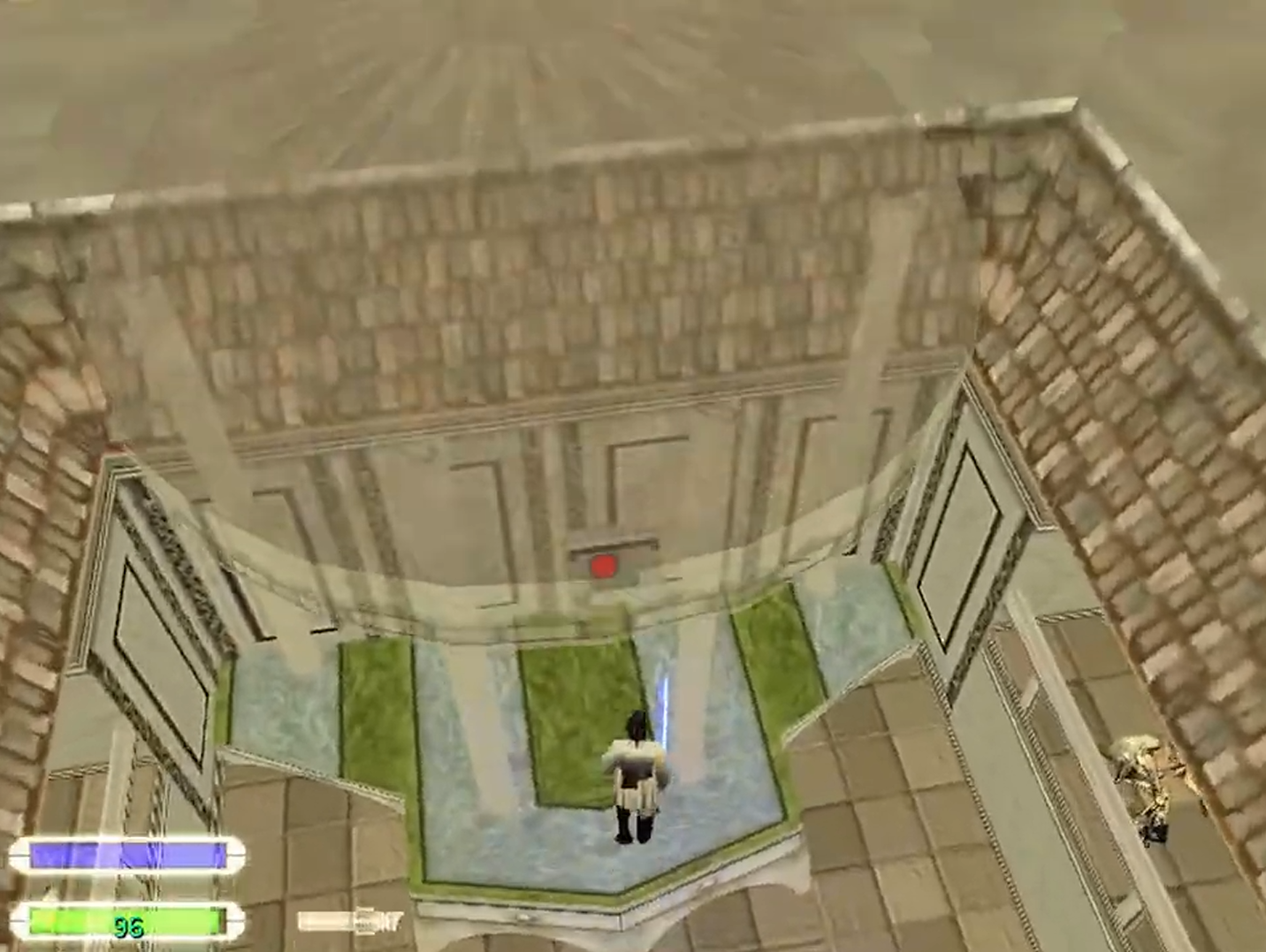
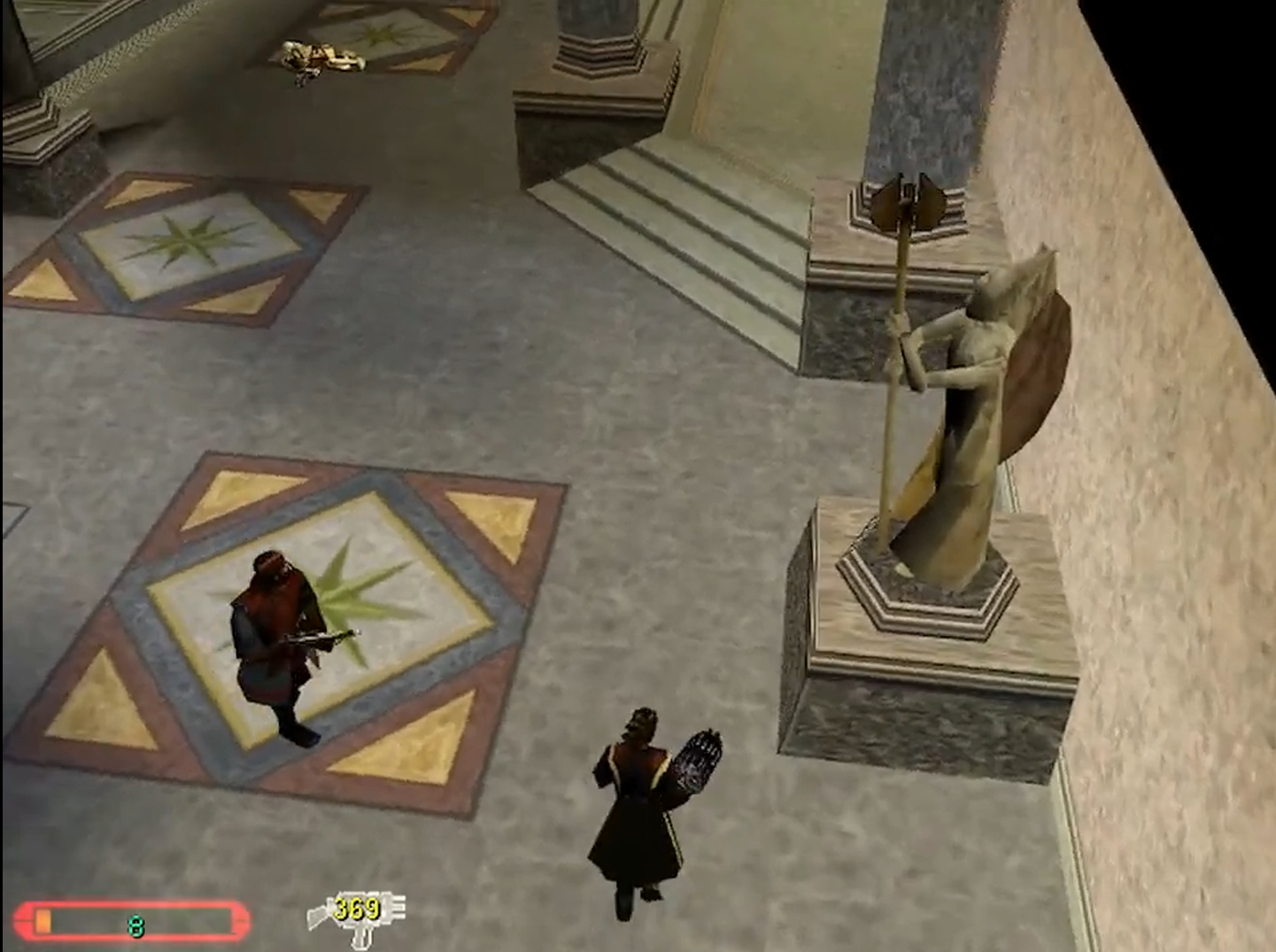
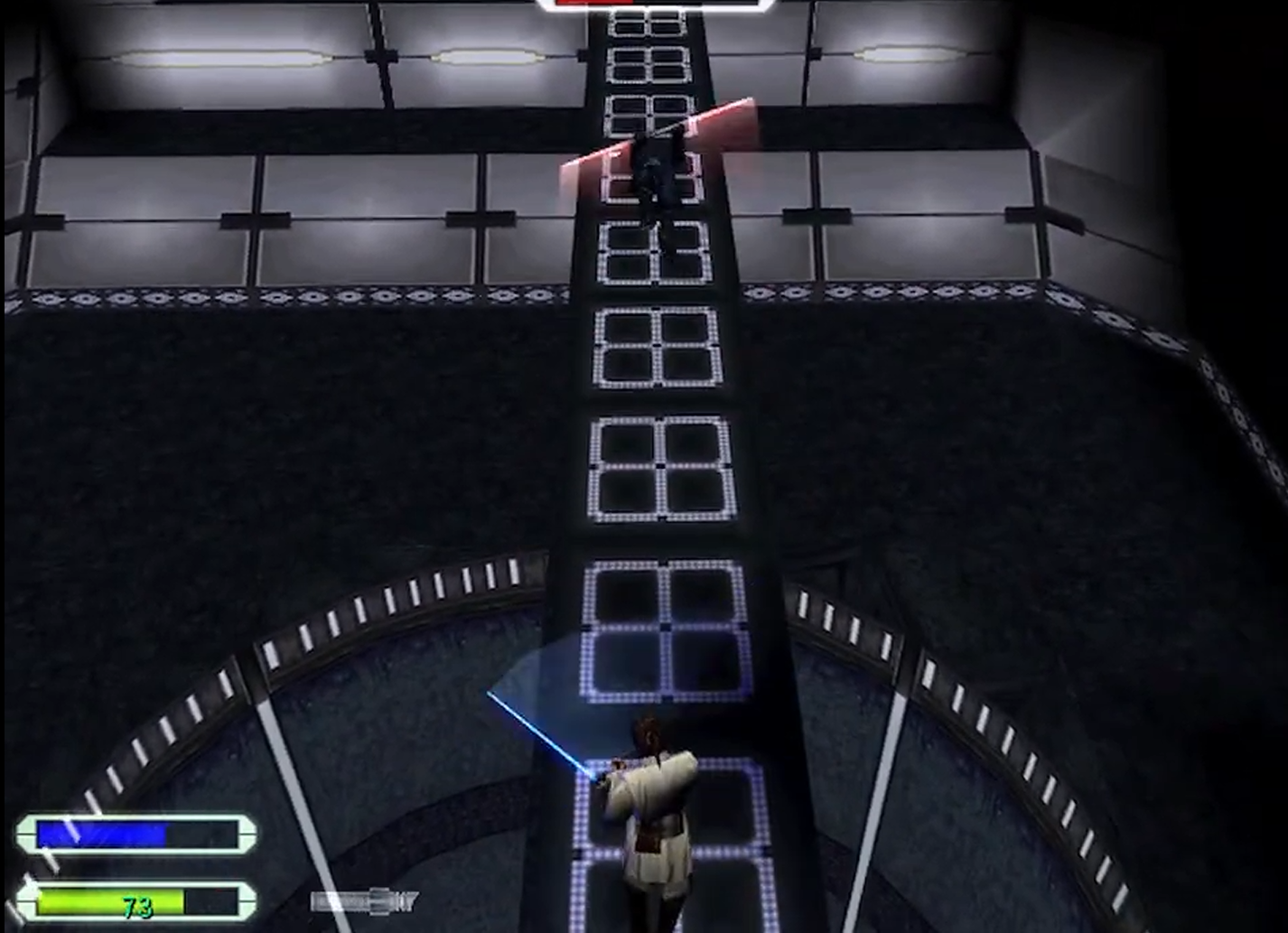
The game uses an elevated third-person perspective, positioning the camera behind and above the character.
This works reasonably well when crossing open areas.
It becomes less helpful near walls, doors, corners, narrow platforms, enemies, ledges, staircases, architecture, or anything else commonly found in a 3D action game.
The camera can make it difficult to judge distances, see incoming attacks, or understand what is immediately ahead. GameSpot’s contemporary review compared the perspective more closely to Syphon Filter than Tomb Raider, while criticizing the limited forward visibility, muddy presentation, and unreliable controls.
Platforming suffers badly.
Jumping in early 3D games was already an act of faith. Here, the perspective often makes it unclear whether a ledge is directly ahead, slightly to the side, or part of the background.
The Jedi spend years learning to trust the Force.
Players spend several seconds trying to determine whether Obi-Wan is facing the correct crate.
The Lightsaber Feels More Like Sporting Equipment
Combat is simple.
Battle droids fire.
You swing the lightsaber.
Sometimes the bolt is reflected.
Sometimes the droid is cut down.
Sometimes Obi-Wan rotates toward a nearby wall because the targeting system has developed other priorities.
GameSpot described the lightsaber as behaving more like a baseball bat, with players repeatedly swinging to knock blaster bolts back toward droids. The game also provides rolling, backflips, Force push, and close-range attacks, although none of it has the precision associated with LucasArts’ stronger Jedi combat systems.
The lightsaber is still satisfying in the most basic sense.
It glows.
It makes the correct noise.
Battle droids fall over.
In 1999, that was enough to carry a surprising amount of goodwill.
The problem is rhythm.
Enemies can attack from outside the visible area. Reflected shots do not always go where expected. Melee combat becomes frantic. Characters collide awkwardly. Powerful weapons can trivialize encounters until ammunition disappears, at which point the player returns to swinging a lightsaber with the strategic sophistication of someone clearing weeds.
It is functional.
Elegant would be an ambitious word.
Big Ape Was Building the Game Almost Blind
The development history explains a great deal.
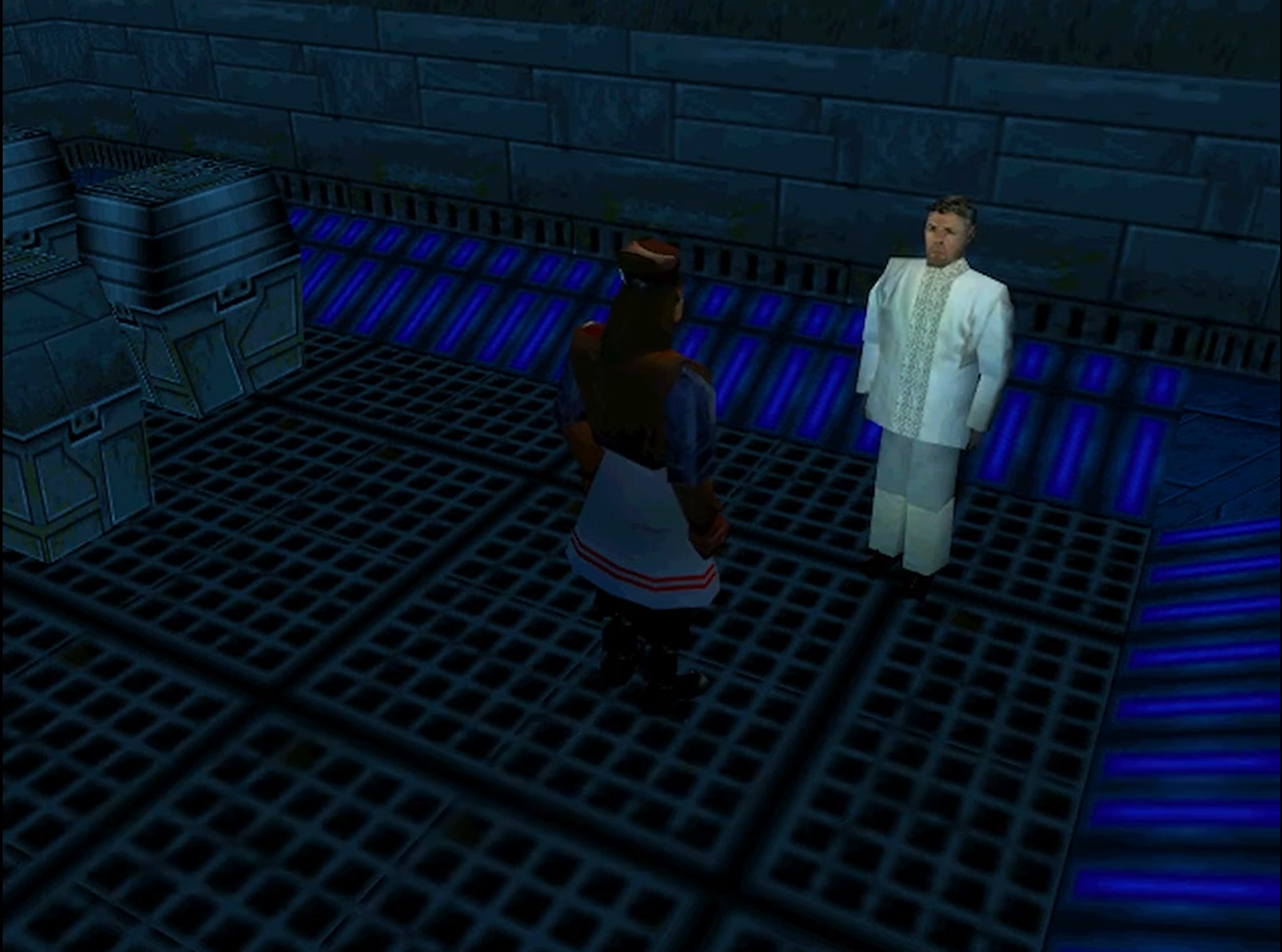
Big Ape Productions had been founded by former LucasArts developers Dean Sharpe and Mike Ebert. According to Ebert, the team began work with extremely limited tools. One designer reportedly plotted background artwork on graph paper because the level-building pipeline could not import 3D art directly.
The developers also had limited access to the film itself.
They received an early script and large amounts of blue-screen production material, but often lacked a clear picture of what the finished environments and scenes would look like. Ebert later said the team frequently made assumptions about the story and visual design, some correct and others not.
This is one of the fundamental problems with movie tie-in development.
The game must be ready when the film arrives.
The film is still being created.
The studio protects unfinished material.
The developers are expected to accurately recreate things they have not properly seen.
It is like being asked to paint someone’s house while the architect refuses to confirm how many floors it has.
The Hardware Target Refused to Stay Still
The game began as a PC production.
LucasArts initially required support for software rendering rather than assuming players owned dedicated 3D graphics cards. That widened the potential audience but limited what the developers could demand from the hardware.
Big Ape also expected to target PlayStation 2 later in development.
When Sony’s next console did not arrive within the required schedule, the team had to make the game work on the original PlayStation instead. Ebert later described that process as a “nightmare.”
The compromise is visible.
The PC version can run at higher resolutions and presents the world more clearly, although its original software-rendered foundation still shows. The PlayStation version carries heavier pixelation, reduced visual clarity, and the usual texture distortion associated with ambitious 3D games on Sony’s first console.
The game was not simply ported from one similar machine to another.
It was being pushed onto hardware with very different limitations while the launch window moved closer.
Every level had to survive the journey.
Some looked more tired when they arrived.
The Developers Had Freedom but Almost No Time
Strangely, LucasArts does not appear to have micromanaged every creative decision.
Ebert recalled relatively little direct oversight beyond the major restrictions. The team could invent side stories, conversations, locations, and interactions as necessary.
The real pressure was time.
LucasArts needed the game completed for the film’s launch, while Big Ape was working quickly with incomplete information and limited technology.
That combination explains why the adaptation contains both surprising creativity and obvious rough edges.
The Coruscant chapter is a good example.
The film spends much of its time there in political meetings. The game instead follows Panaka and Amidala through a new action-heavy sequence involving the city’s lower levels, criminals, locked routes, and attacks largely absent from the movie. MobyGames specifically notes that the game adds material around their attempt to reach the Senate chamber.
Big Ape needed gameplay.
So it invented some.
This is exactly what a good adaptation should do.
Unfortunately, the team also needed several more months to polish it.
They did not receive those.
The Missing Podrace Defines the Whole Game
The most famous action sequence from The Phantom Menace is the podrace.
It is also missing from this adaptation.
The developers had access to useful information about the scene, but LucasArts instructed them to avoid it because another team was building Episode I: Racer.
Commercially, that was sensible.
Creatively, it left a hole.
The Phantom Menace reaches Mos Espa, introduces Anakin, gathers podracer components, visits the arena, and builds toward the Boonta Eve Classic.
Then the race happens somewhere else.
The game must move on without letting the player participate in the moment the film had practically designed as a videogame level.
Still, this restriction produced something more unusual.
Instead of a mediocre racing stage attached to an action-adventure, we got the sprawling Mos Espa errands, conversations, trades, and opportunities for accidental Jedi criminality.
The missing set piece forced the developers toward social interaction.
The game became stranger.
That may have been the better historical outcome.
The PlayStation Version Received a Brutal Welcome
Critical reception varied, but the game was never treated as a major LucasArts triumph.
MobyGames currently records an aggregated critic average of 63 percent across 48 reviews, which suggests a genuinely mixed response rather than universal rejection.
GameSpot was far harsher.
Its PlayStation review gave the game 4.2 out of 10, criticizing the controls, muddy graphics, restricted visibility, and overall presentation. The reviewer argued that stronger third-person action games already existed on the platform.
Both reactions make sense.
The Phantom Menace is easy to dislike if judged primarily as an action game.
The combat lacks precision.
The camera fights the player.
Platforming is unreliable.
Visuals are inconsistent.
Voice performances range from acceptable to wonderfully peculiar.
But players who connected with its exploration and NPC interactions found something critics did not always prioritize.
The game allowed them to wander around a new Star Wars era.
In 1999, that was powerful.
The Strange Voice Acting Became Part of the Charm
Most of the film’s principal actors did not return to voice their characters.
The game instead uses soundalike performers, returning film audio in places, and a broad cast of LucasArts voice talent. GameSpot considered the sound generally decent and described the replacement actors as acceptable in many scenes.
Time has been less polite.
The performances are now part of the game’s cult appeal.
Characters repeat themselves.
Emotional emphasis arrives in unexpected places.
Darth Maul sounds less like a silent Sith assassin and more like someone who has been waiting all afternoon to shout the word “die.”
NPC conversations can move from useful information to accidental comedy within seconds.
It works because the game contains so much dialogue.
Even when the acting is awkward, it gives the locations personality.
Mos Espa is filled with merchants, criminals, children, guards, race spectators, and people who have somehow developed strong opinions about Qui-Gon within moments of meeting him.
The galaxy talks back.
Sometimes it should not.
The Game Expanded the Film in Useful Ways
Movie adaptations often struggle because the player already knows the story.
The best solution is not always to change the outcome.
Sometimes it is to explore the gaps.
The Phantom Menace builds playable events around moments the film skips or handles briefly. Obi-Wan’s path through Otoh Gunga becomes a larger rescue. The occupation of Theed becomes a sequence of battles and environmental puzzles. Qui-Gon spends far more time navigating Mos Espa. Panaka and Amidala receive an original Coruscant adventure.
These additions are rarely sophisticated storytelling.
They are useful world-building.
The adaptation makes Episode I feel larger by showing streets, rooms, merchants, prisoners, civilians, guards, and side conflicts outside the film’s frame.
That is why the game can remain interesting even when its mechanics fail.
It offers a version of the prequel era that no later game recreated in quite the same way.
The PlayStation Classic Release Gave It Another Chance
For many years, revisiting The Phantom Menace meant finding an old PC disc, dealing with compatibility problems, using an original PlayStation, or turning to fan-made solutions.
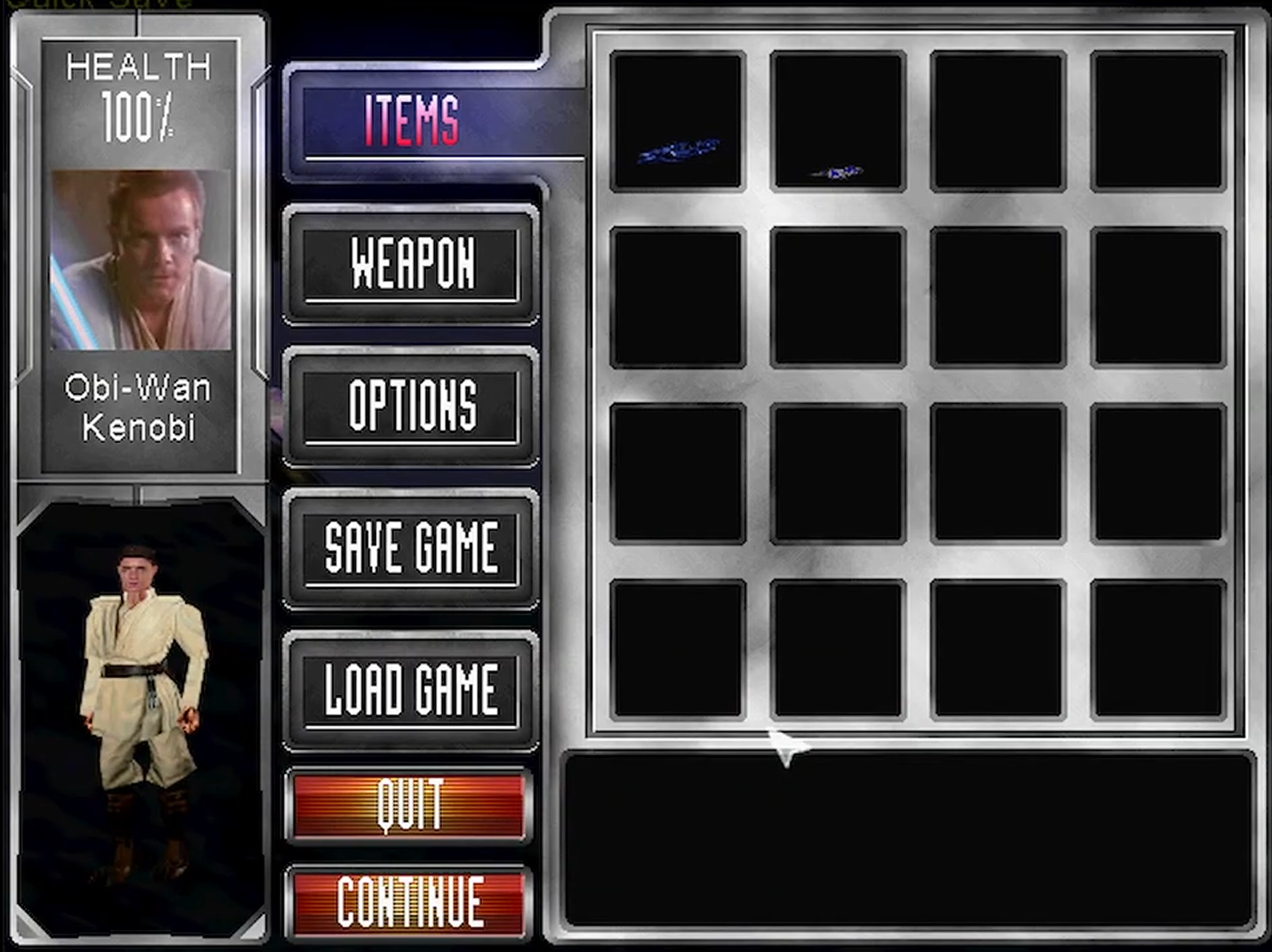
That changed in January 2024 when the PlayStation version was released digitally for PS4 and PS5. The modern conversion includes up-rendering, rewind, quick saving, and selectable video filters.
Rewind may be the most important addition.
A game containing uncertain platforming, awkward combat, and instant opportunities to annoy important NPCs benefits enormously from the ability to reverse time.
The modern version preserves the PlayStation edition rather than rebuilding the game.
Textures still wobble.
Characters remain angular.
The camera continues making personal decisions.
But the quick-save and rewind features remove some of the punishment that made the original version exhausting.
It is not a remaster.
It is a more forgiving museum exhibit.
Why People Still Remember It
The Phantom Menace is not remembered because it perfected third-person action.
It is remembered because it gave players stories.
Getting lost in Otoh Gunga.
Accidentally attacking a civilian.
Discovering that Mos Espa reacts badly to murder.
Trying to trade for podracer components.
Reflecting blaster bolts with unreliable confidence.
Listening to Darth Maul deliver dialogue with all the restraint of a theatrical understudy who has finally been given a speaking role.
The best parts are not always the parts the developers intended to be best.
That is often how cult games survive.
Polished games produce admiration.
Messy games produce anecdotes.
Why The Phantom Menace Belongs in the Archive
This game represents the brutal reality of the late-1990s movie tie-in.
Big Ape was working toward an immovable film deadline.
The team had limited production material.
It lacked mature development tools.
Its hardware target changed.
It could not use the film’s most obvious gameplay sequence.
It could not step too far into Jedi Knight territory.
And it still had to turn a story about trade negotiations, political procedure, underwater travel, podracing, palace warfare, and ancient space wizards into a coherent action-adventure.
The final game is visibly compromised.
It is also visibly ambitious.
It offers multiple playable characters, interactive locations, dialogue choices, side tasks, environmental puzzles, moral consequences, and levels that expand beyond the film.
Big Ape did not create a good combat system and then forget to build a world around it.
The studio created a surprisingly reactive world and forgot that players would spend much of their time fighting the camera.
That is a much more interesting failure.
The Force Was With It. The Development Schedule Was Not
Star Wars: Episode I – The Phantom Menace is clumsy, frustrating, ugly in places, and far more memorable than many better-reviewed movie games.
Its lightsaber combat never reached Jedi Knight quality.
Its platforming occasionally feels like a personal insult.
Its camera should probably have been questioned by the Jedi Council.
But Mos Espa still works.
The conversations still surprise.
The freedom still creates chaos.
And beneath all the technical problems, there is a genuine attempt to let players inhabit Episode I rather than merely reenact its action scenes.
Big Ape Productions was building from assumptions, blue-screen photographs, graph paper, incomplete tools, and an approaching release date.
Somehow, it produced a game where Anakin Skywalker can judge Qui-Gon Jinn for obtaining podracer parts through murder.
That may not be the adaptation George Lucas imagined.
It is absolutely the one gaming history deserved.
Frequently Asked Questions
What is Star Wars: Episode I – The Phantom Menace?
Star Wars: Episode I – The Phantom Menace is a third-person action-adventure developed by Big Ape Productions and published by LucasArts in 1999. It adapts and expands the story of the film across Windows and PlayStation.
Which characters can you play?
Players control Obi-Wan Kenobi, Qui-Gon Jinn, Queen Amidala, and Captain Panaka during different parts of the campaign.
How many levels are in The Phantom Menace game?
The campaign contains eleven levels covering the Trade Federation battleship, Naboo, Otoh Gunga, Theed, Mos Espa, Coruscant, and the final battle against Darth Maul.
Can you participate in the podrace?
No. The developers were instructed not to include the podracing sequence because LucasArts had assigned it to the separate Star Wars: Episode I Racer project.
Can you attack friendly characters and civilians?
Yes. The game allows considerable freedom to attack neutral NPCs, although doing so may cause characters to flee, become hostile, refuse to help, or react to the player’s actions.
Why was the game difficult to develop?
Big Ape Productions worked with limited development tools, incomplete film material, software-rendering requirements, a changing console target, restrictions designed to avoid overlap with other Star Wars games, and a strict release deadline.
Was the game released on both PC and PlayStation?
Yes. The Windows version arrived in 1999, followed by a PlayStation release later that year.
Can you play The Phantom Menace on modern consoles?
Yes. The original PlayStation version is available on PS4 and PS5 with up-rendering, rewind, quick-save support, and video filters.
Is Star Wars: Episode I – The Phantom Menace worth playing today?
It remains worth exploring as an unusual piece of Star Wars gaming history. The camera, combat, and platforming have aged poorly, but the dialogue, NPC interactions, expanded locations, and open-ended Mos Espa chapter still give it a personality few movie adaptations possess.
Author

Related Posts

SWTOR’s Pirate Incursion Returns Tomorrow, So Dantooine Is About to Be Annoying Again
When The Old Republic Became a Comic Omnibus, SWTOR’s Backstory Got a Second Life
SWTOR Galactic Season 10 Is Almost Over, So Finish the Syndicate Before It Vanishes
TIE Fighter Strategy Guide: When Star Wars PC Games Needed Manuals Like Sacred Texts

When The Clone Wars Returned From the Dead and Star Wars Fans Lost Their Minds
Star Wars: Starfighter Writer Says There Are “No Barriers to Entry,” and That Might Be Exactly What the Franchise Needs
Darth Revan Gets a New Sideshow Figure, and the Unmasked Portrait Has Fans Talking
PowerWash Simulator 2’s Star Wars Pack Is Out Now, So the Galaxy Can Finally Be Clean Again